


Page 107 - D. Cancer biology
P. 107
Ginsenoside Rh3 and three minor ginsenosides inhibits epithelial
mesenchymal transition (EMT) in neuroblastoma cells
Jung-Mi Oh , Sun Young Park , and Sungkun Chun 1,2
1,2
1,2
1 Department of Physiology, Jeonbuk National University Medical School, Jeonju, Korea
2 Brain Korea 21 Plus Program, Jeonbuk National University Medical School, Jeonju, Korea
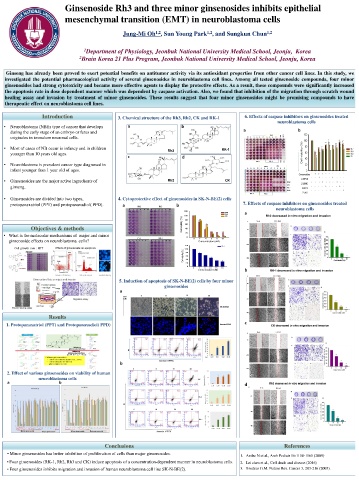
Ginseng has already been proved to exert potential benefits on antitumor activity via its antioxidant properties from other cancer cell lines. In this study, we
investigated the potential pharmacological activity of several ginsenosides in neuroblastoma cell lines. Among all tested ginsenoside compounds, four minor
ginsenosides had strong cytotoxicity and became more effective agents to display the protective effects. As a result, these compounds were significantly increased
the apoptosis rate in dose dependent manner which was dependent by caspase activation. Also, we found that inhibition of the migration through scratch wound
healing assay and invasion by treatment of minor ginsenosides. These results suggest that four minor ginsenosides might be promising compounds to have
therapeutic effect on neuroblastoma cell lines.
Introduction 3. Chemical structure of the Rh3, Rh2, CK and RK-1 6. Effects of caspase inhibitors on ginsenosides treated
neuroblastoma cells
• Neuroblastoma (NB)is type of cancer that develops a b
during the early stage of an embryo or fetus and a b
originates in immature neuronal cells.
• Most of cases of NB occur in infancy and in children Rh3 RK-1
younger than 10 years old ages.
c d
• Neuroblastoma is prevalent cancer type diagnosed in
infant younger than 1 year old of ages.
• Ginsenosides are the major active ingredients of Rh2 CK
ginseng.
• Ginsenosides are divided into two types, 4. Cytoprotective effect of ginsenosides in SK-N-BE(2) cells
protopanaxatriol (PPT) and protopanaxadiol( PPD). a b 7. Effects of caspase inhibitors on ginsenosides treated
neuroblastoma cells
120
Rh3 a
Rh2
Cell viability (%) 100
CK
80
60
Objectives & methods 40
• What is the molecular mechanisms of major and minor 20
0
ginsenoside effects on neuroblastoma cells? 0 2 4 6 8 10
Concentration (uM)
120 Rk-1
Cell growth rate : MTT
Cell viability (%) 100
assay 80
60
40
20
0
0 2 5 10 15 20
Concentration (uM) b
5. Induction of apoptosis of SK-N-BE(2) cells by four minor
ginsenosides
a
Results
1. Protopanaxatriol (PPT) and Protopanaxadiol( PPD) c
b
2. Effect of various ginsenosides on viability of human
neuroblastoma cells
a b d
Conclusions References
▪ Minor ginsenosides has better inhibition of proliferation of cells than major ginsenosides. 1. Andre N et al., Arch Pediatr 16:1158-1165 (2009)
▪ Four ginsenosides (RK-1, Rh2, Rh3 and CK) induce apoptosis of a concentration-dependent manner in neuroblastoma cells. 2. Lei chen et al., Cell death and disease (2016)
▪ Four ginsenosides inhibits migration and invasion of human neuroblastoma cell line SK-N-BE(2). 3. Brodeur G.M. Nature Rev. Cancer 3, 203-216 (2003).

