


Page 109 - D. Cancer biology
P. 109
Ginsenoside Rk1 inhibits antitumor activity through ß-catenin signalling
pathway in neuroblastoma cells
Jung-Mi Oh , Young Bae Kwon Sungkun Chun 1,2
3
1,2
1 Department of Physiology, Jeonbuk National University Medical School, Jeonju, South Korea
2 Brain Korea 21 Plus Program, Jeonbuk National University Medical School, Jeonju 54907, Korea
3 Department of Pharmacology, Jeonbuk National University Medical School, Jeonju 54907, Republic of Korea
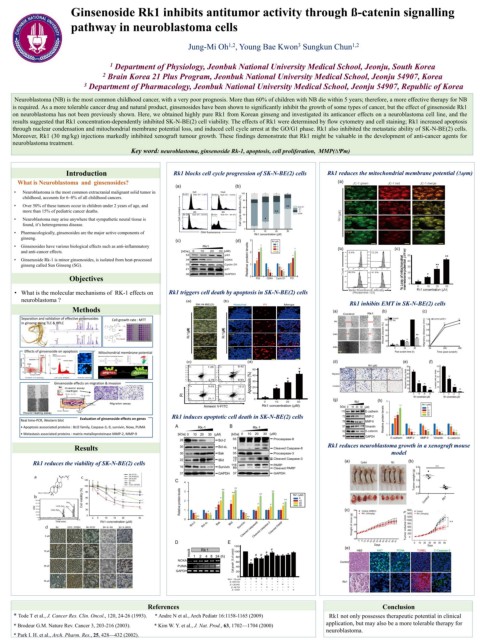
Neuroblastoma (NB) is the most common childhood cancer, with a very poor prognosis. More than 60% of children with NB die within 5 years; therefore, a more effective therapy for NB
is required. As a more tolerable cancer drug and natural product, ginsenosides have been shown to significantly inhibit the growth of some types of cancer, but the effect of ginsenoside Rk1
on neuroblastoma has not been previously shown. Here, we obtained highly pure Rk1 from Korean ginseng and investigated its anticancer effects on a neuroblastoma cell line, and the
results suggested that Rk1 concentration-dependently inhibited SK-N-BE(2) cell viability. The effects of Rk1 were determined by flow cytometry and cell staining; Rk1 increased apoptosis
through nuclear condensation and mitochondrial membrane potential loss, and induced cell cycle arrest at the GO/G1 phase. Rk1 also inhibited the metastatic ability of SK-N-BE(2) cells.
Moreover, Rk1 (30 mg/kg) injections markedly inhibited xenograft tumour growth. These findings demonstrate that Rk1 might be valuable in the development of anti-cancer agents for
neuroblastoma treatment.
Key word: neuroblastoma, ginsenoside Rk-1, apoptosis, cell proliferation, MMP(∆Ψm)
Introduction Rk1 blocks cell cycle progression of SK-N-BE(2) cells Rk1 reduces the mitochondrial membrane potential (∆ψm)
What is Neuroblastoma and ginsenosides?
(a) (b)
• Neuroblastoma is the most common extracranial malignant solid tumor in 0µM 10µM 100
childhood, accounts for 6~8% of all childhood cancers. S-G1 Sub - G1 : 2.8% S-G1 Sub-G1 : 12.6% (%) 80
• Over 50% of these tumors occur in children under 2 years of age, and distribution 60 ** Sub-G1
G1
more than 15% of pediatric cancer deaths. numbers S-G1 20 30 ** G2/M
S
• Neuroblastoma may arise anywhere that sympathetic neural tissue is Cell Sub -G1 : 24.5% S-G1 Sub-G1 : 43.3% cycle 40 *
found, it’s heterogeneous disease. Cell 20
0
• Pharmacologically, ginsenosides are the major active components of DNA fluorescence 0 Rk1 concentration (µM) 30
20
10
ginseng.
(c) (d) 3 Rk1 (µM)
• Ginsenosides have various biological effects such as anti-inflammatory Rk1 levels * 10
0
and anti-cancer effects. [kDa] 0 10 20 30 (µM) 2 * 20 *
30
53 p53 *
• Ginsenoside Rk-1 is minor ginsenosides, is isolated from heat-processed 34 CDK4 protein *
ginseng called Sun Ginseng (SG). 33 Cyclin D1 1 *
21 p21 Relative * * * *
*
Objectives 36 GAPDH 0 P53 CDK4 Cycin D1 P21
• What is the molecular mechanisms of RK-1 effects on Rk1 triggers cell death by apoptosis in SK-N-BE(2) cells
neuroblastoma ? (a) (b)
SK-N-BE(2) Hoechst PI Merge Rk1 inhibits EMT in SK-N-BE(2) cells
Methods 0µM 0µM (a) (b) (c)
Control Rk1
Separation and validation of effective ginsenosides Cell growth rate : MTT 100 Control 1.0 Control Rk-1 **
in ginseng using TLC & HPLC assay 10µM 10µM 0h 80 Rk1 (mm) 0.8 **
(µM) (µM) 60 distance 0.6
1 20µM 1 20µM 24h Wound closure (%) 40 ** 0.4
Rk Rk 20 * Migratory 0.2
30µM 30µM 48h 0 0 24 48 0 0h 24h 48h
Effects of ginsenoside on apoptosis Mitochondrial membrane potential Post scratch time (h) Time (post scratch)
(c) (d) (d) (e) (f)
1.29 8.42 Rk1 (µM) 350 500
50 * 0 10 20 30 300 400
(%) 40 Migration 250 300 **
2.76 8.93 30 * Migrated cells per fields 200 Invaded cells per fields
150
Ginsenoside effects on migration & invasion ** ** 200
5.03 12.3 Apoptosis 20 * Invasion 100 ** 100 ** **
50
10
20
30
20
0
10
30
PI 10 0 0 Rk1 concentration (µM) 0 Rk1 concentration (µM)
21.1 31.4 0 (g)
0 10 20 30 Rk1 (h) 3
Annexin V-FITC Rk1 concentration (µM) [ kDa] 0 10 20 30 (μM) ** Rk1 (µM)
0
110 E-cadherin levels 2 * 10
20
Rk1 induces apoptotic cell death in SK-N-BE(2) cells 72 MMP-2 ** 30
Real time-PCR, Western blot Evaluation of ginsenoside effects on genes 78 MMP-9 protein
• Apoptosis asssociated proteins : Bcl2 family, Caspase-3,-9, survivin, Noxa, PUMA A Rk-1 B Rk-1 57 Vimentin Relative 1 * * * *
Snail
92 ß-catenin * ** * * ** *
78
• Metastasis associated proteins : matrix metalloproteinase MMP-2, MMP-9 [kDa] 0 10 20 30 (μM) [kDa] 0 10 20 30 (μM) 36 GAPDH 0 ** *
Snail
28 Bcl-2 55 Procaspase-8 E-cadherin MMP-2 MMP-9 Vimentin ß-catenin
Results 30 Bcl-xL 18 Cleaved Caspase-8 Rk1 reduces neuroblastoma growth in a xenograft mouse
30 Bak 35 Procaspase-3 model
19 Cleaved Caspase-3
22
tBid
Rk1 reduces the viability of SK-N-BE(2) cells 17 (a) (b)
Control
Rk1
16 Survivin 116 PARP 2.0 **
89
Cleaved PARP
37 GAPDH 37 GAPDH (g) 1.5
C 4 weight 1.0
levels 3 ** ** ** ** ** Rk1 (µM) Tumor 0.5
0.0
protein 2 * * * * * * ** 10 Control Rk1
0
20
30
Relative 1 * * * ** (c) 24 Vehicle (DMSO) 3 ) 1600 Control
1400
Rk1 (30mg/kg)
Rk1 (30mg/kg)
** ** ** (g) 22 1200
0 mice (mm 1000 **
of 20 volume 800
600
Weight 18 400
200
16 Tumor 0
D E 3 9 14 18 23 28 33 38 42 46 51 56 61 0 10 20 30 40 50 60
120 # (e) Days Days
mock 1 2 Rk1 100 # # # H&E Ki67 PCNA TUNEL C-Caspase-3
4 8 24 (h)
NOXA Cell growth (% of control) 80 * Control
60
PUMA 40
GAPDH 20
0
Rk1 15 μ M - + + + + + - - - -
Z -DEVD - - + - - - + - - - Rk1
Z -LEHD - - - + - - - + - -
Z -IETD - - - - + - - - + -
Z -VAD - - - - - + - - - +
References Conclusion
* Tode T et al., J. Cancer Res. Clin. Oncol., 120, 24-26 (1993). * Andre N et al., Arch Pediatr 16:1158-1165 (2009) Rk1 not only possesses therapeutic potential in clinical
* Brodeur G.M. Nature Rev. Cancer 3, 203-216 (2003). * Kim W. Y. et al., J. Nat. Prod., 63, 1702—1704 (2000) application, but may also be a more tolerable therapy for
neuroblastoma.
* Park I. H. et al., Arch. Pharm. Res., 25, 428—432 (2002).

