


Page 111 - D. Cancer biology
P. 111
Effect of HDAC inhibitor Apicidin on epithelial-
mesenchymal transition and cell migration
in human oral squamous cell carcinoma cells
2
1
2
A-Reum Choi , Seong-Min Kwon , Andre Kim , Jung-Hoon Yoon , Mee-Young Ahn 1,*
1
1 Department of Pharmaceutical Engineering, College of Medical and Life Sciences, Silla University, Busan 46958, Republic of Korea;
2 Department of Department of Oral & Maxillofacial Pathology, College of Dentistry, Wonkwang Bone Regeneration Research
Institute, Daejeon Dental Hospital, Wonkwang University, Daejeon 302-120, Republic of Korea.
BACKGROUND & AIM
Epithelial-to-mesenchymal transition (EMT) is crucial for increasing the metastasis of Oral squamous cell carcinoma
(OSCC). Recently, studies suggested that HDAC inhibitors can modulate the EMT of cancer cells, but the effects of
HDACIs on EMT were contradictory. Previous study showed that apicidin have anti-proliferative effect in OSCC. This
study investigated the effect of HDAC inhibitor apicidin on EMT and cell migration of human OSCC cells.
METHODS
YD10B and FaDu cells were treated with Apicidin 5 μM and SAS cells was treated with Apicidin 1 μM for 24h. EMT
markers and transcription factors were detected by western blot. Wounded healing assay and transwell migration
assay were performed to detect cell migration. The expression of migration-related proteins was examined by
western blot and zymography.
RESULTS & CONCLUSION
A YD10B SAS FaDu B YD10B SAS FaDu YD10B SAS FaDu
E-cadherin Zeb1
Con
β-catenin Zeb2
Vimentin Snail
N-cadherin Slug Api
β-actin β-actin
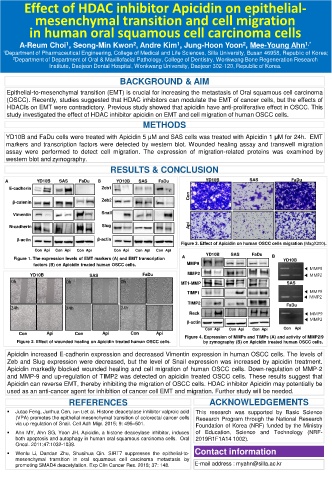
Figure 3. Effect of Apicidin on human OSCC cells migration (MagX200).
Con Api Con Api Con Api Con Api Con Api Con Api YD10B SAS FaDu
Figure 1. The expression levels of EMT markers (A) and EMT transcription A B YD10B
factors (B) on Apicidin treated human OSCC cells. MMP9
◀ MMP9
YD10B SAS FaDu MMP2 ◀ MMP2
0h 0h 0h MT1-MMP SAS
TIMP1 ◀ MMP9
◀ MMP2
TIMP2 FaDu
24h 24h 24h
Reck ◀ MMP9
◀ MMP2
β-actin
Con Api Con Api Con Api Con Api
Con Api Con Api Con Api
Figure 4. Expression of MMPs and TIMPs (A) and activity of MMP2/9
Figure 2. Effect of wounded healing on Apicidin treated human OSCC cells. by zymography (B) on Apicidin treated human OSCC cells.
Apicidin increased E-cadherin expression and decreased Vimentin expression in human OSCC cells. The levels of
Zeb and Slug expression were decreased, but the level of Snail expression was increased by apicidin treatment.
Apicidin markedly blocked wounded healing and cell migration of human OSCC cells. Down-regulation of MMP-2
and MMP-9 and up-regulation of TIMP2 was detected on apicidin treated OSCC cells. These results suggest that
Apicidin can reverse EMT, thereby inhibiting the migration of OSCC cells. HDAC inhibitor Apicidin may potentially be
used as an anti-cancer agent for inhibition of cancer cell EMT and migration. Further study will be needed.
REFERENCES ACKNOWLEDGEMENTS
Jutao Feng, Junhua Cen, Jun Liet al. Histone deacetylase inhibitor valproic acid This research was supported by Basic Science
(VPA) promotes the epithelial mesenchymal transition of colorectal cancer cells Research Program through the National Research
via up regulation of Snail. Cell Adh Migr. 2015; 9: 495–501. Foundation of Korea (NRF) funded by the Ministry
Ahn MY, Ahn SG, Yoon JH. Apicidin, a histone deaceylase inhibitor, induces of Education, Science and Technology (NRF-
both apoptosis and autophagy in human oral squamous carcinoma cells. Oral 2019R1F1A14 1002). ).
Oncol. 2011;47:1032-1038.
Wenlu Li, Dandan Zhu, Shuaihua Qin. SIRT7 suppresses the epithelial-to- Contact information
mesenchymal transition in oral squamous cell carcinoma metastasis by
promoting SMAD4 deacetylation. Exp Clin Cancer Res. 2018; 37: 148. E-mail address : myahn@silla.ac.kr

