


Page 213 - ebook
P. 213
Development of efficient immunomodulatory therapeutics
using microsphere-incorporated secretory factors derived
from canine stem cells
1
Su-Jeong Oh 1,2,3 , Ji-Su Ahn 1,2,3 , Ye Young Shin 1,2,3 , Min-Hye Song , Min-Jung Kang , Yoojin Seo ,
1
1
4
Jee-Heon Jeong , and Hyung-Sik Kim 1,2
1 Department of Oral Biochemistry; Dental and Life Science Institute, School of Dentistry, Pusan National University, Yangsan 50612, Korea
2 Department of Life Science in Dentistry, School of Dentistry, Pusan National University, Yangsan 50612, Korea
3 Education and Research Team for Life Science on Dentistry, Pusan National University, Yangsan 50612, Korea
4 College of Pharmacy, Yeungnam University, Gyeongsan, Gyeongbuk, 38541, Korea
Abstract Results
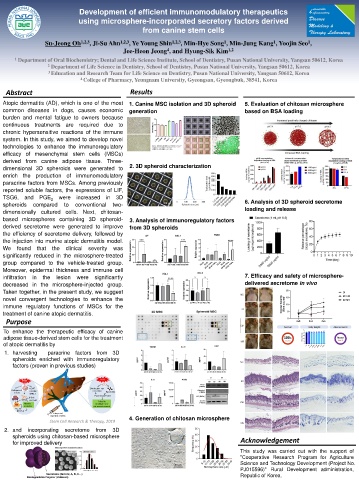
Atopic dermatitis (AD), which is one of the most 1. Canine MSC isolation and 3D spheroid 5. Evaluation of chitosan microsphere
common diseases in dogs, causes economic generation based on BSA loading
burden and mental fatigue to owners because
continuous treatments are required due to
chronic hypersensitive reactions of the immune
system. In this study, we aimed to develop novel
technologies to enhance the immunoregulatory
efficacy of mesenchymal stem cells (MSCs)
derived from canine adipose tissue. Three-
dimensional 3D spheroids were generated to 2. 3D spheroid characterization
enrich the production of immunomodulatory
paracrine factors from MSCs. Among previously
reported soluble factors, the expressions of LIF,
TSG6, and PGE 2 were increased in 3D
spheroids compared to conventional two- 6. Analysis of 3D spheroid secretome
dimensionally cultured cells. Next, chitosan- loading and release
based microspheres containing 3D spheroid- 3. Analysis of immunoregulatory factors
derived secretome were generated to improve from 3D spheroids
the efficiency of secretome delivery, followed by
the injection into murine atopic dermatitis model.
We found that the clinical severity was
significantly reduced in the microsphere-treated
group compared to the vehicle-treated group.
Moreover, epidermal thickness and immune cell
infiltration in the lesion were significantly 7. Efficacy and safety of microsphere-
decreased in the microsphere-injected group. delivered secretome in vivo
Taken together, in the present study, we suggest 20 Df
novel convergent technologies to enhance the 15 #2 CM
#2 MS
immune regulatory functions of MSCs for the Clinical Severity (Time course) 10
treatment of canine atopic dermatitis. 5 *
0 **
Purpose 2wk 3wk 4wk
To enhance the therapeutic efficacy of canine
adipose tissue-derived stem cells for the treatment
of atopic dermatitis by
1. harvesting paracrine factors from 3D
spheroids enriched with immunoregulatory
factors (proven in previous studies)
4. Generation of chitosan microsphere
Stem Cell Research & Therapy, 2019
2. and incorporating secretome from 3D
spheroids using chitosan-based microsphere
for improved delivery Acknowledgement
This study was carried out with the support of
"Cooperative Research Program for Agriculture
Science and Technology Development (Project No.
PJ015596)" Rural Development administration,
Republic of Korea.

