


Page 215 - ebook
P. 215
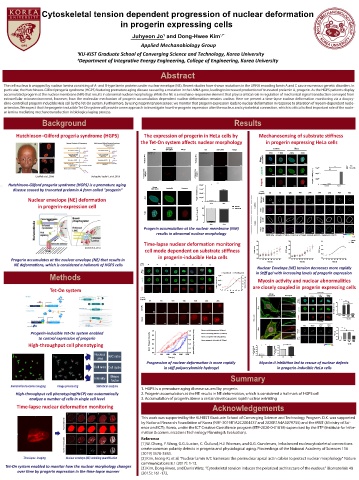
Cytoskeletal tension dependent progression of nuclear deformation
in progerin expressing cells
Juhyeon Jo¹ and Dong-Hwee Kim ¹,²*
Applied Mechanobiology Group
1KU-KIST Graduate School of Converging Science and Technology, Korea University
2Department of Integrative Energy Engineering, College of Engineering, Korea University
Abstract
The cell nucleus is wrapped by nuclear lamina consisting of A- and B-type lamin proteins under nuclear envelope (NE). Recent studies have shown mutations in the LMNA encoding lamin A and C cause numerous genetic disorders. In
particular, the Hutchinson-Gilford progeria syndrome (HGPS) featuring premature aging disease caused by a mutation in the LMNA gene, leading to increased production of truncated prelamin A, progerin. As the HGPS patients display
accumulated progerin at the nuclear membrane (NM) that results in abnormal nuclear morphology. While the NE is a mechano-responsive element that plays a critical role in regulation of mechanical signal transduction conveyed from
extracellular microenvironment, however, how the molecular mechanism of progerin accumulation dependent nuclear deformation remains unclear. Here we present a time-lapse nuclear deformation monitoring via a doxycy-
cline-controlled progerin inducible Hela cell by the Tet-On system. Furthermore, by using nesprin tension sensor, we monitor that progerin expression leads to nuclear deformation in response to alteration of myosin-dependent nucle-
ar tension. We expect that the progerin-inducible Tet-On system will provide a new approach to investigate how the progerin expression alter the nucleus and cytoskeletal connection, which is critical to nd important role of the nucle-
ar lamina mediating mechanotransduction in biological aging process.
Background Results
Hutchinson–Gilford progeria syndrome (HGPS) The expression of progerin in HeLa cells by Mechanosensing of substrate s�ffness
the Tet-On system affects nuclear morphology in progerin expressing HeLa cells
Young Old
mCherry
DIC d50 LMNA Merge DIC d50 LMNA Merge
Doxycycline Doxycycline
- -
*** - Dox
10 m 1.5 10 7 ns + Dox 36h
×
+ Doxycycline (2ug/ml) + Doxycycline (2ug/ml) 1.0 10 7
×
(Sca di et al., 2006) (Ashapkin, Vasily V., et al. 2019) Progerin intensity (a.u.) 5.0 10 6
×
Hutchinson-Gilford progeria syndrome (HGPS) is a premature aging 2.0 10 7 *** 0 1.37kPa Glass
×
Merge
disease caused by truncated prelamin A form called “progerin” With DAPI Lamin B1 Progerin Progerin intensity (a.u.) 1.5 10 7 7
×
1.0 10
×
Nuclear envelope (NE) deforma�on dox - 5.0 10 0 6
×
in progerin-expression cell 10μm 100 - dox + dox Normal
Percent of nuclei (%) 50
Abnormal
+ dox
0
- dox + dox
Progerin accumulation at the nuclear membrane (NM)
results in abnormal nuclear morphology
Time-lapse nuclear deforma�on monitoring 0.8 0.8 0.8 1.37kPa
Glass
0.6
0.6
cell mode dependent on substrate s�ffness FRET ratio 0.4 FRET ratio 0.4 FRET ratio 0.4
(Dechat et al., 2015) 0.6
in progerin-inducible HeLa cells 0.2 0.2 0.2
Progerin accumulates at the nuclear envelope (NE) that results in 0.0 6 12 18 TIme (h) 36 42 48 0.0 0 6 12 18 24 30 36 42 48 0.0 0 6 12 18 Time (h) 30 36 42 48
24
30
24
Time (h)
NE deformations, which is considered a hallmark of HGPS cells
Nuclear Envelope (NE) tension decreases more rapidly
Methods 1.5 × 10 7 Progerin intensity NE wrinkling percent in Stiff gel with increasing levels of progerin expression
25
Progerin intensity (a.u.) 1.0 × 10 7 6 15 NE wrinkling percent(%) Myosin ac�vity and nuclear abnormali�es
20
10
5.0 × 10
Tet-On system 0 0 6 12 18 24 30 36 42 5 0 are closely coupled in progerin expressing cells
Time (h)
***
ns
15 ***
NE wrinkling percent(%) 10 5
0
- Dox DMSO Cyto D Blebbi
2uM 15uM
+ Dox 36h
0.8 ***
- 0.6 *** ns
Norm. wrinkling percent (Glass)
1.0
1.0
Progerin-inducible Tet-On system enabled 0.8 0.8 Norm. wrinkling percent (1.37kPa) FRET ratio 0.4
to control expression of progerin 0.6 0.6 Norm. progerin intensity (Glass) 0.2 - Dox DMSO Cyto D Blebbi
0.0
Norm.progerin intensity (1.37kpa)
2uM
High-throughput cell phenotyping Norm. Progerin intensity 0.4 0.4 Norm. Nuclear wrinkling percent 1.0 *** 0.8 *** + Dox 36h 15uM
0.8
0.2
0.2
0.6
0.4
0.0
Nucleus N/C ratio 0.0 0 500 1000 1500 2000 2500 Norm. F-actin intensity to cell area 0.6 Norm. pMLC2 intensity to F-actin 0.4
0.2
0.2
0.0
0.0
area Time (m) - Dox + Dox - Dox + Dox
Progression of nuclear deformation is more rapidly Myosin-II inhibition led to rescue of nuclear defects
Cell area Cell cycle in stiff polyacrylamide hydrogel in progerin-inducible HeLa cells
Shape
Intensity Summary
factor
Immunofluoroscence imaging Image processing Statistical analysis
1. HGPS is a premature aging disease caused by progerin
High-throughput cell phenotyping(HtCP) can automatically 2. Progerin accumulation at the NE results in NE deformation, which is considered a hallmark of HGPS cell
analyze a number of cells in single cell level 3. Accumulation of progerin above a certain level causes rapid nuclear wrinkling
Time-lapse nuclear deforma�on monitoring Acknowledgements
T1 T2 T3 T4 T5
This work was supported by the KU-KIST Graduate School of Converging Science and Technology Program. D.K. was supported
Total nuclear area by National Research Foundation of Korea (NRF-2019R1A2C2004437 and 2020R1A4A3079755) and the MSIT (Ministry of Sci-
ence and ICT), Korea, under the ICT Creative Consilience program (IITP-2020-0-01819) supervised by the IITP (Institute for Infor-
mation & communications Technology Planning & Evaluation).
Reference
Nuclear wrinkling area [1] W. Chang, Y. Wang, G.G. Luxton, C. Östlund, H.J. Worman, and G.G. Gundersen, Imbalanced nucleocytoskeletal connections
create common polarity defects in progeria and physiological aging. Proceedings of the National Academy of Sciences 116
(2019) 3578-3583.
Time-lapse imaging Nuclear envelope (NE) wrinkling quantification [2] Kim, Jeong-Ki, et al. "Nuclear lamin A/C harnesses the perinuclear apical actin cables to protect nuclear morphology." Nature
communications 8.1 (2017): 1-13.
Tet-On system enabled to monitor how the nuclear morphology changes [3] Kim, Dong-Hwee, and Denis Wirtz. "Cytoskeletal tension induces the polarized architecture of the nucleus." Biomaterials 48
over time by progerin expression in the time-lapse manner (2015): 161-172.

