


Page 217 - ebook
P. 217
Selec ve Modula on of Single Molecular Force
in Integrin Differen ates Cell Migra on
Seong-Beom Han and Dong-Hwee Kim , ,
Applied Mechanobiology Group
KU-KIST Graduate School of Converging Science and Technology, Korea University, 145 Anam-ro, Seongbuk-gu, Seoul, South Korea
Department of Integrative Energy Engineering, College of Engineering, Korea University, 145 Anam-ro, Seongbuk-gu, Seoul, South Korea
Abstract
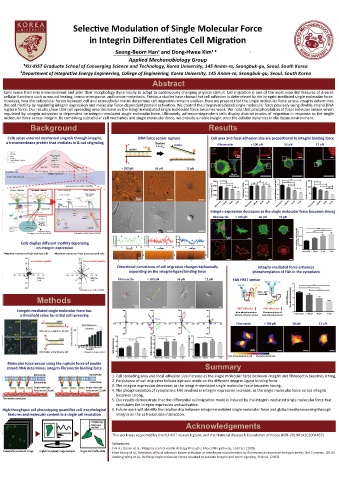
Cells sense their micro-environment and alter their morphology dynamically to adapt to con nuously changing physical s muli. Cell migra on is one of the most essen al features of diverse
cellular func ons such as wound healing, immune response, and cancer metastasis. Previous studies have shown that cell adhesion is determined by the integrin-mediated single molecular force.
However, how the subcellular forces between cell and extracellular matrix determine cell migra on remains unclear. Here we present that the single molecular force across integrin determines
the cell mo lity by regula ng integrin expression and molecular force-dependent protein ac va on. We control the integrin-mediated single molecular force precisely using double-strand DNA
rupture force. Our results show that cell spreading area decrease as the integrin-mediated single molecular force becomes weak. We note that phosphoryla on of focal adhesion kinase which
regulated by integrin ac va on is dependent on integrin-mediated single molecular force. Ul mately, adhesion-dependent cells display dis nct modes of migra on in response to the single
molecular force across integrin. By combining subcellular cell mechanics and single molecular force, we provide a noble insight onto the cellular dynamics in the ssue environment.
Background Results
Cells sense external mechanical singnals through integrin, DNA force sensor rupture Cell area and focal adhesion size are propor onal to integrin binding force
a transmembrane protein that mediates in & out singnaling Fibronec n > 100 pN 56 pN 12 pN
F-ac n
DAPI
Vinculin
5 µm
20 m
> 100 pN 56 pN 12 pN
50 µm
4 ***
4000 * 1.0 NS 150 *
*** NS NS *** ***
S Seetharaman et al, Biol Cell (2016) 3000 ** 0.8 3 * **
*** 0.6 * 100 ***
CHEMICAL SIGNALING MECHANICAL SIGNALING 2000 2
0.4 50
1000 0.2 1
20 µm
0 0.0 0 0
Integrin expression decreases as the single molecular force becomes strong
Fibronec n > 100 pN 56 pN 12 pN
r
g
n
I integrin αvβ3 α β v 3
e
t
n
i
a
F F-ac n c n
-
D DAPI A P I
1.6
***
**
***
CL Happe et al, Circ Res (2016) H Hamidi et al, Br J Cancer (2016)
2.0 2.0 1.2 1.2
1.6 1.6 20 µm
1.2 1.2 0.8 I integrin αvβ3 α β v 3
r
n
e
i
t
n
g
Cells display different mo lity depending 0.8 0.4 0.8 0.4 0.4 0.8
on integrin expression 0.0 0 20 40 X-axis (m) 60 80 100 0.0 0 25 X-axis (m) 75 100 0.0 0 25 X-axis (m) 75 100
50
50
Fibronec n > 100 pN 56 pN 12 pN
Migra on trajectory of αvβ3 depleted cells Migra on trajectory of αvβ3 overexpressed cells
10 µm
Direc onal persistence of cell migra on changes biphasically Integrin-mediated force enhances
depending on the integrin-ligand binding force phosphoryla on of FAK in the cytoplasm
Fibronec n > 100 pN 56 pN 12 pN FAK FRET sensor
6
EHJ Danen et al, J Cell Sci (2005) 5
Methods 4
20 µm 3
FRET effieciency
FRET effieciency
Integrin-mediated single molecular force has 120 120 120 120 Non-phosphoryla on Phosphoryla on of 2
a threshold value for ini al cell spreading 60 60 60 60 of focal adhesion kinase focal adhesion kinase Fibronec n > 100 pN 56 pN 12 pN
-120 -60 60 120 -120 -60 60 120 -120 -60 60 120 -120 -60 60 120 Fibronec n > 100 pN 56 pN 12 pN
-60 -60 -60 -60
DNA rupture at high force (56 pN)
-120 -120 -120 -120
120 50 30
**
40
90
30 20
60
20 20 m 20 m 20 m
10 20 m
DNA rupture at low force (12 pN) X Wang et al, Science (2013) 30 10
0 0 0 Non-phosphorylated FAK Phosphorylated FAK
Fibronec n > 100 pN 56 pN 12 pN Fibronec n > 100 pN 56 pN 12 pN Fibronec n > 100 pN 56 pN 12 pN
Molecular force sensor using the rupture force of double
strand DNA determines integrin-fibronec n binding force Summary
Intracellular Intracellular 1. Cell spreading area and focal adhesion size increase as the single molecular force between integrin and fibronec n becomes strong.
2. Persistance of cell migra on follows biphasic mode on the different integrin-ligand binding force.
Extracellular Extracellular
3. The integrin expression decreases as the integrin-mediated single molecular force becomes strong.
Single molecular Single molecular
force sensor (56 pN) force sensor (12 pN) 4. The phosphoryla on of cytoplasmic FAK involved in integrin expression increases as the single molecular force across integrin
becomes strong.
Fibronec n coated glass
5. Our results demonstrate that the differen al cell migra on mode is induced by the integrin-mediated single molecular force that
modulates the integrin expression and ac va on.
High-thoughtput cell phenotyping quan fies cell morphological 6. Future work will iden fy the rela onship between integrin-mediated single molecular force and global mechanosensing through
features and molecular content in a single cell resolu on integrin on the cell-substrate interac on.
- Morphology
- Molecular Acknowledgements
content
This work was supported by the KU-KIST research grant, and the Na onal Research Founda on of Korea (NRF-2019R1A2C2004437)
References
Erik H.J Danen et al., Integrins control mo le strategy through a Rho-cofilin pathway, J Cell Sci. (2005)
Immunofluorescence Image High-throughput Image Analysis Single Cell Profile data Jihye Seong et al., Detec on of focal adhesion kinase ac va on at membrane microdomains by fluorescence resonance energy transfer, Nat Commun. (2011)
Xuefeng Wang et al., Defining single molecular forces required to ac vate integrin and notch signaling, Science. (2013)

