


Page 209 - ebook
P. 209
Adhesion related molecule X Is elevated in Parkinson’s Disease
           Models and affects to pathogenesis of sporadic PD cases

    Mihee Oh , Jeong-Su Byun , Seonha Lee , Baek-Soo Han ¹,²*
                                   ¹,²
                         ¹
            ¹
    1 Biodefense Center, Korea Research Institute of Bioscience and Biotechnology (KRIBB), Daejeon 34141, Korea
    2 Department of Functional Genomics, University of Science and Technology (UST), Daejeon 34141, Korea
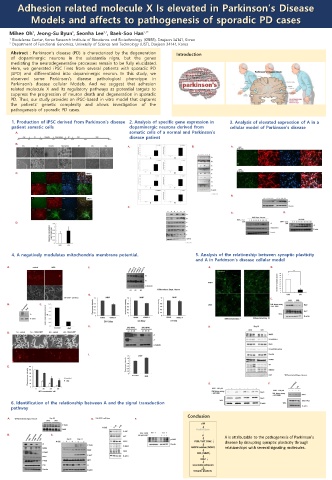
     Abstract : Parkinson’s disease (PD) is characterized by the degeneration  Introduction
     of dopaminergic neurons in the substantia nigra, but the genes
     mediating the neurodegenerative processes remain to be fully elucidated.
     Here, we generated iPSC lines from several patients with sporadic PD
     (SPD) and differentiated into dopaminergic neuron. In this study, we
     observed  some  Parkinson's  disease  pathological  phenotype  in
     Parkinson’s disease cellular Models. And we suggest that adhesion
     related molecule X and its regulatory pathways as potential targets to
     suppress the progression of neuron death and degeneration in sporadic
     PD. Thus, our study provides an iPSC-based in vitro model that captures
     the patients’ genetic complexity and allows investigation of the
     pathogenesis of sporadic PD cases.
     1. Production of iPSC derived from Parkinson’s disease  2. Analysis of specific gene expression in   3. Analysis of elevated expression of A in a
     patient somatic cells                 dopaminergic neurons derived from   cellular model of Parkinson's disease
                                           somatic cells of a normal and Parkinson’s
                                           disease patient


     4. A negatively modulates mitochondria membrane potential.  5. Analysis of the relationship between synaptic plasticity
                                                                 and A in Parkinson's disease cellular model


     6. Identification of the relationship between A and the signal transduction
     pathway
                                                              Conclusion


                                                                          A is attributable to the pathogenesis of Parkinson's
                                                                          disease by disrupting synaptic plasticity through
                                                                          relationships with several signaling molecules.

