


Page 207 - ebook
P. 207
Functional Validation of RKIP knockout effect on Cancer Cell Signaling
¹
Md Abu Rayhan , Eun-Young Lee , Mohammad Faysal Al Mazid , Minjeong Kim , Hye Jin You ¹,²*
²
²
¹
** Presenting Author : Md Abu Rayhan ¹
*Corresponding Author
1 1Department of Cancer Biomedical Science, National Cancer Center (NCC)-Graduate School of Cancer Science and Policy (GCSP), Gyeonggi 10408, Korea
2 Tumor Microenvironment Branch, Division of Cancer Biology, National Cancer Center, Gyeonggi 10408, Korea.
Abstract
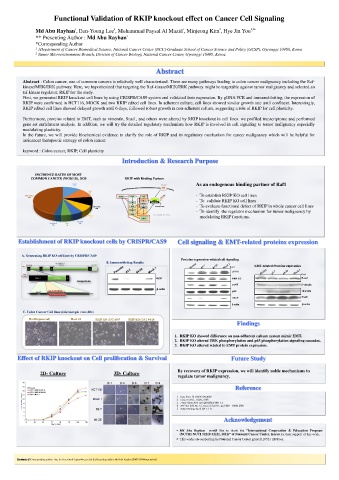
Abstract : Colon cancer, one of common cancers is relatively well characterized. There are many pathways leading to colon cancer malignancy including the Raf-
kinase/MEK/ERK pathway. Here, we hypothesized that targeting the Raf-kinase/MEK/ERK pathway might be targetable against tumor malignancy and selected an
raf kinase regulator, RKIP for the study.
First, we generated RKIP knockout cell lines by using CRISPR/CAS9 system and validated their expression. By gDNA PCR and immunoblotting, the expression of
RKIP were confirmed in HCT116, MOCK and two RKIP edited cell lines. In adherent culture, cell lines showed similar growth rate until confluent. Interestingly,
RKIP edited cell lines showed delayed growth until 6 days, followed robust growth in non-adherent culture, suggesting a role of RKIP for cell plasticity.
Furthermore, proteins related to EMT, such as vimentin, Snai1, and others were altered by RKIP knockout in cell lines. we profiled transcriptome and performed
gene set enrichment analysis. In addition, we will try the detailed regulatory mechanism how RKIP is involved in cell signaling to tumor malignancy especially
modulating plasticity.
In the future, we will provide biochemical evidence to clarify the role of RKIP and its regulatory mechanism for cancer malignancy which will be helpful for
anticancer therapeutic strategy of colon cancer.
keyword : Colon cancer, RKIP, Cell plasticity
Introduction & Research Purpose
INCIDENCE RATES OF MOST
COMMON CANCER (WORLD), 2020 RKIP with Binding Partner
As an endogenous binding partner of Raf1
Breast
12%
EGFR
Lung
11%
Other cancers PTEN P13K Ras - To establish RKIP KO cell lines
MAPK pathway MEK
46%
RKIP
AKT Raf-1 Monomeric - To validate RKIP KO cell lines
Colorectum IKK ERK Mutant RKIP - To evaluate functional defect of RKIP in whole cancer cell lines
10%
- To identify the regulator mechanism for tumor malignancy by
NF-kB
Snai1 Arranged by Abu
Prostate modulating RKIP functions.
7%
EMT
Stomach
Cervix uteri Liver 6%
3% 5%
Establishment of RKIP knockout cells by CRISPR/CAS9 Cell signaling & EMT-related proteins expression
A. Generating RKIP KO cell lines by CRISPR/CAS9
Proteins expression-related cell signaling
B. Immunobloting Results
EMT-related Proteins expression
(β-mer)
pERK
(β-mer)
RKIP ERK 1/2 E-cad
p-p65 β-catenin
β-actin
p65 vimentin
RKIP Snai1
β-actin β-actin
C. Colon Cancer Cell lines (microscopic view-20x)
Hct116 (parental) Mock #1 RKIP KO (C/C) #3-7 RKIP KO (C/C) #4-26
Findings
1. RKIP KO showed difference on non-adherent culture system mimic EMT.
2. RKIP KO altered ERK phosphorylation and p65 phosphorylation signaling cascades.
3. RKIP KO altered related to EMT protein expression.
Effect of RKIP knockout on Cell proliferation & Survival Future Study
By recovery of RKIP expression, we will identify noble mechanisms to
2D- Culture 3D- Culture
regulate tumor malignancy.
Reference
1. Data from: GLOBOCAN 2020
2. Cancers 2021, 13(24), 6388
3. J Biol Chem 2012 Jul 6;287(28):23407-17;
4. JBC Vol. 278, No. 15, Issue of April 11, pp.13061–13068, 2003
5. Tumor Biology April 2017:1-17
Acknowledgement
Md Abu Rayhan would like to thank the “International Cooperation & Education Program
(NCCRI·NCCI 52210-52211, 2021)” of National Cancer Center, Korea for their support of this work.
This works are supporting by National Cancer Center grant 2110521 (HJYou).
Contact: (*Corresponding author: Hye Jin You, Email: hjyou@ncc.re.kr) & (Presenting author: Md Abu Rayhan (2005105@ncc.re.kr))

