


Page 203 - ebook
P. 203
B-36  Umbilical Cord Blood Ameliorated Neurological Dysfunction and
         Mitochondrial Dynamics in Collagenase Induced Intracerebral
         Hemorrhage Rat Model.

                                                            1
         Sung Chan  Ha , Joo-Wan Choi , Jee In Choi , Jin seung Choung , MinYoung Kim *
                                            2
                                                                          1,2
                     1
                                  1
         1 Department of Rehabilitation Medicine, CHA BundangMedical Center, CHA University School of Medicine, Republic of Korea
         2 Rehabilitation and Regeneration Research Center, CHA University, Republic of Korea
                       Abstract                                              Results
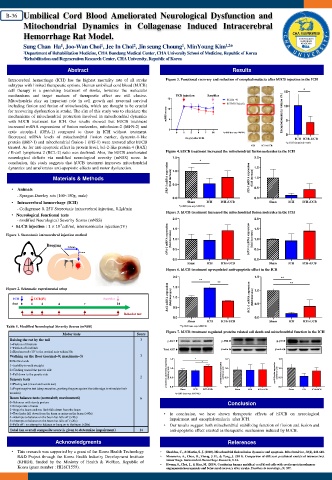
    Intracerebral hemorrhage (ICH) has the highest mortality rate of all stroke  Figure 3. Functional recovery and reduction of encephalomalacia after hUCB injection in the ICH
    subtypes with limited therapeutic options. Human umbilical cord blood (hUCB)
    cell therapy is a promising treatment of stroke, however the molecular                   15     *
    mechanisms and target markers of therapeutic effect are still elusive.  UCB injection  Sacrifice
    Mitochondria play an important role in cell growth and neuronal survival  15  ICH(n=4)
    including fission and fusion of mitochondria, which are thought to be crucial  *  ICH+UCB(n=5)  10
    for recovering dysfunction in stroke. The aim of this study was to elucidate the  10     Encephalomalacia volume (%)
    mechanisms of mitochondrial protection involved in mitochondrial dynamics  mNSS scores
    with hUCB treatment for ICH. Our results showed that hUCB treatment  5                    5
    increased mRNA expressions of fusion molecules, mitofusion-2 (MFN-2) and
    optic atrophy-1 (OPA-1) compared to those in ICH without treatment.  0  0  1  2  4  7  14  *p<0.05 (two way ANOVA)
    Decreased mRNA levels of mitochondrial fission marker, dynamin-1-like  Day(s) after ICH   0  ICH ICH+UCB
    protein (DRP-1) and mitochondrial fission-1 (FIS-1) were restored after hUCB              *p<0.05 (unpaired t-test)
    treated. As for anti-apoptotic effect in protein level, bcl-2-like protein 4 (BAX)  ICH  ICH+UCB
    / B-cell lymphoma 2 (BCL-2) ratio was declined. Also, the hUCB ameliorated  Figure 4. hUCB treatment increased the mitochondrial fission molecules in the ICH
    neurological deficits via modified neurological severity (mNSS) score. In  1.5  2.0
    conclusion, this study suggests that hUCB treatment improves mitochondrial  *
    dynamics and ameliorates anti-apoptotic effects and motor dysfunction.  1.0     1.5
                  Materials & Methods                   DRP-1 mRNA expression  (fold increase)  FIS-1 mRNA expression  (fold increase)  1.0
     •  Animals                                          0.5                        0.5
       - Sprague-Dawley rats (160~180g, male)
                                                         0.0                        0.0
     • Intracerebral hemorrhage (ICH)                         Sham  ICH  ICH+UCB         Sham  ICH  ICH+UCB
                                                           *p<0.05 (one way ANOVA)
       - Collagenase 0. 25U Stereotaxic intracerebral injection, 0.2μl/min
     • Neurological functional tests                   Figure 5. hUCB treatment increased the mitochondrial fusion molecules in the ICH
       - modified Neurological Severity Scores (mNSS)    2.0                        2.0
                     7
     • hUCB injection : 1 × 10 cell/ml, intraventricular injection(IV)  1.5         1.5
   Figure 1. Stereotaxic intracerebral injection method  OPA-1 mRNA expression  (fold increase)  1.0  MFN-2 mRNA expression  (fold increase)  1.0
                Bregma  3.5 mm                           0.5                        0.5
                           6 mm
                                                         0.0                        0.0
                                                              Sham  ICH  ICH+UCB         Sham  ICH  ICH+UCB
                                                       Figure 6. hUCB treatment up-regulated anti-apoptotic effect in the ICH
                                                         2.0                        1.5     **
                                                                  **    **                     **
                                                        BAX mRNA expression  (fold increase)  1.0  BCL-2 mRNA expression  (fold increase)
   Figure 2. Schematic experimental setup                1.5                        1.0
     ICH    UCB(IV)                Sacrifice
     (Day)  0  1  2  4      7          14                0.5                        0.5
                                         Behavior test
                                                         0.0                        0.0
                                                              Sham  ICH  ICH+UCB         Sham  ICH  ICH+UCB
   Table 1. Modified Neurological Severity Scores (mNSS)   **p<0.01 (one-way ANOVA)
                                                       Figure 7. hUCB treatment regulated proteins related cell death and mitochondrial function in the ICH
                     Motor tests              Score
    Raising the rat by the tail                3        p-AKT ▶          p-JNK ▶           p-p38 ▶
    1=Flexion of forelimb
    1=Flexion of hindlimb                             Total AKT ▶        β-actin ▶         β-actin ▶
    1=Head moved >10° to the vertical axis within 30s
    Walking on the floor (normal=0; maximum=3)  3
    0=Normal walk                                       1.5     *  *      1.5               1.5
    1=Inability to walk straight
    2=Circling toward the paretic side                  1.0               1.0               1.0
    3=Fall down to the paretic side                    p-Akt/total Akt Protein expression  (arbitrary unit)  p-JNK Protein expression  (arbitrary unit)  p-p38 Protein expression  (arbitrary unit)
    Sensory tests                              2        0.5               0.5               0.5
    1=Placing test (visual and tactile test)
    1=Proprioceptive test (deep sensation, pushing the paw against the table edge to stimulate limb   0.0  Sham  ICH  ICH+UCB  0.0  Sham  ICH  ICH+UCB  0.0  Sham  ICH  ICH+UCB
    muscles)                                              *p<0.05 (one way ANOVA)
    Beam balance tests (normal=0; maximum=6)   6
    0=Balances with steady posture                                         Conclusion
    1=Grasps side of beam
    2=Hugs the beam and one limb falls down from the beam
    3=Two limbs fall down from the beam or spins on the beam (>60s)  •  In conclusion, we have shown therapeutic effects of hUCB on neurological
    4=Attempts to balance on the beam but falls off (>40s)  impairment and encephalomalacia after ICH.
    5=Attempts to balance on the beam but falls off (>20s)
    6=Falls off : no attempt to balance or hang on to the beam (<20s)  •  Our results suggest both mitochondrial stabilizing function of fission and fusion and
    Total (an overall composite score is given to determine impairment)  14  anti-apoptotic effect exerted as therapeutic mechanism induced by hUCB.
                   Acknowledgments                                         References
     •  This research was supported by a grant of the Korea Health Technology  •  Sheridan, C., & Martin, S. J. (2010). Mitochondrial fission/fusion dynamics and apoptosis. Mitochondrion, 10(6), 640-648.
       R&D Project through the Korea Health Industry Development Institute  •  Manaenko, A., Chen, H., Zhang, J. H., & Tang, J. (2011). Comparison of different preclinical models of intracerebral
       (KHIDI), funded by the Ministry of Health & Welfare, Republic of  •  hemorrhage. Intracerebral Hemorrhage Research, 9-14.
                                                       Hwang, S., Choi, J., & Kim, M. (2019). Combining human umbilical cord blood cells with erythropoietin enhances
       Korea (grant number : HI16C1559).               angiogenesis/neurogenesis and behavioral recovery after stroke. Frontiers in neurology, 10, 357.

