


Page 199 - ebook
P. 199
Alginate Encapsulation of 3D Spheroidal Mesenchymal Stem Cell
                              for Treatment of Inflammatory Bowel Disease

                                                                                 1
                                     Junhyeung Park , Tiep Tien Nguyen , Jee-Heon Jeong *
                                                                   1
                                                   1
                    1 College of Pharmacy, Yeungnam University, 280 Daehak-ro, Gyeongsan-si, Gyeongbuk-do 38541, Korea
                                                     jeeheon@yu.ac.kr
     INTRODUCTION                                         RESULTS
                                                         2. Viability of encapsulated ADMSCs spheroids


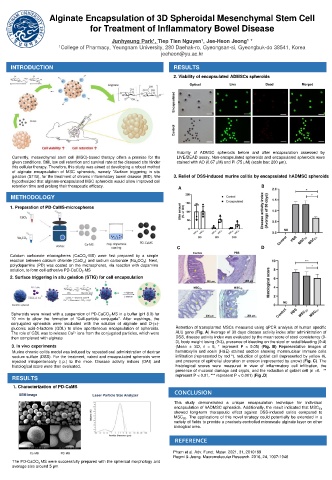
                                                           Viability of ADMSC spheroids before and after encapsulation assessed by
     Currently, mesenchymal stem cell (MSC)-based therapy offers a promise for the  LIVE/DEAD assay. Non-encapsulated spheroids and encapsulated spheroids were
     given conditions. Still, low cell retention and survival rate at the diseased site hinder  stained with AO (0.67 μM) and PI (75 μM) (scale bar: 200 μm).
     this cellular therapy. Therefore, this study was aimed at developing a robust method
     of alginate encapsulation of MSC spheroids, namely “Surface triggering in situ
     gelation (STIG), for the treatment of chronic inflammatory bowel disease (IBD). We  3. Relief of DSS-induced murine colitis by encapsulated hADMSC spheroids
     hypothesized that alginate-encapsulated MSC spheroids would allow improved cell
     retention time and prolong their therapeutic efficacy.  A                        B
     METHODOLOGY

    1. Preparation of PD-CaMS-microspheres


                                                       00
                                                           C                          D
    Calcium carbonate microspheres (CaCO 3 -MS) were first prepared by a simple
    reaction between calcium chloride (CaCl 2 ) and sodium carbonate (Na 2 CO 3 ). Next,
    polydopamine (PD) was coated on the microspheres, via reaction with dopamine
    solution, to form cell-adhesive PD-CaCO 3 -MS
    2. Surface triggering in situ gelation (STIG) for cell encapsulation


     Spheroids were mixed with a suspension of PD-CaCO 3 -MS in a buffer (pH 8.0) for
     10 min to allow the formation of “Cell-particle conjugate”. After washings, the
     conjugated spheroids were incubated with the solution of alginate and D-(+)-
     gluconic acid-δ-lactone (GDL) to allow spontaneous encapsulation of spheroids.  Retention of transplanted MSCs measured using qPCR analysis of human specific
     The role of GDL was to release Ca 2+ ions from the conjugated particles, which were  ALU gene (Fig. A) Average of 30 days disease activity index after administration of
     then complexed with alginate                         DSS, disease activity index was evaluated by the mean score of stool consistency (0-
                                                          3), body weight losing (0-3), presence of bleeding on the stool or rectal bleeding (0-4)
     3. In vivo experiments                               (Mean ± SD, n = 6, * represent P < 0.05) (Fig. B) Representative images of
     Murine chronic colitis model was induced by repeated oral administration of dextran  hematoxylin and eosin (H&E) stained section showing mononuclear immune cells
     sodium sulfate (DSS). For the treatment, naked and encapsulated spheroids were  infiltration (represented by red *), reduction of goblet cell (represented by yellow #),
     injected intraperitoneally (i.p.) to the mice. Disease activity indices (DAI) and  and presence of epithelial ulceration or erosion (represented by arrow) (Fig. C). The
     histological score were then evaluated.              histological scores were measured in view of inflammatory cell infiltration, the
                                                          presence of mucosal damage and crypts, and the reduction of goblet cell (n =6. **
     RESULTS                                              represent P < 0.01, *** represent P < 0.001) (Fig .D)
     1. Characterization of PD-CaMS
                                                          CONCLUSION
                                                          This study demonstrated a unique encapsulation technique for individual
                                                          encapsulation of hADMSC spheroids. Additionally, the result indicated that MSC En
                                                          showed long-term therapeutic effect against DSS-induced colitis compared to
                                                          MSC 3D . The applications of this novel strategy could potentially be extended in a
                                                          variety of fields to provide a precisely-controlled microscale alginate layer on other
                                                          biological area.
                                                          REFERENCE
                                                         Pham et al. Adv. Funct. Mater. 2021, 31, 2010169
                                                         Regmi & Jeong. Macromolecular Research. 2016, 24, 1037-1046
     The PD-CaCO 3 MS were successfully prepared with the spherical morphology and
     average size around 5 μm.

