


Page 13 - ebook
P. 13
ROS-responsive Dual Targeted Smart Nano system Boosted Cellular Immunity Combining Immune Cell
Infiltration and Immunogenic Cell Death Against Breast Cancer
Asmita Banstola , Simmyung Yook 1 *
1
1 College of Pharmacy, Keimyung University, Daegu, 42601, Republic of Korea
Introduction Aims
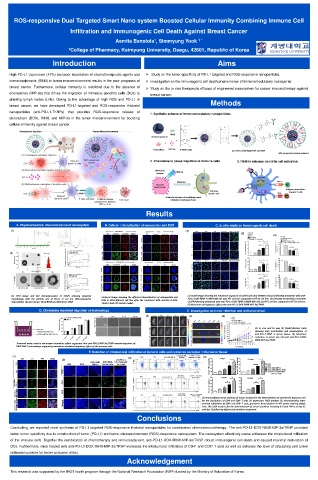
High PD-L1 expression (47%) and poor localization of chemotherapeutic agents and ➢ Study on the tumor specificity of PD-L1 targeted and ROS-responsive nanoparticles.
immunoadjuvants (R848) in tumor microenvironment results in the poor prognosis of ➢ Investigation on the immunogenic cell death phenomenon of immunomodulatory nanocarrier
breast cancer. Furthermore, cellular immunity is restricted due to the absence of ➢ Study on the in vivo therapeutic efficacy of engineered nanosystem for cancer immunotherapy against
chemokines (MIP-3α) that drives the migration of immature dendritic cells (DCs) to breast cancer.
draining lymph nodes (LNs). Owing to the advantage of high ROS and PD-L1 in Methods
breast cancer, we have developed PD-L1-targeted and ROS-responsive thioketal
nanoparticles (anti-PD-L1-TKNPs) that provides ROS-responsive release of
1. Synthetic scheme of immunomodulatory nanoparticles
doxorubicin (DOX), R848, and MIP-3α in the tumor microenvironment for boosting
cellular immunity against breast cancer.
OH
HO
R848
Thioketal polymer
+ O NH OH O
+
n
Doxorubicin MIP-3α D-PEMA (1%)
anti-PD-L1-DOX-R848-MIP-3α/TKNP
ROS-responsive release behavior
2. Chemokine to cause migration of immune cells 3. R848 to enhance dendritic cell activation
Chemokine
receptor MIP-3α
Migration
Immature
dendritic cells
Antigen presentation
Draining
towards T cells
lymph node
Avoid the limitation of insufficient tumor
infiltration of cytotoxic T cells
Results
A. Physicochemical characterization of nanosystem B. Cellular internalization of nanocarrier and DOX C. In vitro study on immunogenic cell death
(1) (3) (1)
(2)
(3)
(2)
(1) TEM image and DLS characterization of TKNPs showing spherical Confocal image showing the efficient internalization of nanoparticle and (1) CLSM image showing the maximum exposure of calreticulin and HMGB1 release following treatment with anti-
morphology with the particle size of 80.16 ± 4.4 nm. ROS-responsive PD-L1-DOX-TKNP in MDA-MB-231 and 4T1 cell line compared to BT-20 cell line. (2) Elevated extracellular secretion
DOX in MDA-MB-231 cell line after the treatment with anti-PD-L1-DOX-
degradation (2) and release (3) of R848 and DOX from TKNP. of ATP following treatment with anti-PD-L1-DOX-TKNP in MDA-MB-231 and 4T1 cell line compared to BT-20 cell line.
TKNP in both 2D and 3D model.
(3) Maximum cell cytotoxic effect with anti-PD-L1-DOX-R848-MIP-3α/TKNP.
D. Chemokine mediated migration of macrophage E. Investigation on tumor retention and antitumor effect
(1) (2) (3)
(1) In vivo and Ex vivo (2) biodistribution study
showing high penetration and accumulation of
anti-PD-L1-TKNP in tumor tissue. (3) Maximum
reduction in tumor size (4) with anti-PD-L1-DOX-
R848-MIP-3α/TKNP.
Transwell assay used to determine chemokine effect suggested that anti-PD-L1-MIP-3α/TKNP caused migration of
RAW 264.7 macrophage suggesting chemokine mediated migratory effect of the immune cells.
F. Detection of intratumoral infiltration of immune cells and cytokines secretion in the tumor tissue
(1) (3) (4)
(2)
(1) Immunofluorescence staining of tumor sections for the determination of calreticulin exposure and
+
+
for the elucidation of CD4 and CD8 T cells (2) expression. FACS analysis (3) demonstrating intra-
+
+
tumoral infiltration of CD4 and CD8 T cells, granzyme B and perforin in 4T1 tumor bearing balb/c
mice. (4) ELISA analysis for the determination of serum cytokines including IL-6 and TNF-α at day 15
and day 20 following different formulation treatment
Conclusions
Concluding, we reported novel synthesis of PD-L1 targeted ROS-responsive thioketal nanoparticles for combination chemoimmunotherapy. The anti-PD-L1-DOX-R848-MIP-3α/TKNP provided
better tumor specificity due to construction of tumor (PD-L1) and tumor-microenvironment (ROS)-responsive nanosystem. The nanosystem effectively cause enhances the intratumoral infiltration
of the immune cells. Together the combination of chemotherapy and immunoadjuvant, anti-PD-L1-DOX-R848-MIP-3α/TKNP robust immunogenic cell death and caused maximal maturation of
DCs. Furthermore, mice treated with anti-PD-L1-DOX-R848-MIP-3α/TKNP increases the intratumoral infiltration of CD4 and CD8 T cells as well as enhance the level of circulating and tumor
+
+
infiltrated cytokine for better antitumor effect.
Acknowledgement
This research was supported by the BK21 fourth program through the National Research Foundation (NRF) funded by the Ministry of Education of Korea.

