


Page 9 - ebook
P. 9
Antibody-Based Targeting of Cell Surface GRP94 Specifically Inhibits
Cetuximab-Resistant Colorectal Cancer Growth
Ji Woong Kim 1# , Yea Bin Cho , Kyun Heo and Sukmook Lee 1*
1
1#
Biopharmaceutical Chemistry Major, School of Applied Chemistry, Kookmin University, Seoul 136-702, Korea
In Vivo Mouse Experiments We monitored morphological changes in HUVECs in the presence
All experiments were performed following protocols approved by or absence of GRP94 IgG by labeling the actin cytoskeleton with
Colorectal cancer (CRC) is one of the leading causes of cancer death IACUC and in accordance with the guidelines of Hallym rhodamine–phalloidin, which is a fluorescent dye that stains F-actin,
worldwide. Cetuximab, a human/mouse chimeric monoclonal antibody, is University (Hallym 2017-72). To evaluate the effect of GRP94 and found that GRP94 IgG does not induce significant
effective in a limited number of CRC patients because of cetuximab IgG on HCT116 tumor growth, BALB/c-nude mice were morphological changes in HUVECs
resistance. This study aimed to identify novel therapeutic targets in subcutaneously injected with 3 × 10 HCT116 cells. After 7 days,
6
cetuximab-resistant CRC in order to improve clinical outcomes. Through 10 mg/kg GRP94 IgG (n = 7), cetuximab (n = 7), or vehicle (n =
phage display technology, we isolated a fully human antibody strongly 10) was intravenously injected twice weekly. Mice were weighed
binding to the cetuximab-resistant HCT116 cell surface and identified the
target antigen as glucose-regulated protein 94 (GRP94) using proteomic and tumor sizes were measured once per week up to day 42.
analysis. Short interfering RNA-mediated GRP94 knockdown showed that
GRP94 plays a key role in HCT116 cell growth. In vitro functional studies Statistical Analysis
revealed that the GRP94-blocking antibody we developed strongly inhibits Data were analyzed using two-tailed Student’s t-tests for
the growth of various cetuximab-resistant CRC cell lines. We also comparison between two groups and one-way analysis of
demonstrated that GRP94 immunoglobulin G monotherapy significantly variance with Bonferroni correction for multiple comparisons in
reduces HCT116 cell growth more potently compared to cetuximab, GraphPad Prism 5.0 (GraphPad Software, La Jolla, CA, USA). Figure 5. Effect of GRP94 IgG on endothelial cell toxicity.
without severe toxicity in vivo. Therefore, cell surface GRP94 might be a Data are presented as mean ± SEM. p-values < 0.05 were
potential novel therapeutic target in cetuximab-resistant CRC, and considered statistically significant. To investigate the effect of GRP94 IgG on cetuximab-resistant CRC cell
antibody-based targeting of GRP94 might be an effective strategy to growth, we generated an HCT116 xenograft mouse model by
suppress GRP94-expressing cetuximab-resistant CRC. subcutaneously injecting HCT116 cells into nude mice. Then, GRP94
IgG or cetuximab was injected intravenously twice weekly for 7–42 days
after HCT116 cell injection. Tumor sizes and body weights were
Figure 1. Graphical abstract
monitored during this period.
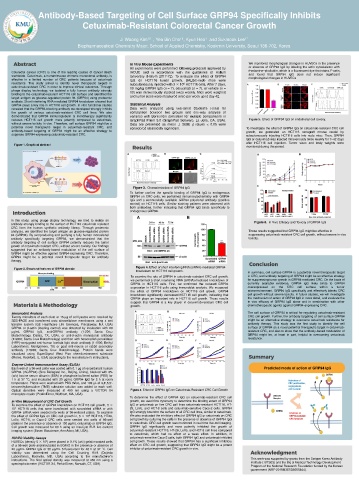
Figure 3. Characterization of GRP94 IgG
To further confirm the specific binding of GRP94 IgG to endogenous
GRP94 on CRC cells, we performed immunocytochemistry with GRP94
IgG and a commercially available GRP94 polyclonal antibody (positive
control) on HCT116 cells. Similar staining patterns were observed with
both antibodies, further indicating that GRP94 IgG binds specifically to
endogenous GRP94.
In this study, using phage display technology, we tried to isolate an Figure 6. In Vivo Efficacy and Toxicity of GRP94 IgG
antibody strongly binding to the surface of HCT116 cetuximab-resistant
CRC from the human synthetic antibody library. Through proteomic
analyses, we identified the target antigen as glucose-regulated protein These results suggested that GRP94 IgG might be effective in
94 (GRP94). By overproducing and purifying a fully human monoclonal suppressing cetuximab-resistant CRC cell growth, without severe in vivo
antibody specifically targeting GRP94, we demonstrated that the toxicity.
antibody targeting of cell surface GRP94 potently reduces the tumor
growth of cetuximab-resistant CRC, without severe toxicity. Our findings
suggested that an antibody-based modulation of the cell surface of
GRP94 might be effective against GRP94-expressing CRC. Therefore,
GRP94 might be a potential novel therapeutic target for antibody
therapy.
Figure 4. Effect of short interfering RNA (siRNA)-mediated GRP94
Figure 2. Structural features of GRP94 domain
knockdown on HCT116 cell growth. In summary, cell surface GRP94 is a potential novel therapeutic target
To examine the role of GRP94 in cetuximab-resistant CRC cell growth, in CRC, and antibody targeting of GRP94 might be an effective strategy
we performed a short interfering RNA (siRNA)-mediated knockdown of for suppressing tumor growth in GRP94-mediated CRC. On the basis of
GRP94 in HCT116 cells. First, we confirmed the reduced GRP94 currently available evidence, GRP94 IgG likely binds to GRP94
expression in HCT116 cells using immunoblot analysis. We measured overexpressed on the CRC cell surface within a tumor
the effect of GRP94 knockdown on HCT116 cell growth. GRP94 microenvironment. GRP94 IgG specifically and effectively blocks CRC
knockdown significantly decreased HCT116 cell growth, indicating that cell growth without severe toxicity. In future studies, we will investigate
GRP94 plays an important role in HCT116 cell growth. These results the mechanism of action of GRP94 IgG in more detail, and evaluate the
suggest that GRP94 is a key player in cetuximab-resistant CRC cell in vivo efficacy of GRP94 IgG alone and in combination with other
growth. chemotherapeutic agents against GRP94-expressing CRC.
Immunoblot Analysis The cell surface of GRP94 is critical for regulating cetuximab-resistant
Twenty microliters of each elute or 15 µg of cell lysates were resolved by CRC cell growth. Further, the antibody targeting of cell surface GRP94
SDS-PAGE and transferred onto nitrocellulose membranes using a wet might be an alternative strategy to overcome cetuximab resistance for
transfer system (GE Healthcare Life Sciences, Piscataway, NJ, USA) antibody therapy. This study was the first study to identify the cell
GRP94 or β-actin (loading control) was detected by incubation with 20 surface of GRP94 as a novel potential therapeutic target in cetuximab-
µg/mL GRP94 IgG, anti-GRP94 antibody (1:200; Santa Cruz resistant CRC, and also to show that the antibody-based modulation of
Biotechnology, Dallas, TX, USA), or anti-β-actin monoclonal antibody GRP94 might be, at least in part, helpful in overcoming cetuximab
(1:3000; Santa Cruz Biotechnology) and then with horseradish peroxidase resistance.
(HRP)-conjugated anti-human lambda light chain antibody (1:1000; Bethyl
Laboratories, Montgomery, TX) or goat anti-mouse or rabbit secondary
antibody (1:5000; Santa Cruz Biotechnology). Protein bands were
visualized using SuperSignal West Pico chemiluminescent substrate
(Pierce, Rockford, IL, USA) according to the manufacturer’s instructions.
Enzyme-Linked Immunosorbent Assay (ELISA)
Each well of a 96-well plate was coated with 0.1 μg of recombinant human Predicted mode of action of GRP94 IgG
GRP94 (rhGRP94) (Sino Biological Inc., Beijing, China), blocked with 3%
(w/v) bovine serum albumin (BSA) in phosphate buffered saline (PBS) for
1 h at 37 °C, and incubated with 20 μg/mL GRP94 IgG for 2 h at room
temperature. Plates were washed with PBS thrice, and 100 µL of 3,3′,5,5′-
tetramethylbenzidine (TMB) substrate solution was added to each well.
Optical densities were measured at 450 nm using a VICTOR X4 Figure 5. Effect of GRP94 IgG on Cetuximab-Resistant CRC Cell Growth
microplate reader (PerkinElmer, Waltham, MA, USA).
To determine the effect of GRP94 IgG on cetuximab-resistant CRC cell
In Vitro Measurement of CRC Cell Growth growth, we used flow cytometry to determine the binding extent of GRP94
To examine the effect of GRP94 knockdown on HCT116 cell growth, 5 × IgG or cetuximab on five CRC cell lines cetuximab-resistant HCT116, HT-
10 HCT116 cells that were transfected with scrambled siRNA or with 29, LoVo, and HCT-8 cells and cetuximab-sensitive Caco-2 cells. GRP94
3
GRP94 siRNA were seeded into wells of 96-wvitroell plates. To examine IgG strongly bound to the surface of all CRC cell lines, similar to cetuximab.
the effect of GRP94 IgG on CRC cell growth in, 5 × 10 HCT116, HT29, We also evaluated the inhibitory effect of GRP94 IgG or cetuximab on CRC
3
LoVo, HCT-8, or Caco-2 CRC cells were seeded into wells of 96-well cell growth by culturing the cells in the presence or absence of GRP94 IgG
plates in the presence or absence of 100 μg/mL cetuximab or GRP94 IgG. or cetuximab. CRC cell growth was monitored in real time live-cell imaging.
Cell growth was measured for 60 h using an IncuCyte FLR live content GRP94 IgG significantly and more potently inhibited the growth of
imaging system (Essen Bioscience, Ann Arbor, MI, USA). cetuximab-resistant HCT116, HT-29, LoVo, and HCT-8 cell lines compared
to cetuximab, which had no effect or a weak effect. In addition, in
HUVEC Viability Assays cetuximab-sensitive Caco-2 cells, both GRP94 IgG and cetuximab inhibited
HUVECs (density 5 × 10 ) were placed in 0.1% (w/v) gelatin-coated wells cell growth. These results showed that GRP94 has a significant inhibitory
3
of a 96-well plate and incubated in EGM-2 in the presence or absence of effect on CRC cell growth, suggesting that GRP94 IgG might be a potent
20 μg/mL GRP94 IgG or 36 μg/mL 5-fluorouracil for 48 h at 37 °C. Cell inhibitor of cetuximab-resistant CRC growth in vivo.
viability was determined using the Cell Counting Kit-8 (Dojindo
Laboratories, Rockville, MD, USA) according to the manufacturer’s
instructions. The final optical density was measured at 450 nm using a This work was supported by grants from the Scripps Korea Antibody
spectrophotometer (VICTOR X4, PerkinElmer, Norwalk, CT, USA). Institute (10TS03) and the Bio & Medical Technology Development
Program of the National Research Foundation funded by the Korean
government (NRF-2019M3E5D5065844).

