


Page 7 - ebook
P. 7
Diversity of Non-human Glycan Antigen Expression
in Porcine as Xenograft Model
1,2
Ji Eun Park , Myung Jin Oh 1,2 , and Hyun Joo An 1,2*
1 Graduate School of Analytical Science and Technology, Chungnam National University, Daejeon, 34134, Korea
2 Asia-pacific Glycomics Reference Site, Daejeon, 34134, Korea
Overview
Xenotransplantation is a solution to bridge the gap between patients with severe
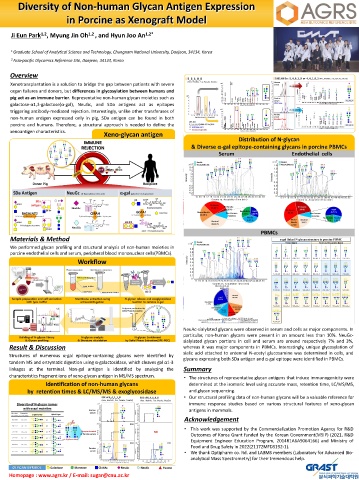
organ failures and donors, but differences in glycosylation between humans and
pig act as an immune barrier. Representative non-human glycan moieties such as
galactose-α1,3-galactose(α-gal), NeuGc, and SDa antigens act as epitopes
triggering antibody-mediated rejection. Interestingly, unlike other transferases of
non-human antigen expressed only in pig, SDa antigen can be found in both
porcine and humans. Therefore, a structural approach is needed to define the
xenoantigen characteristics.
Xeno-glycan antigen
Distribution of N-glycan
& Diverse α-gal epitope-containing glycans in porcine PBMCs
Materials & Method
We performed glycan profiling and structural analysis of non-human moieties in
porcine endothelial cells and serum, peripheral blood mononuclear cells(PBMCs).
Workflow
NeuAc-sialylated glycans were observed in serum and cells as major components. In
particular, non-human glycans were present in an amount less than 10%. NeuGc-
sialylated glycan portions in cell and serum are around respectively 7% and 3%,
Result & Discussion whereas it was major components in PBMCs. Interestingly, unique glycosylation of
sialic acid attached to antennal N-acetyl glucosamine was determined in cells, and
Structures of numerous α-gal epitope-containing glycans were identified by
glycans expressing both SDa antigen and α-gal epitope were identified in PBMCs.
tandem MS and enzymatic digestion using α-galactosidase, which cleaves gal α1-3
linkages at the terminal. Non-gal antigen is identified by analyzing the Summary
characteristics fragment ions of xeno-glycan antigen in MS/MS spectrum. • The structures of representative glycan antigens that induce immunogenicity were
Identification of non-human glycans determined at the isomeric level using accurate mass, retention time, LC/MS/MS,
by retention times & LC/MS/MS & exoglycosidase and glycan sequencing.
• Our structural profiling data of non-human glycans will be a valuable reference for
immune response studies based on various structural features of xeno-glycan
antigens in mammals.
Acknowledgement
• This work was supported by the Commercialization Promotion Agency for R&D
Outcomes of Korea Grant funded by the Korean Government(MSIP) (2021, R&D
Equipment Engineer Education Program, 2014R1A6A9064166) and Ministry of
Food and Drug Safety in 2022(21172MFDS192-1).
• We thank Optipharm co. ltd. and LABMS members (Laboratory for Advanced Bio-
analytical Mass Spectrometry) for their tremendous help.
GLYCAN SYMBOL
Homepage : www.agrs.kr / E-mail: sugar@cnu.ac.kr

