


Page 3 - ebook
P. 3
Hydrophobic Cell Penetrating Peptide-Combined
                   Nuclear Localization Signal Suppresses Pro-Inflammatory Cytokines
                                           In Inflammatory Bowel Disease
                    Seokwon Lee, Jaehyeon Kim, Hyunji Lee, Hyeontae Kang, Mingu Kang, Eunhee Yang, Eunna Chung and Daewoong Jo
                                     Cellivery R&D Institute, Cellivery Therapeutics, Inc., Seoul 03929, Korea.
                                                BACKGROUND
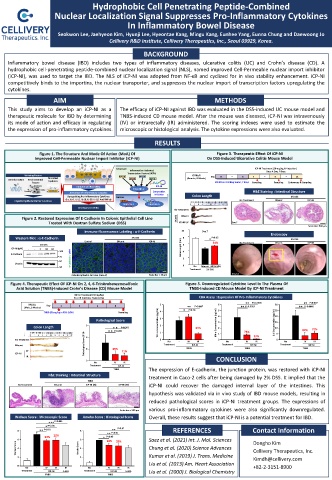
    Inflammatory bowel disease (IBD) includes two types of inflammatory diseases, ulcerative colitis (UC) and Crohn’s disease (CD). A
    hydrophobic cell-penetrating peptide-combined nuclear localization signal (NLS), named improved Cell-Permeable nuclear import inhibitor
    (iCP-NI), was used to target the IBD. The NLS of iCP-NI was adopted from NF-κB and cyclized for in vivo stability enhancement. iCP-NI
    competitively binds to the importins, the nuclear transporter, and suppresses the nuclear import of transcription factors upregulating the
    cytokines.
                  AIM                                                  METHODS
    This study aims to develop an iCP-NI as a  The efficacy of iCP-NI against IBD was evaluated in the DSS-induced UC mouse model and
    therapeutic molecule for IBD by determining  TNBS-induced CD mouse model. After the mouse was diseased, iCP-NI was intravenously
    its mode of action and efficacy in regulating  (IV) or intrarectally (IR) administered. The scoring indexes were used to estimate the
    the expression of pro-inflammatory cytokines.  microscopic or histological analysis. The cytokine expressions were also evaluated.
                                                   RESULTS

              Figure 1. The Structure And Mode Of Action (MoA) Of       Figure 3. Therapeutic Effect Of iCP-NI
            Improved Cell-Permeable Nuclear Import Inhibitor (iCP-NI)  On DSS-Induced Ulcerative Colitis Mouse Model
                                       Cytoplasm                                    iCP-NI Treatment (50 mg/kg, IV Injection)
                                           Inflammation Activated                       Once A Day, 7 Days
                                           Transcription Factors (IATFs)
         Initiating Factors             NF-κB  NFAT             C57BL/6  Day  0  …  6  7  …  9  …  13
                 Microbial                                    (Female, 8 Weeks)
    Genetic Factors  Environmental         STAT   AP-1
           Factors  Dysbiosis                                          3% DSS In Drinking Water, 7 Days  Sampling  Sampling  Endoscopy & Sampling
            Antibiotics                             iCP-NI
                          Immune Cell Recruiting
             Food Intake                    Importin α
         Smoking                                   Competitive                     H&E Staining : Intestinal Structure
                        Activation Of Inflammatory Cascades
                                                   Inhibition
                       Upregulating Pro-Inflammatory Cytokines  Nucleus  Colon Length           3% DSS
                      (i.e. IL-6, IL-12, IL-18, IL-23, IL-1β, And TNF-α)
      Impaired Epithelial Barrier Functions  IATFs                             No Treatment  Diluent  iCP-NI
                                         Importin α  Importin α
                          Development Of IBD
                                                          No Treatment
        Figure 2. Restored Expression Of E-Cadherin In Colonic Epithelial Cell Line  3% DSS  Diluent
                 Treated With Dextran Sulfate Sodium (DSS)  iCP-NI I.V      Day 7
                                                                                                     Scale Bar: 200 μm
                             Immuno-Fluorescence Labeling : α-E-Cadherin  10  Day 7
                                                                                         Endoscopy
      Western Blot : α-E-Cadherin           2% DSS           8       *  P<0.05                  3% DSS
                            Control    Diluent    iCP-NI              31%      No Treatment  Diluent  iCP-NI
              2% DSS                                         6
     iCP-NI (μM)  -  -  1  10  50                           Colon Length (Cm)
                    100                                      4
     E-Cadherin
                    75  E-Cadherin / DAPI                    2
                    50
      β-actin
                    38                                       0  No  Diluent iCP-NI (IV)
                                                               Treatment  3% DSS
                                                                            Day 13
                        Colonic Epithelial Cell Line (Caco-2)  Scale bar = 20 μm
    Figure 4. Therapeutic Effect Of iCP-NI On 2, 4, 6-Trinitrobenzenesulfonic  Figure 5. Downregulated Cytokine Level In The Plasma Of
      Acid Solution (TNBS)-Induced Crohn’s Disease (CD) Mouse Model  TNBS-Induced CD Mouse Model By iCP-NI Treatment
                         iCP-NI Treatment (50 mg/kg)
                         IV or IR Injection, Twice A Day          CBA Assay : Expression Of Pro-Inflammatory Cytokines
          BALB/c  Day  1   2     3    4              5                  6        **  P=0.0001  30   **  P=0.007
         (Male, 8 Weeks)                                     *  ** P=0.78 P=0.007  ** P=0.0017    ** P=0.0003
               TNBS (25 mg/kg in 40% EtOH)  Sampling  4                 5 4                25 20
                                Pathological Score   3                  3                  15
                             9                      TNF-α Concentration (pg/ml)  2  IFN-γ Concentration (pg/ml)  IL-6 Concentration (pg/ml)
            Colon Length              * *  P=0.001               64%    2                  10
                                    * * P=0.001      1                  1       78%        5       82%  72%
                            Pathological Score (0~9)
      No Treatment           6                       0  No  -  IV  IR   0  No  -  IV  97%  0  No  -  IV  IR
                                                                                    IR
      Diluent                                         Treatment  iCP-NI  Treatment  iCP-NI  Treatment  iCP-NI
          IV                 3        65%  71%                TNBS               TNBS               TNBS
      iCP-NI
          IR                                                           CONCLUSION
                             0
                                No  -  IV  IR
                              Treatment  iCP-NI
                                      TNBS       The expression of E-cadherin, the junction protein, was restored with iCP-NI
                 H&E Staining : Intestinal Structure
                                                 treatment in Caco-2 cells after being damaged by 2% DSS. It implied that the
                              TNBS
       No Treatment  Diluent  iCP-NI (IR)  iCP-NI (IV)  iCP-NI could recover the damaged internal layer of the intestines. This
                                                 hypothesis was validated via in vivo study of IBD mouse models, resulting in
                                                 reduced pathological scores in iCP-NI treatment groups. The expressions of
                                                 various pro-inflammatory cytokines were also significantly downregulated.
                                        Scale bar = 200 μm
      Wallace Score : Microscopic Score  Ameho Score : Histological Score  Overall, these results suggest that iCP-NI is a potential treatment for IBD.
                   P<0.001
                 ***
                *  P<0.05
               P<0.01                  P<0.01            REFERENCES                Contact Information
       8      **           8         **
                  22%               **  P<0.01
                23%                *  P<0.05
       6                   6        22%  25%     Saez et al. (2021) Int. J. Mol. Sciences  Dongho Kim
      Wallace Score  4     Ameho Score  4        Chung et al. (2020) Science Advances  Cellivery Therapeutics, Inc.
       2                   2                     Kumar et al. (2019) J. Trans. Medicine
                                                                                   Kimdh@cellivery.com
                                                 Liu et al. (2013) Am. Heart Association
       0                   0
         No  -  IV  IR  IR    No  -  IV  IR  IR                                    +82-2-3151-8900
        Treatment  iCP-NI  5-ASA  Treatment  iCP-NI  5-ASA  Liu et al. (2000) J. Biological Chemistry
                TNBS                TNBS

