


Page 21 - ebook
P. 21
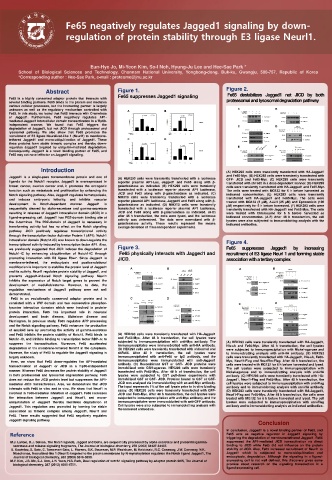
Fe65 negatively regulates Jagged1 signaling by down-
regulation of protein stability through E3 ligase Neurl1.
Eun-Hye Jo, Mi-Yeon Kim, So-I Noh, Hyung-Ju Lee and Hee-Sae Park *
School of Biological Sciences and Technology, Chonnam National University, Yongbong-dong, Buk-ku, Gwangju, 500-757, Republic of Korea
*Corresponding author : Hee-Sae Park, e-mail : proteome@jnu.ac.kr
Abstract Figure 1. Figure 2.
Fe65 suppresses Jagged1 signaling Fe65 destabilizes Jagged1 not JICD by both
Fe65 is a highly conserved adaptor protein that interacts with proteasomal and lysosomal degradation pathway
several binding partners. Fe65 binds to the protein and mediates
various cellular processes, but the interacting partner is largely
unknown as well as the regulatory mechanism controlled with
Fe65. In this study, we found that Fe65 interacts with C-terminus
of Jagged1. Furthermore, Fe65 negatively regulates AP1-
mediated Jagged1 intercellular domain transactivation in a Tip60-
independent manner. We found that Fe65 triggers the
degradation of Jagged1, but not JICD through proteasomal and
lysosomal pathway. We also show that Fe65 promotes the
recruitment of E3 ligase Neuralized-like 1 (Neurl1) to membrane-
tethered Jagged1 and mono-ubiquitination of Jagged1. These
three proteins form stable trimeric complex and thereby down-
regulates Jagged1 targeted by ubiquitin-mediated degradation.
Consequently, Jagged1 is a novel binding partner of Fe65, and
Fe65 may act novel effector on Jagged1 signaling.
Introduction (A) HEK293 cells were transiently transfected with HA-Jagged1
Jagged1 is a single-pass transmembrane protein and one of (A) HEK293 cells were transiently transfected with a luciferase and Fe65-Myc. (B) HEK293 cells were transiently transfected with
ligands for the Notch1 receptor. Jagged1 is overexpressed in reporter plasmid AP1-Luc, Jagged1 and Fe65 along with β- GFP- JICD and Fe65-Myc. (C) HEK293 cells were transiently
transfected with shFe65 in a dose-dependent manner. (D) HEK293
breast cancer, ovarian cancer and, it promotes the oncogenic galactosidase as indicated. (B) HEK293 cells were transiently cells were transiently transfected with HA-Jagged1 and Fe65-Myc.
function such as metastasis and proliferation by enhancing the transfected with a luciferase reporter plasmid AP1 luciferase, The cells were treated with MG132 for 6 h before harvested as
Notch signaling pathway. Also, Jagged1 regulates hematopoiesis, JICD and Fe65 along with β-galactosidase as indicated. (C) indicated concentration. (E) HEK293 cells were transiently
NIH3T3 cells were transiently transfected with a luciferase transfected with HA-Jagged1 and Fe65-Myc. The cells were
and induces embryonic lethality, and inhibits vascular reporter plasmid AP1 luciferase, Jagged1 and Fe65 along with β-
development in Notch-dependent manner. Jagged1 is galactosidase as indicated. (D) NIH3T3 cells were transiently treated with MG132 (5 μM), ALLN (25 μM) and Epoxomicin (100
μM) respectively for 6 h before harvested. (F) HEK293 cells were
sequentially cleaved by alpha-secretase and gamma-secretase transfected with a luciferase reporter plasmid AP1 luciferase, transiently transfected with HA-Jagged1 and Fe65-Myc. The cells
resulting in releases of Jagged1 intracellular domain (JICD) in a JICD and Fe65 along with β-galactosidase as indicated. (A-D) were treated with Chloroquine for 6 h before harvested as
after 48 h transfection, the cells were lysed, and the luciferase
ligand-expressing cell. Jagged1 has PDZ-domain binding site at indicated concentration. (A-F) After 48 h transfection, the cell
activity was determined. The data were normalized with β- lysates were also subjected to immunoblotting analysis with the
the C-terminus. The PDZ-domain of Jagged1 is necessary in galactosidase activity. These results represent the means
transforming activity but has no effect on the Notch signaling average deviation of three independent experiments. indicated antibodies.
pathway. JICD positively regulates transcriptional activity
through the transcription factor Activator Protein 1 (AP1). Notch1
intracellular domain (Notch1-IC) was known to down-regulate the Figure 4.
transcriptional activity induced by transcription factor AP1. Also,
we previously suggested that JICD induces the degradation of Figure 3. Fe65 suppresses Jagged1 by increasing
Notch1-IC by enhancing ubiquitination of Notch1-IC through Fe65 physically interacts with Jagged1 and recruitment of E3 ligase Neurl 1 and forming stable
promoting interaction with E3 ligase Fbw7. Since Jagged1 is JICD. association with a tertiary complex
membrane-tethered, the endocytosis and posttranslational
modification is important to stabilize the protein level of Jagged1
and its activity. Neurl1 regulates protein stability of Jagged1, and
prevents Jagged1-induced Notch signaling pathway. Neurl1
inhibits the expression of Notch target genes to prevent the
development of medulloblastoma. However, to date, the
regulation mechanisms of Jagged1 pathway were not well
demonstrated.
Fe65 is an evolutionally conserved adaptor protein and is
consisted with a WW domain and two consecutive phosphor-
tyrosine interaction domains which were involved in protein-
protein interaction. Fe65 has important role in neuronal
development and brain disease, Alzheimer disease and
Huntington. In previous study, Fe65 regulates APP processing
and the Notch signaling pathway. Fe65 enhances the production
of amyloid beta by promoting the activity of gamma-secretase
and Fe65 inhibits the protein stability of Notch1. Fe65 binds to (A) HEK293 cells were transiently transfected with HA-Jagged1
Notch1-IC, and inhibits binding to transcription factor RBP-Jκ to and Fe65-Myc. After 48 h transfection, the cell lysates were
subjected to immunoprecipitation with anti-Myc antibody. The (A) HEK293 cells were transiently transfected with HA-Jagged1,
suppress the transactivation. Moreover, Fe65 accelerated immunoprecipitates were immunoblotted with anti-HA antibody. His-ub and Fe65-Myc. After 48 h transfection, the cell lysates
degradation of the membrane-tethered Notch1 in the cytoplasm. (B) HEK293 cells were transiently transfected with shControl and were subjected to immunoprecipitation with Nickel-agarose and
However, the study of Fe65 to regulate the Jagged1 signaling is shFe65. After 48 h transfection, the cell lysates were to immunoblotting analysis with anti-HA antibody. (B) HEK293
largely unknown. immunoprecipitated with anti-Fe65 or IgG antibody, and the cells were transiently transfected with HA-Jagged1, His-ub, Fe65-
Here, we show that Fe65 down-regulates the AP1-mediated immunoprecipitates were immunoblotted with anti-Jagged1 Myc, Neurl1-Flag and NeurlRm-Flag. After 48 h transfection, the
antibody. (C) Recombinant GST or GST- JICD proteins were cells were treated with MG132 for 6 h before harvested and lysed.
transactivation of Jagged1 or JICD in a Tip60-independent
immobilized onto GSH-agarose. HEK293 cells were transiently The cell lysates were subjected to immunoprecipitation with
manner. Whereas Fe65 decreases the protein stability of Jagged1 transfected with Fe65-Myc. After 48 h of transfection, the cell Nickel-agarose and to immunoblotting analysis with anti-HA
in both proteasomal and lysosomal degradation pathway, Fe65 lysates were subjected to GST pull-down experiments with antibody. (C) HEK293 cells were transiently transfected with HA-
does not reduce the JICD protein level but suppresses the AP1- immobilized GST or GST- JICD. Proteins bound to GST or GST- Jagged1, Neurl1-Flag and Fe65-Myc. After 48 h transfection, the
mediated JICD transactivation. Also, we demonstrate that JICD JICD was analyzed via immunoblotting with an anti-Myc antibody. cell lysates were subjected to immunoprecipitation with anti-Flag
The input represents 1% of the cell lysate prior to in vitro binding antibody and to immunoblotting analysis with anti-HA antibody.
interacts with Fe65 in vitro and in vivo. We show that Neurl1 is
assay. (D) HEK293 cells were transiently transfected with GFP- (D) HEK293 cells were transiently transfected with HA-Jagged1,
involved in Fe65-mediated inhibition of Jagged1. Fe65 increases JICD and Fe65-Myc. After 48 h transfection, the cell lysates were Neurl1-Flag and Fe65-Myc. After 48 h transfection, the cells were
the interaction between Jagged1 and Neurl1, and mono- subjected to immunoprecipitation with anti-Myc antibody, and the treated with MG132 for 6 h before harvested and lysed. The cell
ubiquitination of Jagged1 thereby facilitates degradation of immunoprecipitates were immunoblotted with anti-GFP antibody. lysates were subjected to immunoprecipitation with anti-Flag
Jagged1. This regulation was promoted by forming the stable Cell lysates were also subjected to immunoblotting analysis with antibody and to immunoblotting analysis as indicated antibodies.
the indicated antibodies.
association as trimeric complex among Jagged1, Neurl1 and
Fe65. These results suggested that Fe65 negatively regulates
Jagged1 signaling pathway.
Conclusion
In conclusion, Jagged1 is a novel binding partner of Fe65, and
Reference Fe65 acts as negative regulator in Jagged1 signaling by
triggering the degradation of membrane-tethered Jagged1. Fe65
M.J. LaVoie, D.J. Selkoe, The Notch ligands, Jagged and Delta, are sequentially processed by alpha-secretase and presenilin/gamma- suppressed the AP1-mediated JICD transactivation via direct
secretase and release signaling fragments, The Journal of biological chemistry, 278 (2003) 34427-34437. binding to JICD while Fe65 did not influence on the protein
E. Koutelou, S. Sato, C. Tomomori-Sato, L. Florens, S.K. Swanson, M.P. Washburn, M. Kokkinaki, R.C. Conaway, J.W. Conaway, N.K. stability of JICD. Also, Fe65 increased recruitment of Neurl1 to
Moschonas, Neuralized-like 1 (Neurl1) targeted to the plasma membrane by N-myristoylation regulates the Notch ligand Jagged1, The Jagged1 which is subjected to mono-ubiquitination and
Journal of biological chemistry, 283 (2008) 3846-3853. endocytosis, degradation. Although the signaling in a ligand-
M.Y. Kim, J.S. Mo, E.J. Ann, J.H. Yoon, H.S. Park, Dual regulation of notch1 signaling pathway by adaptor protein fe65, The Journal of expressing cell is not well defined, this discovery gives some
biological chemistry, 287 (2012) 4690-4701. promise about research on the signaling transduction in a
ligand-expressing cell.

