


Page 17 - ebook
P. 17
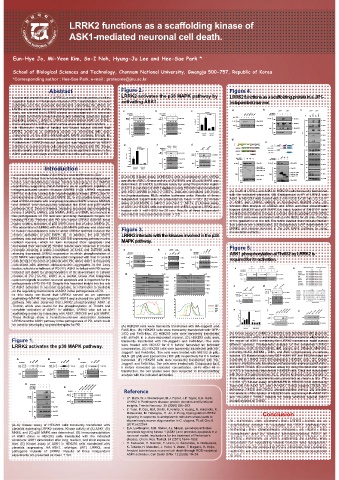
LRRK2 functions as a scaffolding kinase of
ASK1-mediated neuronal cell death.
Eun-Hye Jo, Mi-Yeon Kim, So-I Noh, Hyung-Ju Lee and Hee-Sae Park *
School of Biological Sciences and Technology, Chonnam National University, Gwangju 500-757, Republic of Korea
*Corresponding author : Hee-Sae Park, e-mail : proteome@jnu.ac.kr
Abstract Figure 2. Figure 4.
Leucine-rich repeat kinase 2 (LRRK2), a multi-domain protein, is a key LRRK2 activates the p38 MAPK pathway by LRRK2 functions as a scaffolding protein in a JIP1-
causative factor in Parkinson's disease (PD). Identification of novel activating ASK1. independent manner.
substrates and the molecular mechanisms underlying the effects of
LRRK2 are essential for understanding the pathogenesis of PD. In this a b c
study, we showed that LRRK2 played an important role in neuronal a HA-G2019S : - - + + b HA-G2019S : c 3.0 ATF2-Luc HA-MLK3 : + JIP1 +/+ - + + JIP1 -/- - + JIP1 +/+ JIP1 -/-
cell death by directly phosphorylating and activating apoptosis signal- shASK1 : - + - + p38 shASK1 : - - - + + - + + 2.5 P < 0.001 Myc-LRRK2 : + + + + + + Myc-LRRK2 : - + + - + + IP: IgG LRRK2 IgG LRRK2
regulating kinase 1 (ASK1). LRRK2 phosphorylated ASK1 at Thr832 MKK6 63 1 0.5 2.1 1.3 GST-p38 assay 75 1 0.6 1.6 0.5 GST-ATF2 2.0 1.5 IP: HA 245 Myc-LRRK2 IP: Myc 100 HA-MLK3 180 ASK1
assay
that is adjacent to Thr845, which serves as an autophosphorylation 245 HA-G2019S 245 HA-G2019S R.L.U (fold) 1.0 100 HA-MLK3
site. Moreover, results of binding and kinase assays showed that Input 180 ASK1 Input 180 ASK1 0.5 Input 245 (kD) Myc-LRRK2 Input 245 Myc-LRRK2 35 MKK3
LRRK2 acted as a scaffolding protein by interacting with each 48 48 G2019S : 0.0 - + - + 135 JIP1 35 p38
components of the ASK1–MKK3/6–p38 MAPK pathway through its 35 (kD) MKK6 35 (kD) p38 shCon shASK1 (kD) IP 100 MLK3
specific domains and increasing the proximity to downstream targets. d MKK7
Furthermore, LRRK2-induced apoptosis was suppressed by ASK1 LRR Roc COR kinase WD40 e 35
inhibition in neuronal stem cells derived from patients with PD. These d 3.0 ATF2-Luc e ASK1+/+ ASK1-/- f 1 LRRK2 ΔN 1313 Roc COR 1845 kinase 2143 WD40 2527 35 JNK1
1035
results clearly indicate that LRRK2 acts as an upstream kinase in the 2.5 P < 0.001 HA-G2019S : - + + + - + + + H 2 O 2 : - + - + LRRK2 G/K Roc COR kinase 180 ASK1
Flag-p38 :
ASK1 pathway and plays an important role in the pathogenesis of PD. 2.0 assay p38 75 GST-ATF2 ASK1 63 GST-MKK6 LRRK2 K kinase MKK3
R.L.U (fold) 1.5 1.0 1 6 . 9 0 0 assay 1 2.9 0.3 0.8 Myc-LRRK2 : + N G/K K Flag-JIP1 : + 35
0.5 245 HA-G2019S 245 LRRK2 Flag-JIP1 : + + + + Myc-LRRK2 : + + + + 35 p38
Input 180 ASK1 Input IP: Myc Flag-JIP1 IP: Flag Myc-LRRK2
0.0 180 ASK1 100 245 Input 100 MLK3
Introduction G2019S : - ASK1+/+ + - ASK1-/- + (kD) 48 Flag-p38 (kD) 245 Myc-LRRK2 100 Flag-JIP1 48 MKK7
Myc-LRRK2 ΔN
100 135 Myc-LRRK2 G/K 75 Flag-JIP1 ΔJBD 48
Leucine-rich repeat kinase 2 (LRRK2) is a serine/threonine (Ser/ Input 75 35 Myc-LRRK2 K Input 63 48 Flag-JIP1 JBD JNK1
Flag-JIP1 PID
Thr) protein kinase that is homologous to receptor-interacting protein (A and B) Kinase assay of HEK293 cells knockdowned with shRNA Flag-JIP1 Myc-LRRK2 48 β-actin
specific for ASK1. Kinase activity of (A) MKK6 and (B) p38 MAPK was
kinase and mixed-lineage kinase families belonging to the MAP3K determined. (C and D) Luciferase assay by using the promoter region 100 (kD) 245 (kD) (kD)
superfamily, suggesting that it functions as an upstream regulator of
mitogen-activated protein kinases (MAPK) [1,2]. LRRK2 regulates of ATF2 in condition of ASK1 depletion using HEK293 cells transfected (A) Co-IP of LRRK2 and ASK1 in HEK293 cells transiently transfected
with ASK1 shRNA or Ask1−/− MEFs. Data are normalized with those
MAPKs, including extracellular signal-regulated kinase (ERK), Jun N- with the indicated plasmids. (B) Endogenous co-IP of LRRK2 and
terminal kinase (JNK), and p38 MAPK [3]. In vitro studies have shown for β-galactosidase; RLU, relative luciferase units. Results of three ASK1 in HEK293 cells treated with 2 mM H2O2 for 20 min. (C) Co-IP
independent experiments are presented as mean ± SD. (E) Kinase
that LRRK2 interacts with and phosphorylates MAPK kinases MKK3/6 of ASK1 and LRRK2 variants in transfected HEK293 cells. (D)
and MKK4/7 and consequently activates the ERK and p38 MAPK assay of p38 MAPK in Ask1+/+ and Ask1−/− MEFs. (F) Kinase assay Western blot analysis of LRRK2 and ASK1 and their downstream
of ASK1 in HEK293 cells transfected with shRNA against LRRK2 and
pathways [4,5]. Several kinases, including apoptosis signal-regulating treated with 2 mM H2O2 for 20 min. Results of three independent kinases (MKK3/6 and p38 MAPK) by using lysates of SH-SY5Y cells
kinase 1 (ASK1), LRRK2, p38 MAPK, JNK3, and ERK, are involved in separated by floatation through a sucrose density gradient (10%–50%).
the pathogenesis of PD and are promising therapeutic targets for experiments are presented as mean ± SD. SH-SY5Y cells were pretreated with 2 mM H2O2 for 20 min. The top
treating PD [6]. Patients with PD who harbor LRRK2 G2019S show of the gradient is on the left. The white dashed lines indicate fraction
higher relative activation of p38 MAPK than that of other MAPKs [7]. that proteins are codistributed. (E) Endogenous co-IP experiments of
The association of LRRK2 with the p38 MAPK pathway was observed Figure 3. LRRK2 and kinases involved in the p38 MAPK pathway by using
in human neuroblastoma cells in which LRRK2 G2019S induced the mouse brain extracts.
chronic activation of p38 MAPK [8]. In addition, the p38 MAPK LRRK2 interacts with the kinases involved in the p38
pathway was activated in LRRK2 G2019S-expressing primary murine
cortical neurons, which in turn increased their apoptosis and MAPK pathway.
decreased their survival [8]. Similar results were observed in murine Figure 5.
microglia showing a stable knockdown of Lrrk2 and DAT165 cells a b control H 2 O 2 c
showing decreased LRRK2 expression in which phosphorylation of Flag-LRRK2 : - - + - + - + + IP: HA-LRRK2 : - + + + + ASK1 phosphorylation at Thr832 by LRRK2 is
HA-ASK1 :
Myc-ASK1 :
p38 MAPK was specifically attenuated compared with that in control IP: HA 245 Flag-LRRK2 IP 180 ASK1 IP: HA 180 Myc-ASK1
cells [9,10]. In the brain of patients with PD, active ASK1 is frequently 180 HA-ASK1 0 1 0 2 . 4 0 1 1 5 . 0 . 4 Myc-ASK1 required for its activation.
colocalized with aberrant alpha-synuclein aggregates in the Lewy Input 245 Flag-LRRK2 Input 245 LRRK2 Input 180
bodies, which is a hallmark of PD [11]. ASK1 is linked with PD toxins- (kD) 180 (kD) ASK1 245 (kD) HA-LRRK2
induced cell death by phosphorylation of its downstream in cellular
models of PD [12–15]. ASK1 is a central kinase that integrates d 245 Low MW Mock High MW LRRK2 245 Low MW H 2 O 2 High MW LRRK2
upstream signals to control neuronal apoptosis and is important for the 180 ASK1 180 ASK1
pathogenesis of PD [16–18]. Despite this important insight into the role 48 48
of ASK1 activation in neuronal apoptosis, no information is available 35 48 MKK3 35 48 MKK3
MKK6
on the regulating mechanisms of ASK1 in the pathogenesis of PD. 35 MKK6 35 48
In this study, we found that LRRK2 served as an upstream (kD) 48 35 1 2 3 4 5 6 7 8 9 1 0 1 1 1 2 1 3 1 4 p38 (kD) 35 1 2 3 4 5 6 7 8 9 1 0 1 1 1 2 1 3 1 4 p38
scaffolding–MAP4K that targeted ASK1 and activated the p38 MAPK 80 60
pathway. We also observed that LRRK2 phosphorylated ASK1 at 60 50
Thr832, which was crucial for the phosphorylation of Thr845 and 40 40 30 LRRK2
ASK1
complete activation of ASK1. In addition, LRRK2 also act as a 20 20 MKK3
MKK6
scaffolding protein by interacting with ASK1, MKK3/6 and p38 MAPK. 0 10 p38
These findings show a heretofore-unknown association between 0
LRRK2 and the ASK1 pathway in the pathogenesis of PD, which could 1 2 3 4 5 6 7 8 9 1 0 1 1 1 2 1 3 1 4 1 2 3 4 5 6 7 8 9 1 0 1 1 1 2 1 3 1 4
be used for developing targeted therapies for PD. (A) HEK293 cells were transiently transfected with HA-Jagged1 and
Fe65-Myc. (B) HEK293 cells were transiently transfected with GFP-
JICD and Fe65-Myc. (C) HEK293 cells were transiently transfected (A) Kinase assay of LRRK2 in HEK293 cells transfected with plasmids
with shFe65 in a dose-dependent manner. (D) HEK293 cells were expressing GST–ASK1 substrates. (B) Multiple sequence alignment of
Figure 1. transiently transfected with HA-Jagged1 and Fe65-Myc. The cells the region of ASK1 containing the LRRK2 consensus motif across
LRRK2 activates the p38 MAPK pathway. were treated with MG132 for 6 h before harvested as indicated different species. Phylogenetic analysis of the conserved LRRK2
concentration. (E) HEK293 cells were transiently transfected with HA- consensus motif [F/Y]xTx[K/R] (left panel) and different MAP3Ks,
Jagged1 and Fe65-Myc. The cells were treated with MG132 (5 μM), including MLK3, MEKK1, TAK1, and RAF1 (right panel), in various
ALLN (25 μM) and Epoxomicin (100 μM) respectively for 6 h before species. (C) Kinase assay using GST–ASK1 WT and T832A mutant as
A B C harvested. (F) HEK293 cells were transiently transfected with HA- substrate in LRRK2 G2019S-expressing HEK293 cells. (D) Kinase
HA-LRRK2 : - HA-LRRK2 : - HA-LRRK2 : - Jagged1 and Fe65-Myc. The cells were treated with Chloroquine for 6 assay in HEK293 cells transfected with plasmids expressing WT ASK1
63
ASK1 GST-MKK6 MKK6 63 GST-p38 p38 75 GST-ATF2 and ASK1 T832A. (E) Luciferase assay by using the promoter region
assay 48 assay assay h before harvested as indicated concentration. (A-F) After 48 h
1 2.7 9.1 2.8 1 4.5 18.8 5.1 1 2.3 4.0 0.5
48 48 transfection, the cell lysates were also subjected to immunoblotting of ATF2 in transiently transfected HEK293 cells. Data are normalized
180 ASK1 MKK6 p38
Input Input 35 Input 35 analysis with the indicated antibodies. with those of β-galactosidase; RLU, relative luciferase units. Results of
245 HA-LRRK2 245 HA-LRRK2 245 HA-LRRK2
(kD) (kD) (kD) three independent experiments are presented as mean ± SD. ***p
< 0.001. (F) Kinase assay of p38 MAPK in HEK293 cells expressing
D Flag-ASK1 : + - + + + Flag–p38, HA–ASK1 WT, and HA–ASK1 Thr832 mutants (T832A, Thr
Myc-ASK1 : - + + + +
HA-G2019S : - - - + - E
HA-K1906M : - - - - + deficiency; T832E and T832D, phosphorylation mimic). (G) Western
HA-ASK1 : + + + + + + Reference
180 long blot analysis of the lysates of HEK293 cells expressing HA–ASK1 WT
ASK1 63
assay GST-MKK6
IP: Myc Medium 48 and HA–ASK1 Thr832 mutants by using antibody against ASK1
IB: Flag 180 1 1.2 2 1.8 0.1 2.3 • I.F. Mata, W.J. Wedemeyer, M.J. Farrer, J.P. Taylor, K.A. Gallo,
180 short Input 245 Myc-LRRK2 LRRK2 in Parkinson's disease: protein domains and functional phosphorylated at Thr845.
(kD)
insights, Trends Neurosci. 29 (2006) 286–293.
180 Flag-ASK1
• Y. Yuan, P. Cao, M.A. Smith, K. Kramp, Y. Huang, N. Hisamoto, K.
Input 180 Myc-ASK1
Matsumoto, M. Hatzoglou, H. Jin, Z. Feng, Dysregulated LRRK2 Conclusion
HA-LRRK2
245 signaling in response to endoplasmic reticulum stress leads to
(kD)
dopaminergic neuron degeneration in C. elegans, PLoS One 6 In summary, we showed that LRRK2 acted as a
(A–C) Kinase assay of HEK293 cells transiently transfected with (2011) e22354. scaffolding protein to regulate the ASK1 pathway by
plasmids expressing LRRK2 variants. Kinase activity of (A) ASK1, (B) • E.A. Liedhegner, K.M. Steller, J.J. Mieyal, Levodopa activates tethering the downstream kinases of ASK1 into
MKK6, and (C) p38 MAPK was determined. (D) Immunoprecipitation apoptosis signaling kinase 1 (ASK1) and promotes apoptosis in a complexes and by directly phosphorylating ASK1 at
of ASK1 dimer in HEK293 cells transfected with the indicated neuronal model: implications for the treatment of Parkinson's
constructs. ASK1 dimerization after long, medium, and short exposure disease, Chem. Res. Toxicol. 24 (2011) 1644–1652. Thr832. Activation of ASK1 signaling by LRRK2 was
time. (E) Kinase assay of ASK1 in HEK293 cells transfected with • H. Kadowaki, H. Nishitoh, F. Urano, C. Sadamitsu, A. Matsuzawa, important for regulating neural toxicity and apoptosis.
plasmids expressing HA–ASK1, wild-type (WT) LRRK2, and K. Takeda, H. Masutani, J. Yodoi, Y. Urano, T. Nagano, H. Ichijo, Furthermore, by analyzing iPSCs obtained from patients
pathogenic mutants of LRRK2. Results of three independent Amyloid beta induces neuronal cell death through ROS-mediated with PD, we found that LRRK2 induced neural apoptosis
experiments are presented as mean ± SD. ASK1 activation, Cell Death Differ. 12 (2005) 19–24. in vivo.

