


Page 91 - ebook
P. 91
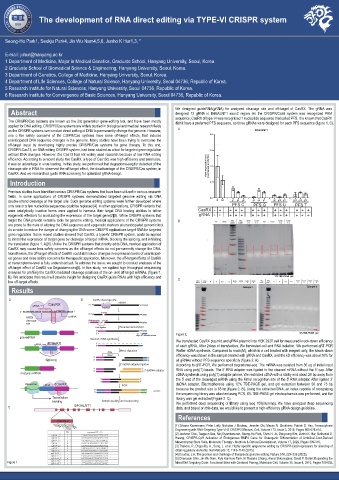
The development of RNA direct editing via TYPE-VI CRISPR system


   Seong-Ho Park1, Seokju Park4, Jin Wu Nam4,5,6, Junho K Hur1,3, *


   E-mail: juhur@hanyang.ac.kr
   1 Department of Medicine, Major in Medical Genetics, Graduate School, Hanyang University, Seoul, Korea.
   2 Graduate School of Biomedical Science & Engineering, Hanyang University, Seoul, Korea.
   3 Department of Genetics, College of Medicine, Hanyang University, Seoul, Korea.
   4 Department of Life Sciences, College of Natural Science, Hanyang University, Seoul 04736, Republic of Korea.
   5 Research Institute for Natural Sciences, Hanyang University, Seoul 04736, Republic of Korea.
   6 Research Institute for Convergence of Basic Sciences, Hanyang University, Seoul 04736, Republic of Korea.


     Abstract                                                  We designed guideRNA(gRNA) for analyzed cleavage site and off-target of CasRX.  The gRNA was
                                                               designed  12  gRNA  in  B4GALNT1  exon2  region. As  the  CRISPR/Cas9  system  was  recognized  PAM
                                                               sequence, CasRX of type-VI was recognized 1 nucleotide sequence that called PFS. It is known that CasRX
    The CRISPR/Cas systems are known as the 3rd generation gene-editing tool, and have been mostly   didn’t have a preferred PFS sequence, so three gRNAs were designed for each PFS sequence (figure 1. C).
    applied for DNA editing. CRISPR/Cas systems are widely studied in biological and medical research fields
    as the CRISPR systems can conduct direct editing of DNA to permanently change the genome. However,   A  B4GALNT1
    one o the safety concerns of the CISPR/Cas systems have been off-target effects, that induces   2.0
    unanticipated DNA sequence changes in the genome. Many studies have been trying to overcome the
    off-target  issue  by  developing  highly  precise  CRISPR/Cas  systems  for  gene  therapy.  To  this  end,
    CRISPR-Cas13, an RNA editing CRISPR system, had been studied as a tool for targeted gene regulation   1.5
    without DNA changes. However, the Cas13 had not widely used research because of low RNA editing
    efficiency. According to a recent study, the CasRX, a type of Cas13d, was high efficiency and small size,
    it was an advantage in virus loading. In this study, we performed that degradome-seq for detected of the    Gene expression level  (normalized to GAPDH)  1.0
    cleavage site in RNA for observed the off-target effect, the disadvantage of the CRISPR/Cas system, in
    CasRX. And we researched guide RNA screening for optimized gRNA design.
     Introduction                                                          0.5
    Previous studies have identified various CRISPR/Cas systems that have been utilized in various research
    fields. In some applications of CRISPR systems demonstrated targeted genome editing via DNA   0.0
    double-strand cleavage at the target site. Such genome editing systems were further developed where   M  NC  g1  g2  g3  g5  g6  g7  g9  g10 g11  g13 g14 g15
    only one or a few nucleotide sequences could be replaced [4]. In other applications, CRISPR variants that   PFS C  PFS G  PFS U  PFS T
    were  catalytically  inactive  forms  were  applied  to  harness  their  target  DNA  binding  abilities  to  tether   CasRX - +  + + +  + + +  + + +  + + +
    epigenetic effectors for modulating the expression of the target gene[2][3]. While CRISPR systems that   gRNA - -  + + +  + + +  + + +  + + +
    target the DNA provide versatile tools for genome editing, medical applications of the CRISPR systems   B
    are prone to the risks of altering the DNA sequence and epigenetic markers at unanticipated genomic loci.
    As a route to reduce the danger of changing the DNA some CRISPR applications target RNA for targeted
    gene regulation. Some recent studies showed that CasRX, a type-IV CRISPR system, could be applied
    to inhibit the expression of target gene by cleavage of target mRNA, blocking the splicing, and inhibiting
    the translation (figure 1. A)[1]. Unlike the CRISPR systems that directly edits DNA, medical application of
    CasRX may cause less safety concerns as the off-target effects do not permanently change the DNA.
    Nonetheless, the off-target effects of CasRX could still induce changes in expression levels of unanticipat-
    ed genes and raise safety concerns for therapeutic application. Moreover, the off-target effects of CasRX
    at transcriptome-level is fully understood yet. To address the issue, we sought to conduct analyses of the
    off-target effect of CasRX via Degradome-seq[5]. In this study, we applied high throughput sequencing
    analyses for profiling the CasRX mediated cleavage positions of the on- and off-target mRNAs. (figure 1.
    B). We anticipate that result will provide insight for designing CasRX guide RNAs with high efficiency and   C
    low off-target effects.
     Results
    A                        B    CasRx cleavage site  mRNA
                  CasRX
            gRNA                5’ Cap  CasRX     AAAA(A)n
        5’                 3’        5’ PO4
                                5’ Cap            AAAA(A)n
          HPEN           ssRNA
          cleavage              RNA adaptor  5’ PO4
          site                  5’  3’ OH         AAAA(A)n
                                   RNA ligation  Reverse transcription
                                   5’             AAAA(A)n
                                   3’            TTTT          Figure 2.
        pre-mRNA                 Second cDNA synthesis  oligo dT adaptor primer  We transfected CasRX plasmid and gRNA plasmid into HEK 293T cell for measured knock-down efficiency
             gRNA  dCasRX          5’
                                   3’                          of each gRNA. After 2days of transfection, We harvested cell and RNA isolation. We performed qRT-PCR
                                           MmeI digestion      Wafter cDNA synthesis. Compared to mock(M), which is a cell treated with reagent only, the knock-down
                                       20bp
                                       MmeI                    efficiency was shown in the sample treated with gRNA and CasRX, and the kD efficiency was about 70% for
                                  5’                 3’
                 Splicing         3’                 5’        all gRNAs without PFS sequence specificity (figure 2. A).
                                           3’ dsDNA adaptor ligation  According to qRT-PCR, We performed degradome-seq. The mRNA was isolated from 30 ug of initial input
                                  5’               3’          RNA using poly(T) beads. The 5' RNA adapter was ligated to the cleaved mRNA without the 5' cap. After
        mature mRNA               3’               5’ 3’ dsDNA adaptor  cDNA synthesis using poly(T) adaptor primer, We restricted cDNA with a sticky end about 20 bp away from
                                    5’            3’           the 5' end of the cleavaged mRNA using the MmeI recognition site of the 5' RNA adapter. After ligated 3’
                                    3’            5’
          Ribosome  gRNA  dCasRX            PCR                dsDNA  adaptor,  Electrophoresis  using  12% TBE-PAGE  gel,  and  gel  extraction  between  50  and  75  bp
                                  5’                3’  index  because the product size is 63 bp (figure 2. B). Using the extracted DNA, an index capable of recognizing
                                  3’                5’         the sequencing library was attached using PCR, 6% TBE-PAGE gel electrophoresis was performed, and the
                   Translation                                 library was gel extracted(Figure 2. C).
                   bloking           Sample pooling and sequencing  We performed deep sequencing of library using iseq 100(illumina). We have analyzed deep sequencing
    C                      B4GALNT1                            data, and based on this data, we would like to present a high-efficiency gRNA design guideline.
                                                                References
                     EXON 2
                     g1  g3  g2
                     g5  g7  g6                                [1] Silvana Konermann, Peter Lotfy, Nicholas J. Brideau, Jennifer Oki, Maxim N. Shokhirev, Patrick D. Hsu, Transcriptome
                      g9  g10  g11
                        g14  g13
                         g15                                   Engineering with RNA-Targeting Type VI-D CRISPR Effectors, Cell, Volume 173, Issue 3, 2018, Pages 665-676.e14,
                                                               [2] Jaehoon Choi, Taegeun Bae, Ninj Byambasuren, Seong-Ho Park, Chris H. Jo, Dokyoung Kim, Junho K. Hur, Nathaniel S.
                                                               Hwang, CRISPR-Cpf1  Activation  of Endogenous BMP4  Gene for  Osteogenic Differentiation  of  Umbilical-Cord-Derived
                                                               Mesenchymal Stem Cells, Molecular Therapy - Methods & Clinical Development, Volume 17, 2020, Pages 309-316,
                                                               [3] Thakore, P., D'Ippolito, A., Song, L. et al. Highly specific epigenome editing by CRISPR-Cas9 repressors for silencing of
                                                               distal regulatory elements. Nat Methods 12, 1143–1149 (2015).
                                                               [4] Doudna, J.A. The promise and challenge of therapeutic genome editing. Nature 578, 229–236 (2020).
                                                               [5] Chanseok Shin, Jin-Wu Nam, Kyle Kai-How Farh, H. Rosaria Chiang, Alena Shkumatava, David P. Bartel, Expanding the
    Figure 1.                                                  MicroRNA Targeting Code: Functional Sites with Centered Pairing, Molecular Cell, Volume 38, Issue 6, 2010, Pages 789-802,

