


Page 49 - ebook
P. 49
Circulating Proteasome Activity in Plasma
             as a Novel Biomarker in Mild Cognitive Impairment
                                   with Chronic Tinnitus


                               1,2
                       Yejin Yun , Sumin Kim 1,2 , Dawon Jeong 1,2 , and Min Jae Lee 1,2 ,*
          1 Department of Biochemistry and Molecular Biology, Seoul National University College of Medicine, Korea,
                2 Department of Biomedical Sciences, Seoul National University College of Medicine, Korea


   Abstract
   The proteasome is the major proteolytic enzyme complex involved in the maintenance of protein quality
   control in the cell. Although the existence of proteasomes in human blood, termed circulating proteasomes
   (c-proteasomes), has been reported previously, their origin and pathophysiological functions remain largely
   unknown. Over the course of biochemically characterizing c-proteasomes, we observed that the catalytic
   activity of c-proteasomes was significantly reduced in multiple lines of Alzheimer’s disease model mice. Given
   that a relatively high frequency of mild cognitive impairment (MCI) is accompanied by chronic tinnitus in
   aged patients, we examined whether c-proteasome activity in human plasma was associated with cognitive
   function in patients with chronic tinnitus (N = 55). The activity of c-proteasome was significantly lower in
   patients with chronic tinnitus and MCI (p = 0.042), whereas activities of other plasma enzymes showed little
   correlation with c-proteasome activity. In addition, c-proteasome activity was negatively associated with the
   level of plasma beta-amyloids and was directly dependent on its own concentration in the plasma of patients
   with chronic tinnitus.
     Result 1                                                Result 2
    a                           b                           a
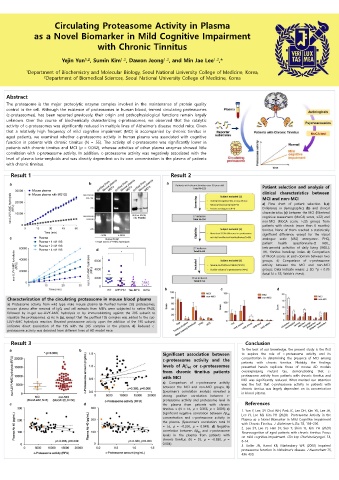
                                                                                             Patient selection and analysis of
                                                                                             clinical characteristics between
                                                                                             MCI and non-MCI
                                                                                             a) Flow chart of patient selection. b,c)
                                                                                             Difference in demographics (b) and clinical
                                                                                             characteristics (c) between the MCI (Montreal
                                                                                             cognitive assessment (MoCA) score, ≤22) and
                                                                                             non-MCI (MoCA score, >23) groups from
                                                                                             patients with chronic (more than 6 months)
                                                                                             tinnitus. None of them reached a statistically
                                                                                             significant difference, except for the visual
    c                                                                                        analogue  scale  (VAS)  annoyance.  PHQ,
                                                                                             patient  health  questionnaire-9;  IADL,
                                                                                             instrumental activities of daily living (IADL);
                                   d
                                                                                             THI, tinnitus handicap index. d) Comparison
                                                                                             of MoCA scores at each domain between two
                                                                                             groups.  d)  Comparison  of  c-proteasome
                                                                                             activity between the MCI  and  non-MCI
                                                                                             groups. Data indicate means ± SD. *p < 0.05
                                                                                             (total N = 55, Welch’s t-test).
                                                           b                  c                   d
    Characterization of the circulating proteasome in mouse blood plasma
    a) Proteasome activity from wild type male mouse plasma b) Purified human 26S proteasomes,
    mouse plasma after removal of IgG, and cell extracts from MEFs were subjected to native PAGE,
    followed by in-gel suc-LLVY-AMC hydrolysis or by immunoblotting against the 20S subunit to
    visualize the proteasomes. c) As in (a), except that the purified 19S complex was added to the suc-
    LLVY-AMC hydrolysis reaction. Elevated proteasome activity upon the addition of the 19S subunit
    indicates direct association of the 19S with the 20S complex in the plasma. d) Reduced c-
    proteasome activity was detected from different lines of AD model mice.

     Result 3                                                                          Conclusion
    a                        b                                                        To the best of our knowledge, the present study is the first
                                                          Significant association between  to explore the role of c-proteasome activity and its
                                                                                      concentration in determining the presence of MCI among
                                                          c-proteasome activity and the
                                                                                      patients  with  chronic  tinnitus.  Notably,  the  findings
                                                          levels of Ab 40 or c-proteasomes  presented herein replicate those of mouse AD models
                                                          from chronic tinnitus patients  overexpressing  mutant  tau,  demonstrating  that  c-
                                                          with MCI                    proteasome activity from patients with chronic tinnitus and
                                                                                      MCI was significantly reduced. What merited our attention
                                                          a)  Comparison  of  c-proteasome  activity  was the fact that c-proteasome activity in patients with
                                                          between the MCI and non-MCI groups. b)  chronic tinnitus was largely dependent on its concentration
                                                          Spearman’s correlation analysis revealed a  in blood plasma.
                                                          strong  positive  correlation  between  c-
                                                          proteasome activity and proteasome level in
    c                         d                           the  plasma  from  patients  with  chronic  References
                                                          tinnitus. s (N = 55, ρ = 0.366, p = 0.006) c)
                                                                                      1. Yun Y, Lee, SY Choi WH, Park JC, Lee DH, Kim YK, Lee JH,
                                                          Significant negative correlation between Ab 40  Lee JY, Lee MJ, Kim YH (2020)  Proteasome Activity in the
                                                          concentration and c-proteasome activity in  Plasma as a Novel Biomarker in Mild Cognitive Impairment
                                                          the plasma. (Spearman’s correlation: total N  with Chronic Tinnitus. J. Alzheimer’s Dis 78, 195–205.
                                                                                                          .
                                                          = 55, ρ = –0.266, p = 0.049). d) Negative  2. Lee SY, Lee JY, Han SY, Seo Y, Shim YJ, Kim YH (2020)
                                                          correlation between Ab 40 and c-proteasome  Neurocognition of aged patients with chronic tinnitus: Focus
                                                          levels in the plasma from patients with  on mild cognitive impairment. Clin Exp Otorhinolaryngol. 13,
                                                          chronic tinnitus. (N = 55, ρ = –0.380, p =  8-14.
                                                          0.004)
                                                                                      3. Keller JN, Hanni KB, Markesbery WR (2000) Impaired
                                                                                      proteasome function in Alzheimer’s disease. J Neurochem 75,
                                                                                      436-439.

