


Page 11 - ebook
P. 11
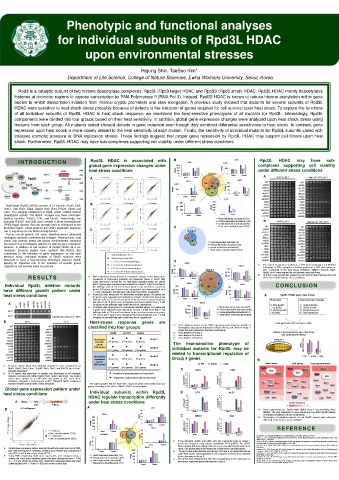
Phenotypic and functional analyses
for individual subunits of Rpd3L HDAC
upon environmental stresses
Hajung Shin, TaeSoo Kim*
Department of Life Science, College of Nature Sciences, Ewha Womans University, Seoul, Korea
Rpd3 is a catalytic subunit of two histone deacetylase complexes, Rpd3L (Rpd3 large) HDAC and Rpd3S (Rpd3 small) HDAC. Rpd3L HDAC mainly deacetylates
histones at promoter regions to repress transcription by RNA Polymerase II (RNA Pol II). Instead, Rpd3S HDAC is known to reduce histone acetylation within gene
bodies to inhibit transcription initiation from internal cryptic promoters and slow elongation. A previous study showed that mutants for several subunits of Rpd3L
HDAC were sensitive to heat shock stress probably because of defects in the induction of genes required for cell survival upon heat shock. To explore the functions
of all individual subunits of Rpd3L HDAC in heat shock response, we monitored the heat-sensitive phenotypes of all mutants for Rpd3L. Interestingly, Rpd3L
components were divided into four groups based on their heat sensitivity. In addition, global gene expression changes were analyzed upon heat shock stress using
mutants from each group. All mutants tested showed defects in gene induction even though they exhibited differential sensitivities to heat shock. In contrast, gene
repression upon heat shock is more closely related to the heat-sensitivity of each mutant. Finally, the sensitivity of individual mutants for Rpd3L subunits varied with
stresses (osmotic pressure or DNA replication stress). These findings suggest that proper gene repression by Rpd3L HDAC may support cell fitness upon heat
shock. Furthermore, Rpd3L HDAC may have sub-complexes supporting cell viability under different stress conditions.
INTRODUCTION Rpd3L HDAC is associated with B RIP1 1,000 IDH2 Rpd3L HDAC may have sub-
global gene expression changes under 200 complexes supporting cell viability
(aa) heat stress conditions FPKM 150 FPKM 500 under different stress conditions
100
HDAC
Ash1 Rpd3 433 50 Group 2 0 0min 7.5min
Ume6 Cti6 Rpd3L DNA binding domain A 0 0min 7.5min A 1XYPD_30 ℃ 1.0M NaCl YPD_30 ℃
CTT1 HBN1
Dep1 Ume6 836 88 72 150 WT WT
Sap30 1,000 46 rpd3Δ rpd3Δ
Sin3 PHD 42 100
Sds3 Rtx2 39 8 FPKM ume1Δ ume1Δ
Rtx3 Cti6 506 FPKM 500 50 sin3Δ sin3Δ
Pho23 87 0 dep1Δ dep1Δ
Ume1 Rpd3 PHD 0 0min 7.5min 0min 7.5min sds3Δ sds3Δ
Pho23 sap30Δ sap30Δ
330 HXT2 ALD3
800 cti6Δ cti6Δ
B 1,500 600 rxt2Δ rxt2Δ
Rpd3 large (Rpd3L) HDAC consists of 12 subunits: Rpd3, Sin3, 1,000 FPKM rxt3Δ
rxt3Δ
Ume1, Cti6, Dep1, Sds3, Sap30, Rxt2, Rxt3, Pho23, Ume6, and FPKM 500 400 pho23Δ pho23Δ
200
Ash1. The catalytic component is Rpd3, which exhibits histone 0 ash1Δ
0 0min 7.5min ash1Δ
deacetylase activity. The Rpd3L complex has three chromatin- 0min 7.5min ume6Δ ume6Δ
binding modules: Pho23, Cti6, and Ume6. Interestingly, two Rpd3 dependent activation (241)
subunits (Pho23 and Cti6) each contain a plant homeodomain Pho23 dependent activation (168) B 1XYPD_30 ℃ 300mM HU YPD_30 ℃
Ume6 dependent activation(176)
(PHD) finger domain that can strongly bind to H3K4me3 at the Heat-stress inducible gene (791) WT
WT
promoter region. Ume6 binds to the URS1 (upstream repressor C C rpd3Δ rpd3Δ
site 1) sequence via the DNA-binding domain. Group 3 ume1Δ ume1Δ
During natural growth, the yeast Saccharomyces cerevisiae sin3Δ sin3Δ
undergoes dynamic environmental changes. Among these, heat 2 4 11 dep1Δ dep1Δ
shock and osmotic stress are typical environmental variations 3 Rpd3 dependent activation (6) sds3Δ sds3Δ
that yeast must immediately adapt to by altering gene expression 4 Pho23 dependent activation (18) sap30Δ sap30Δ
cti6Δ
patterns. In addition to the function of Rpd3L HDAC as a co- Ume6 dependent activation(7) rxt2Δ cti6Δ
repressor, previous studies have reported that Rpd3L also Heat-stress repressed gene (823) rxt3Δ rxt2Δ
rxt3Δ
contributes to the induction of gene expression. In one such pho23Δ pho23Δ
previous study, individual mutants of Rpd3L subunits were ash1Δ ash1Δ
observed to have a heat-sensitive phenotype because Rpd3L D ume6Δ ume6Δ
playing an important role in the induction of specific genes NMD5
required for cell survival under heat shock. 60 RPC25 A. The mutant strains were spotted on a YPD plate containing a 1.0 M NaCl
and grown at 30℃, alongside a control spotted on a YPD plate grown at
60
FPKM 20 FPKM 40 30℃. Compared to the heat stress conditions, different subunits within
40
Group 4
Rpd3L HDAC were required for cell survival under salt stress.
RESULTS A. RNA sequencing was performed to investigate changes in the global gene 0 0min 7.5min 235 20 0 B. Only the Ume6 subunit was required for cell survival under hydroxyurea (HU)
stress that is DNA damage stress conditions.
expression of heat-stress inducible and repressed genes in rpd3Δ cells
under heat shock. Among the 791 heat-stress inducible genes, 241 genes 34 0min 7.5min
Individual Rpd3L deletion mutants and 14 genes were repressed and induced by at least 1.5-fold more than in 300 SUN4 22 185 20 150 CDS1 CONCLUSION
the wild-type cells at 7.5 min of heat shock. In the heat-stress repressed
have different growth pattern under genes, 476 genes and 6 genes were upregulated and downregulated over FPKM 200 8 FPKM 100
1.5-fold compared to the wild-type cells under heat shock, respectively.
heat stress conditions B. In pho23Δ cells, among the 791 heat-stress inducible genes, 168 genes and 100 0 76 50 0 A Rpd3L HDAC upon heat shock
27 genes were repressed and induced by at least 1.5-fold more than in the
wild-type cells at 7.5 min of heat shock. In the heat-stress repressed genes, 0min 7.5min 0min 7.5min Phenotypes Gene expression changes
A rpd3Δ sin3Δ ume1Δ sap30Δ pho23Δ 448 genes and 18 genes were upregulated and downregulated over 1.5-fold ERG11 1) Slow growth 1) Rapid induction
compared to the wild-type cells under heat shock, respectively.
WT sds3Δ dep1Δ rco1Δ C. In ume6Δ cells, among the 791 heat-stress inducible genes, 176 genes and 600 Rpd3 dependent activation (476) - ex) rpd3Δ 2) Slow induction
9 genes were repressed and induced by at least 1.5-fold more than in the 400 Pho23 dependent activation (448) 2) Normal growth 3) Rapid repression
25 ℃ FPKM
wild-type cells at 7.5 min of heat shock. In the heat-stress repressed genes, 200 Ume6 dependent activation(291) - ex) cti6Δ 4) Slow repression
291 genes and 7 genes were upregulated and downregulated over 1.5-fold Heat-stress repressed gene (823)
39 ℃ Clàudia Ruiz-Roig et al., 2010 compared to the wild-type cells under heat shock, respectively. 0 0min 7.5min
B 30 ℃ 41 ℃ Heat-stress response genes are Slow repression was not seen in cti6Δ
A. Venn diagrams based on the RNA sequencing data show the specific or
WT WT classified into four groups
rpd3Δ rpd3Δ overlapping target genes regulated by Rpd3, Pho23, and Ume6 in Group 1
genes that were induced by the three components.
ume1Δ ume1Δ rpd3Δ pho23Δ ume6Δ B. Venn diagram of Group 2. Defects in gene repression upon heat shock
sin3Δ sin3Δ C. Venn diagram of Group 3. may cause growth defects
dep1Δ dep1Δ D. Venn diagram of Group 4. 1.2
sds3Δ sds3Δ Heat-stress (14 genes) (27 genes) (9 genes) Group 1 1xYPD_41 ℃ 1
sap30Δ sap30Δ inducible The heat-sensitive phenotype of 0.8
genes
WT
cti6Δ cti6Δ (791 genes) rpd3Δ mRNA 0.6 expression level
rxt2Δ rxt2Δ Group 2 individual mutants for Rpd3L may be cti6Δ 0.4 0.2
rxt3Δ rxt3Δ (241 genes) (168 genes) (176 genes) related to transcriptional regulation of 0
pho23Δ pho23Δ 22℃ 41℃
ash1Δ ash1Δ Heat-stress Group 3 Group 4 genes WT rpd3Δ cti6Δ
ume6Δ ume6Δ repressed (6 genes) (18 genes) (7 genes) B
genes
(823 genes) Group 4 WT rpd3Δ cti6Δ Heat-stress Salt-stress Hydroxyurea-stress
A. Previous studies found that individual mutants in some components of
Rpd3L (Rpd3, Sin3, Ume1, Sap30, Sds3, Dep1, and Pho23) had a heat- (476 genes) (448 genes) (291 genes) A Rpd3 Rpd3 Ume6
sensitive phenotype. DAP1 PIN3 Sin3 Ume6
B. SPOT assay was performed to identify the phenotype of all individual Induction of gene expression in heat shock 1.4 1.4 Ume1 Ume6 Sin3 Rpd3
mutants of components within Rpd3L HDAC under heat shock. The mutant 1.2 1 1.2 1 Sin3
strains were spotted on a YPD plate and grown at 41℃ heat shock Repression of gene expression in heat shock DAP1/SCR1 0.8 0.8
conditions, alongside a control grown at 30℃. Individual Rpd3L component 0.6 PIN3/SCR1 0.6 Dep1 Rtx2 Dep1 Sds3 Ume1 Dep1
mutants showed varying levels of heat sensitivity. The table indicates that the heat-stress response genes were divided into four 0.4 0.4 Rtx2 Sds3
0.2
0.2
groups according to the effect of Rpd3L HDAC on transcription. 0 0 Sap30 Sap30 Rtx3 Rtx2 Sds3
Global gene expression pattern under 0min 7.5min 0min 7.5min Sap30
heat stress conditions Individual subunits within Rpd3L B CTT1 ALD3 Pho23 Rtx3 Ume1 Cti6 Pho23 Rtx3
HDAC regulate transcription differently 1.2 1 1.4 1.2 Cti6 Ash1 Pho23 Ash1 Cti6 Ash1
A SC/glu 22℃ +heat (41℃) under heat stress conditions CTT1/SCR1 0.8 0.6 ALD3/SCR1 0.8 1 Stress-sensitivity
0min 7.5min 0.4 0.6 0.4 + -
A LIN1 0.2
B 40 0 0.2 0 A. Some components (ex. Rpd3) within Rpd3L have a heat-sensitivity when
0min 7.5min 0min 7.5min deleted. The slow repression of gene expression may affect growth defects
30
SSA3 C of individual mutations of those components.
800 FPKM 20 RRN11 REI1 B. Phenotypes of individual mutants for the Rpd3L subunit were observed
600 10 1.2 1 1.2 1 differently under various stress conditions.
FPKM 400 0 0min 7.5min 0.8 0.8
200 RCK1 RRN11/SCR1 0.6 REI1/SCR1 0.6
Group 1 0.4 0.4 REFERENCE
0 40 0.2
0min 7.5min 0 0.2
YOR268C 5 20 30 0min 7.5min 0 0min 7.5min
8 Kouzarides, T., Chromatin modifications and their function. Cell, 2007. 128(4): p. 693-705.
15 1 1 FPKM 20 Wang, Z., et al., Genome-wide mapping of HATs and HDACs reveals distinct functions in active and inactive genes. Cell,
10 A. In the wild-type, rpd3Δ, and cti6Δ cells, the expression level of Group 1 2009. 138(5): p. 1019-1031.
10
Aref, R. and H.-J. Schüller, Functional analysis of Cti6 core domain responsible for recruitment of epigenetic regulators Sin3,
FPKM 5 7 0 0min 7.5min genes was analyzed using relative quantitative PCR (qPCR). The qPCR Cyc8 and Tup1. Current genetics, 2020. 66(6): p. 1191-1203.
Lee, B.B., et al., Rpd3L HDAC links H3K4me3 to transcriptional repression memory. Nucleic Acids Res, 2018. 46(16): p.
A. Global gene expression pattern analyzed in wild-type upon heat shock. Wild- DAP1 data indicated that even though Cti6 was a non-essential subunit under heat 8261-8274.
shock, Cti6 participated in the repression of heat-stress inducible genes.
Morano, K.A., C.M. Grant, and W.S. Moye-Rowley, The response to heat shock and oxidative stress in Saccharomyces
type cells were grown in synthetic complete (SC) medium and collected at 0 0 0min 7.5min 200 B. The qPCR data indicated that even though Cti6 was a non-essential subunit cerevisiae. Genetics, 2012. 190(4): p. 1157-1195.
min (22℃) and 7.5 min of heat shock (41℃). 150 under heat shock, Cti6 participated in the induction of heat-stress inducible Ruiz‐Roig, C., et al., The Rpd3L HDAC complex is essential for the heat stress response in yeast. Molecular microbiology,
B. Using RNA sequencing, 6441 gene expressions were analyzed using a Rpd3 dependent activation (14) FPKM 100 genes belonging to Group 2. 2010. 76(4): p. 1049-1062.
De Nadal, E., et al., The MAPK Hog1 recruits Rpd3 histone deacetylase to activate osmoresponsive genes. Nature, 2004.
scatter plot. Heat-stress inducible genes that were upregulated over 1.7-fold Pho23 dependent activation (27) 50 C. The qPCR data indicated that Cti6 did not participate in the repression of 427(6972): p. 370-374.
(n = 791) are shown as orange dots. Heat-stress repressed genes that were Ume6 dependent activation(9) 0 heat-stress repressed genes belonging to Group 4. Sardiu, M.E., et al., Determining protein complex connectivity using a probabilistic deletion network derived from
quantitative proteomics. PloS one, 2009. 4(10): p. e7310.
downregulated over 1.7-fold (n = 823) are shown as blue dots. Heat-stress inducible gene (791)
0min 7.5min

