


Page 7 - S. Plant biology
P. 7
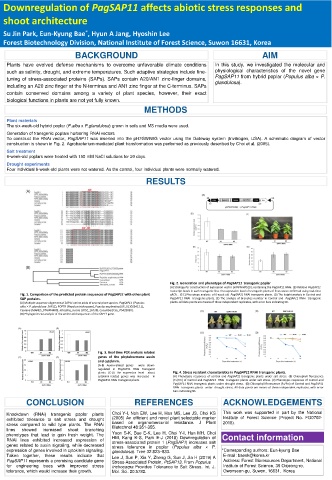
Downregulation of PagSAP11 affects abiotic stress responses and
  shoot architecture

  Su Jin Park, Eun-Kyung Bae , Hyun A Jang, Hyoshin Lee
                             *
  Forest Biotechnology Division, National Institute of Forest Science, Suwon 16631, Korea
                         BACKGROUND                                                   AIM
   Plants have evolved defense mechanisms to overcome unfavorable climate conditions  In this study, we investigated the molecular and
   such as salinity, drought, and extreme temperatures. Such adaptive strategies include fine-  physiological characteristics of the novel gene
   tuning of stress-associated proteins (SAPs). SAPs contain A20/AN1 zinc-finger domains,  PagSAP11 from hybrid poplar (Populus alba × P.
                                                                       glandulosa).
   including an A20 zinc finger at the N-terminus and AN1 zinc finger at the C-terminus. SAPs
   contain conserved domains among a variety of plant species, however, their exact
   biological functions in plants are not yet fully known.
                                                METHODS

   Plant materials
   The six-week-old hybrid poplar (P.alba x P.glandulosa) grown in soils and MS media were used.
   Generation of transgenic poplars harboring RNAi vectors
   To construct the RNAi vector, PagSAP11 was inserted into the pH7GWIWG vector using the Gateway system (Invitrogen, USA). A schematic diagram of vector
   construction is shown in Fig. 2. Agrobacterium-mediated plant transformation was performed as previously described by Choi et al. (2005).
   Salt treatment
   6-week-old poplars were treated with 150 mM NaCl solutions for 20 days.
   Drought experiments
   Four individual 6-week-old plants were not watered. As the control, four individual plants were normally watered.
                                                 RESULTS


                                                        Fig. 2. Generation and phenotype of PagSAP11 transgenic poplar
                                                        (A) Strategy for construction of expression vector pK7GWIWG2(I), containing the PagSAP11 RNAi. (B) Relative PagSAP11
                                                        transcript levels in each transgenic line. The expression level of transgenic plants of lines were confirmed using real-time
        Fig. 1. Comparison of the predicted protein sequences of PagSAP11 with other plant  qPCR. . (C-E) Phenotype analysis of 6 week old PagSAP11 RNAi transgenic plants. (D) The height analysis in Control and
        SAP proteins.                                   PagSAP11 RNAi transgenic plants. (E) The analysis of Branches number in Control and PagSAP11 RNAi transgenic
        (A) Multiple sequence alignment of SAP11 amino acids of several plant species. PagSAP11 (Populus  plants. All data points are means of three independent replicates, with error bars indicatingSD.
        alba × P. glandulosa SAP11), POPTR (Populus trichocarpa), Populus euphratica (XP_011025412.1),
        Cassava (MANES_07G004400), Jatropha_curcas (JCGZ_16738), Cucumber(Csa_7G428830).
        (B) Phylogenic tree analysis of the amino acid sequences of the SAP11 gene.


                                 Fig. 3. Real time PCR analysis related
                                 genes of the phytohormone auxin
                                 and cytokinin.
                                 (A-B) Auxin-related genes  were down-
                                 regulated in PagSAP11 RNAi transgenic
                                 plants. (C-D) The expression level  about  Fig. 4. Stress resistant characteristics in PagSAP11 RNAi transgenic plants.
                                 cytokinin-related genes was increased  in  (A) Phenotypic responses of control and PagSAP11 transgenic plants under salt stress. (B) Chlorophyll florescence
                                 PagSAP11 RNAi transgenic plants.  (Fv/Fm) of Control and PagSAP11 RNAi transgenic plants under salt stress. (C) Phenotypic responses of control and
                                                         PagSAP11 RNAi transgenic plants under drought stress. (D) Chlorophyll florescence (Fv/Fm) of Control and PagSAP11
                                                         RNAi transgenic plants under drought stress. All data points are means of three independent replicates, with error
                                                         bars indicatingSD.
          CONCLUSION                         REFERENCES                   ACKNOWLEDGEMENTS
   Knockdown  (RNAi)  transgenic  poplar  plants  Choi Y-I, Noh EW, Lee H, Han MS, Lee JS, Choi KS  This work was supported in part by the National
   exhibited tolerance to salt stress and drought  (2005) An efficient and novel plant selectable marker  Institute of Forest Science (Project No. FG0702-
   stress compared to wild type plants. The RNAi  based  on  organomercurial  resistance.  J  Plant  2018).
                                     Biotechnol 48:351-355.
   lines  showed  increased  shoot  branching
   phenotypes that lead to gain fresh weight. The  Yoon S-K, Bae E-K, Lee H, Choi Y-I, Han MH, Choi  Contact information
                                     HM, Kang K-S, Park E-J (2018) Downregulation of
   RNAi lines exhibited increased expression of  stress-associated protein 1 (PagSAP1) increases salt
   genes related to auxin signaling, while decreased  stress tolerance in poplar (Populus alba × P.
   expression of genes involved in cytokinin signaling.  glandulosa). Tree 32:823–833.  *Corresponding authors: Eun-kyung Bae
   Taken  together,  these  results  indicate  that  Lee J, Sun P, Xia Y, Zheng G, Sun J, Jia H (2019) A  E-mail: baeek@korea.kr
   PagSAP11 represents a promising candidate gene  Stress-Associated Protein, PtSAP13, From Populus  Address: Forest Bioresources Department, National
   for  engineering  trees  with  improved  stress  trichocarpa Provides Tolerance to Salt Stress. Int. J.  Institute of Forest Science, 39 Onjeong-ro,
   tolerance, which would increase their growth.  Mol. Sci. 20:5782.      Gwonseon-gu, Suwon, 16631, Korea

