


Page 5 - S. Plant biology
P. 5
Pathogenesis-Related Thaumatin-Like Genes are Involved in

                        the ABA Signal Transduction Pathway
                                           Eun Joo Park and Tae-Houn Kim*
             Department of Biotechnology/Convergence Science of Bio-Health, Duksung Women’s University, 01369, Seoul, Korea

                                                 Abstract

   The sweet tasting protein thaumatin was first isolated from Thaumatococcus daniellii Benth and found in various plant species [1]. In Arabidopsis, twenty-two
   thaumatin-like genes were identified, but specific functions of each genes need to be clarified [2]. The abiotic stress hormone ABA was previously reported to be
   involved in the regulation of biotic stress signal transduction. Granting that biotic and abiotic stress signaling pathways might be tightly interconnected by sharing
   certain components in both pathway, characterizations of such factors that exist in common will contribute to understanding the mechanism of signaling interaction.
   Through characterization of quadruple and quintuple mutants of thaumatin-like genes, we found altered physiological phenotypes from the mutants under ABA
   treatment. Moreover, ABA inductions of the ABA-responsive genes were also affected in the mutants which is consistent with the observed physiological phenotypes.
   In addition to the biotic stress-related phenotypes in the mutants, ABA signaling-related phenotypes of the thaumatin mutant suggest that thaumatin-like genes may
   have a role in the regulation of interactions between abiotic and biotic stress signaling pathways.


                                         Result and Discussion
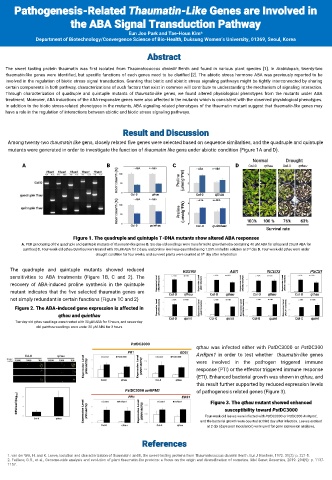
    Among twenty-two thaumatin like gens, closely related five genes were selected based on sequence similarities, and the quadruple and quintuple
    mutants were generated in order to investigate the function of thaumatin like gens under abiotic condition (Figure 1A and D).

        A                           B                    C                    D


                         Figure 1. The quadruple and quintuple T-DNA mutants show altered ABA responses
        A. PCR genotyping of the quadruple and quintuple mutants of thaumatin-like genes B. Six-day-old seedlings were transferred to growth media containing 40 μM ABA for qthau and 20 μM ABA for
        quinthau) C. Four-week-old qthau/quinthau were treated with 30 μM ABA for 2 days, and proline level was quantified using 1.25% ninhydrin solution at 3 rd day D. Four-week-old qthau were under
                                drought condition for four weeks, and survived plants were counted at 5 th day after rehydration

    The quadruple and quintuple mutants showed reduced
    sensitivities to ABA treatments (Figure 1B, C and 2). The
    recovery of ABA-induced proline synthesis in the quintuple
    mutant indicates that the five selected thaumatin genes are
    not simply redundant in certain functions (Figure 1C and 2)
      Figure 2. The ABA-induced gene expression is affected in
                    qthau and quinthau
      Ten-day-old qthau seedlings were treated with 30 μM ABA for 5 hours, and seven-day-
             old quinthau seedlings were under 30 μM ABA for 3 hours


                                            PstDC3000
                                                                 qthau was infected either with PstDC3000 or PstDC300
                                                                 AvrRpm1 in order to test whether thaumatin-like genes
                                                                 were involved in the pathogen triggered immune
                                                                 response (PTI) or the effector triggered immune response
                                                                 (ETI). Enhanced bacterial growth was shown in qthau, and
                                                                 this result further supported by reduced expression levels
                                          PstDC3000 avrRPM1      of pathogenesis related genes (Figure 3).
                                                                      Figure 3. The qthau mutant showed enhanced
                                                                          susceptibility toward PstDC3000
                                                                    Four-week-old leaves were infected with PstDC3000 or PstDC300 AvrRpm1,
                                                                  and the bacterial growth were counted at third day after infection. Leaves excised
                                                                    at 2 dpi (days post inoculation) were used for gene expression analyses.

                                               References

   1. van der Wel, H. and K. Loeve, Isolation and characterization of thaumatin I and II, the sweet-tasting proteins from Thaumatococcus daniellii Benth. Eur J Biochem, 1972. 31(2): p. 221-5.
   2. Faillace, G.R., et al., Genome-wide analysis and evolution of plant thaumatin-like proteins: a focus on the origin and diversification of osmotins. Mol Genet Genomics, 2019. 294(5): p. 1137-
   1157.

