


Page 11 - S. Plant biology
P. 11
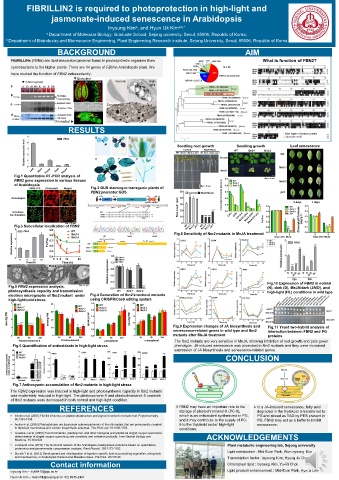
FIBRILLIN2 is required to photoprotection in high-light and
jasmonate-induced senescence in Arabidopsis
Inyoung Kim , and Hyun Uk Kim a,b,*
a
a Department of Molecular Biology, Graduate School, Sejong university, Seoul, 05006, Republic of Korea,
b Department of Bioindustry and Bioresource Engineering, Plant Engineering Research Institute, Sejong University, Seoul, 05006, Republic of Korea
BACKGROUND AIM
FIBRILLINs (FBNs) are lipid-associated proteins found in photosynthetic organism from What is function of FBN2?
cyanobacteria to the higher plants. There are 14 genes of FBN in Arabidopsis plant. We
have studied the function of FBN2 independently.
▼ Elaioplast
▼ Chromoplast Normal High
light
Senescence
Chloroplast ▶
RESULTS
Ι Start region of mature protein
□ lipocalin motif
Seedling root growth Seedling growth Leaf senescence
Fig.1 Quantitative RT-PCR analysis of
FBN2 gene expression in various tissues Bar = 2 mm
of Arabidopsis Bar = 5 mm
Fig.2 GUS staining in transgenic plants of
FBN2 promoter:GUS
Arabidopsis
Nicotiana
benthamiana
Bar = 10 μm
Fig.3 Subcellular localization of FBN2
Fig.8 Sensitivity of fbn2 mutants in MeJA treatment
WT fbn2-2
PG
PG Fig.10 Expression of FBN2 in normal
Fig.5 FBN2 expression analysis, Bar = 1 μm (N), dark (D), MeJA/dark (JA/D), and
photosynthesis capacity and transmission high-light (HL) conditions in wild type
electron micrographs of fbn2 mutant under Fig.4 Generation of fbn2 knockout mutants
high-light/cold stress. using CRISPR/Cas9 editing system
Fig.9 Expression changes of JA biosynthesis and Fig.11 Yeast two-hybrid analysis of
senescence-related genes in wild type and fbn2 interaction between FBN2 and PG
mutants after MeJA treatment proteins
The fbn2 mutants are very sensitive in MeJA, showing inhibition of root growth and pale green
Fig.6 Quantification of antioxidants in high-light stress phenotype. JA-induced senescence was promoted in fbn2 mutants and they were increased
expression of JA biosynthesis and senescence-related genes.
CONCLUSION
Fig.7 Anthocyanin accumulation of fbn2 mutants in high-light stress
The FBN2 expression was induced in high-light and photosynthesis capacity in fbn2 mutants
was moderately reduced in high-light. The plastoquinone-9 and plastochromanol-8 contents
of fbn2 mutants were decreased in both normal and high-light condition.
REFERENCES FBN2 may have an important role in the In a JA-induced senescence, fatty acid
storage of plastochromanol-8 (PC-8),
degraded in the thylakoid is transferred to
Simkin et al. (2007) Fibrillin influence on plastid ultrastructure and pigment content in tomato fruit. Phytochemistry. which is an antioxidant synthesized in PG, PG and stored as TAG by PES present in
68:1545-1556 and it may contribute to the supply of PC- PG. FBN2 may act as a buffer to inhibit
Austin et al. (2006) Plastoglobules are lipoprotein subcompartments of the chloroplast that are permanently coupled 8 to the thylakoid under high-light senescence.
to thylakoid membranes and contain biosynthetic enzymes. The Plant cell. 18:1693-1703 conditions.
Gruszka J et al. (2008) Tocochromanols, plastoquinol, and other biological prenyllipids as singlet oxygen quenchers-
determination of singlet oxygen quenching rate constants and oxidation products. Free Radical Biology and ACKNOWLEDGEMENTS
Medicine. 45:920-928
Lundquist et al. (2012) The functional network of the Arabidopsis plastoglobule proteome based on quantitative Plant metabolic engineering lab, Sejong university
proteomics and genome-wide coexpression analysis. Plant Physiol. 158:1172-1192
Lipid metabolism : Mid-Eum Park, Won nyeong Kim
Suzuki T et al. (2013) Development and disintegration of tapetum-specific lipid-accumulating organelles, elaioplasts
and tapetosomes, in Arabidopsis thaliana and Brassica napus. Plant Sci. 207:25-36 Transcription factor : Inyoung Kim, Hyung Ju Do
Contact information Chloroplast lipid : Inyoung Kim, Yu-Ri Choi
Inyoung Kim – kiy88410@sju.ac.kr Lipid product enhancement : Mid-Eum Park, Hye Ji Lee
Hyun Uk Kim – hukim64@sejong.ac.kr 02) 6935-2491

