


Page 13 - S. Plant biology
P. 13
Metabolic Modification of Arabidopsis, an Oil Model Plant,
to Produce Hydroxy Fatty Acid for Industrial Applications
Mid-Eum Park and Hyun Uk Kim*
Department of Molecular Biology, Sejong University, Seoul, 05006 Republic of Korea
ABSTRACT AIM
Fatty acids of most plants are composed of common fatty acids such as To produce and increase the hydroxy fatty acids in Arabidopsis thaliana.
saturated and unsaturated fatty acids. However, some plants produce unusual In this study, we will increase the hydroxy fatty acids in Arabidopsis because hydroxy
fatty acid, like hydroxy fatty acid (HFA) in seeds. The HFAs are used as a fatty acids are very useful in industrial application.
chemical feedstock, including soaps, lubricants, plastics, so it is important to
accumulate in plants. Therefore, we made a vector that includes five HFA
biosynthesis-related genes from castor. RcFAH12 in Ricinus Communis
directly synthesize HFA. Acyl-CoA:lysophosphatidylcholine acyltransferase
(LPCAT) from castor can transfer HFA on phosphatidylcholine directly into the
acyl-CoA pool, making these HFA available for TAG. Phospholipid:DAG
acyltransferase1-2 (PDAT1-2) from castor synthesize the TAG by
transacylation of the sn-2 HFA from PC. PC:DAG phosphocholine transferase
(PDCT) from castor generate PC-derived DAG by removing the headgroup of
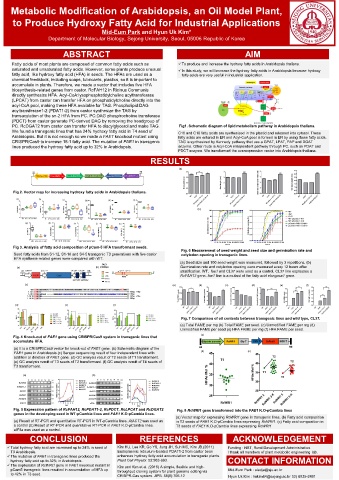
PC. RcDGAT2 from castor can transfer HFA to diacylglycerol and make TAG. Fig1. Schematic diagram of lipid metabolism pathway in Arabidopsis thaliana.
We found a transgenic lines that has 24% hydroxy fatty acid in T4 seed of C16 and C18 fatty acids are synthesized in the plastid and released into cytosol. These
Arabidopsis. But it is not enough so we made a FAE1 knockout mutant using fatty acids are entered in ER and Acyl-CoA pool is formed in ER by using these fatty acids.
CRISPR/Cas9 to increase 18:1 fatty acid. The mutation of FAE1 in transgenic TAG is synthesized by Kennedy pathway that use a GPAT, LPAT, PAP and DGAT
lines produced the hydroxy fatty acid up to 32% in Arabidopsis. enzyme. Other route is Acyl-CoA independent pathway through PC, such as PDAT and
PDCT enzyme. We transformed the overexpression vector into Arabidopsis thaliana.
RESULTS
(a)
Fig 2. Vector map for increasing hydroxy fatty acids in Arabidopsis thaliana.
(b)
Fig 3. Analysis of fatty acid composition of pCam-5 HFA transformant seeds.
Fig. 6 Measurement of seed weight and seed size and germination rate and
Seed fatty acids from S1-12, S1-16 and S4-5 transgenic T3 generations with five castor cotyledon opening in transgenic lines.
HFA synthesis-related genes were compared with WT.
(a) Seed size and 100 seed weight was measured, followed by 3 repetitions. (b)
(a) (b) Germination rate and cotyledon opening were measured every 12 hours after
stratification. WT, fae1 and CL37 were used as a control. CL37 line expresses a
RcFAH12 gene. fae1 line is a mutant of the fatty acid elongase1 gene.
(c) (a) (b) (c) (d) (e) (f)
(d) (e) (f)
Fig. 7 Comparison of oil contents between transgenic lines and wild type, CL37.
(a) Total FAME per mg (b) Total FAME per seed. (c) Unmodified FAME per mg (d)
Unmodified FAME per seed (e) HFA FAME per mg (f) HFA FAME per seed.
(a)
Fig. 4 Knock-out of FAE1 gene using CRISPR/Cas9 system in transgenic lines that
accumulate HFA.
(a) It is a CRISPR/Cas9 vector for knock-out of FAE1 gene. (b) Schematic diagram of the
FAE1 gene in Arabidopsis (c) Sanger sequencing result of four independent lines with (b) (c)
addition or deletion of FAE1 gene. (d) GC analysis result of T2 seeds of T1 transformant.
(e) GC analysis result of T3 seeds of T2 transformant. (f) GC analysis result of T4 seeds of
T3 transformant.
(a) (b)
Fig. 5 Expression pattern of RcFAH12, RcPDAT1-2, RcPDCT, RcLPCAT and RcDGAT2 Fig. 8 RcWRI1 gene transformed into the FAE1 K.O-pCambia lines
genes in the developing seed in WT-pCambia lines and FAE1 K.O-pCambia lines.
(a) Vector map for expressing RcWRI1 gene in transgenic lines. (b) Fatty acid composition
(a) Result of RT-PCR and quantitative RT-PCR in WT-pCambia lines. AtACT2 was used as in T2 seeds of FAE1 K.O-pCambia lines expressing RcWRI1. (c) Fatty acid composition in
a control (b) Result of RT-PCR and quantitative RT-PCR in FAE1 K.O-pCambia lines. T3 seeds of FAE1 K.O-pCambia lines expressing RcWRI1
eIF4a was used as a control.
CONCLUSION REFERENCES ACKNOWLEDGEMENT
Total hydroxy fatty acid are increased up to 24% in seed of Kim HU, Lee KR, Go YS, Jung JH, Suh MC, Kim JB.(2011) Funding : NBT, Rural Development Administration.
T3 Arabidopsis. Endoplasmic reticulum-located PDAT1-2 from castor bean I thank all members of plant metabolic engineering lab.
The mutation of FAE1 in transgenic lines produced the enhances hydroxy fatty acid accumulation in transgenic plants.
hydroxy fatty acid up to 32% in Arabidopsis. Plant Cell Physiol. 52:983-993. CONTACT INFORMATION
The expression of RcWRI1 gene in FAE1 knockout mutant in Kim and Kim et al. (2016) A simple, flexible and high-
pCam5 transgenic lines resulted in accumulation of HFA up throughput cloning system for plant genome editing via Mid-Eum Park : aledja@sju.ac.kr
to 42% in T3 seed. CRISPR-Cas system. JIPB. 58(8):705-12 Hyun Uk Kim : hukim64@sejong.ac.kr 02) 6935-2491

