


Page 17 - S. Plant biology
P. 17
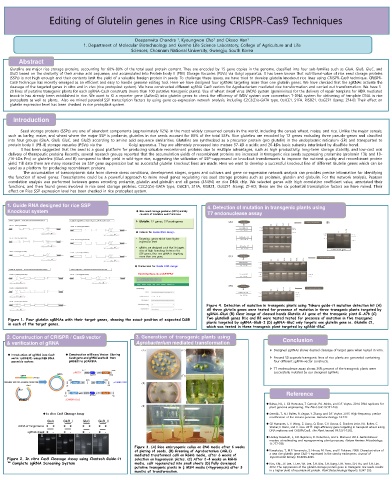
Editing of Glutelin genes in Rice using CRISPR-Cas9 Techniques
Deepanwita Chandra , Kyoungwon Cho and Oksoo Han 1
1
1
1. Department of Molecular Biotechnology and Kumho Life Science Laboratory, College of Agriculture and Life
Sciences, Chonnam National University, Gwangju, South Korea
Abstract
Glutelins are major rice storage proteins, accounting for 60%-80% of the total seed protein content. They are encoded by 15 gene copies in the genome, classified into four sub-families such as GluA, GluB, GluC, and
GluD based on the similarity of their amino acid sequence, and accumulated into Protein body II (PBII) Storage Vacuoles (PSVs) via Golgi apparatus. It has been known that nutritional-value of rice seed storage proteins
(SSPs) is not high enough and their contents limit the yield of a valuable foreign protein in seeds. To challenge these issues, we have tried to develop glutelin knockout rice lines using CRISPR-Cas9 technique. CRISPR-
Cas9 Technique has recently emerged as an efficient and easy to handle genome editing tool. Here we have designed four sgRNAs targeting more than one glutelin genes. We have checked that the sgRNAs activate the
cleavage of the targeted genes in vitro and in vivo (rice protoplast system). We have constructed different sgRNA-Cas9 vectors for Agrobacterium-mediated rice transformation and carried out transformation. We have 5-
20 lines of putative transgenic plants for each sgRNA-Cas9 constructs (more than 100 putative transgenic plants). Use of wheat dwarf virus (WDV) system (geminivirus) for the delivery of repair template for HDR mediated
knock-in has already been established in rice. We want to KI a reporter gene (AsRed2) into glutelin genes to check the efficiency of WDV system over convention T-DNA system for delivering of template DNA in rice
protoplasts as well as plants. Also we mined potential SSP transcription factors by using gene co-expression network analysis, including C2C2(Zn)-GATA type, OsICE1, S1FA, RISBZ1, OsGZF1 & Zf-HD. Their effect on
glutelin expression level has been checked in rice protoplast system.
Introduction
Seed storage proteins (SSPs) are one of abundant components (approximately 12%) in the most widely consumed cereals in the world, including the cereals wheat, maize, and rice. Unlike the major cereals,
such as barley, maize, and wheat where the major SSP is prolamin, glutelins in rice seeds account for 80% of the total SSPs. Rice glutelins are encoded by 12 genes excluding three pseudo-genes and classified
into four groups (GluA, GluB, GluC, and GluD) according to amino acid sequence similarities. Glutelins are synthesized as a precursor protein (pro glutelin) in the endoplasmic reticulum (ER) and transported to
protein body II (PB-II) storage vacuoles (PSVs) via the Golgi apparatus. They are ultimately processed into mature 37-kD a acidic and 20-kDa basic subunits interlinked by disulfide bond.
It has been suggested that the seed is a good platform for producing valuable recombinant proteins due to multiple advantages, such as high productivity, long-term storage stability, and low-cost oral
delivery of therapeutic proteins Recently, several research groups reported that the accumulation yields of recombinant proteins are increased in transgenic rice seeds suppressing prolamins (prolamin 13b and 10-
/16-kDa Pro) or glutelins (GluA and B) compared to their yield in wild-type rice, suggesting the utilization of SSP-suppressed or knockout transformants to improve the nutrient quality and recombinant protein
yield. Till date there are many researches on SSP gene suppression but no successful glutelin knockout lines are made. Here we want to develop a successful knockout line of different Glutelin genes which can be
used as a platform for producing recombinant proteins.
The accumulation of transcriptomic data from diverse stress conditions, development stages, organs and cultivars and gene co-expression network analysis can provides precise information for identifying
the function of novel genes. Transcriptome could be a powerful approach to mine novel genes regulating rice seed storage proteins such as prolamin, glutelin and globulin. For the network analysis, Pearson
correlation analysis was performed between genes encoding prolamin, glutelin and globulin and all genes (43494) on rice DNA chip. We selected genes with high correlation coefficient value, annotated their
functions, and then found genes involved in rice seed storage proteins. C2C2(Zn)-GATA type, OsICE1, S1FA, RISBZ1, OsGZF1 & Zf-HD; these are the six potential transcription factors we have mined. Their
effect on Rice SSP expression level has been checked in rice protoplast system.
1. Guide RNA designed for rice SSP 4. Detection of mutation in transgenic plants using
Knockout system Rice seed storage proteins (SSPs) mainly
consists of Glutelins and Prolamins T7 endonuclease assay
Glutelin: 12 genes, 3 Pseudogenes
Criteria for Guide RNA design
• Targeting genes which have higher
expression level
• gRNAs are designed such that it targets
sites of high homology between the
SSP genes, thus one gRNA is targeting
more than one gene.
Online tool for Guide RNA design
http://crispr.hzau.edu.cn/CRISPR2/
Figure 4. Detection of mutation in transgenic plants using Takara guide-it mutation detection kit (A)
All three glutelin genes were tested for presence of mutation in three transgenic plants targeted by
sgRNA-GluA (B) Clear image of cleaved bands Glutelin A1 gene of the transgenic plant G-A7b (C)
Figure 1. Four glutelin sgRNAs with their target genes, showing the exact position of expected DSB Two glutelinB genes B1a and B2 were tested tested for presence of mutation in five transgenic
in each of the target genes. plants targeted by sgRNA-GluB-I (D) sgRNA-GluC only targets one glutelin gene ie. Glutelin C1,
which was tested in three transgenic plant targeted by sgRNA-GluC
2. Construction of CRISPR / Cas9 vector 3. Generation of transgenic plants using Conclusion
& verification of gRNA Agrobacterium mediated transformation
Designed sgRNAs shows desired cleavage of target gene when tested in vitro.
Introduction of sgRNA into Cas9 Construction of Binary Vector: Cloning
vector (pRGE31) using NEB DNA Cas9 gene and gRNA scaffold from Around 50 separate transgenic lines of rice plants are generated containing
assembly system pRGE31 to pCAMBIA four different sgRNA-vector constructs.
T7 endonuclease assay shows 36% percent of the transgenic plants were
successfully mutated by our designed sgRNAs.
Reference
Baltes, N.J., J. Gil-Humanes, T. Cermak, P.A. Atkins, and D.F. Voytas. 2014. DNA replicons for
plant genome engineering. The Plant Cell
. 26:151-163.
In vitro Cas9 Cleavage Assay Čermák, T., N.J. Baltes, R. Čegan, Y. Zhang, and D.F. Voytas. 2015. High-frequency, precise
modification of the tomato genome. Genome biology. 16:232.
Gil‐Humanes, J., Y. Wang, Z. Liang, Q. Shan, C.V. Ozuna, S. Sánchez‐León, N.J. Baltes, C.
Starker, F. Barro, and C. Gao. 2017. High‐efficiency gene targeting in hexaploid wheat using
. 89:1251-1262.
DNA replicons and CRISPR/Cas9. The Plant Journal
Hanley-Bowdoin, L., E.R. Bejarano, D. Robertson, and S. Mansoor. 2013. Geminiviruses:
masters at redirecting and reprogramming plant processes. Nature Reviews Microbiology.
11:777-788.
Figure 3. (A) Rice embryogenic callus on 2N6 media after 6 weeks
of plating of seeds. (B) Greening of Agrobacterium (AGL1) Kawakatsu, T., M.P. Yamamoto, S. Hirose, M. Yano, and F. Takaiwa. 2008. Characterization of
mediated transformed calli on RGH6 media, after 6 weeks of a new rice glutelin gene GluD-1 expressed in the starchy endosperm. Journal of
. 59:4233-4245.
Figure 2. In vitro Cas9 Cleavage Assay using Clontech Guide-it selection on hygromycin plates. (C) After 2-4 weeks on RGH6 Experimental Botany
™ Complete sgRNA Screening System media, calli regenerated into small shoots (D) Fully developed Kim, Y.M., J.Y. Lee, T. Lee, Y.H. Lee, S.H. Kim, S.H. Kang, U.H. Yoon, S.H. Ha, and S.H. Lim.
putative transgenic plants in ½ MSH media (+hygromycin) after 3 2012. The suppression of the glutelin storage protein gene in transgenic rice seeds results
. 6:347-353.
months of transformation. in a higher yield of recombinant protein. Plant Biotechnology Reports

