


Page 73 - Q. Neuroscience
P. 73
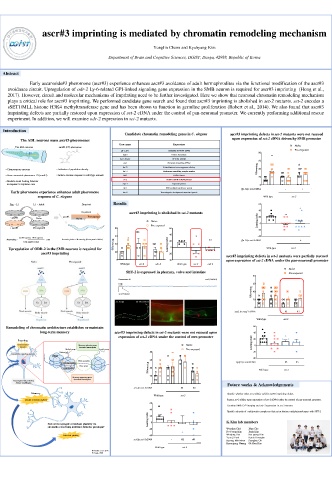
ascr#3 imprinting is mediated by chromatin remodeling mechanism
YongJin Cheon and Kyuhyung Kim
Department of Brain and Cognitive Sciences, DGIST, Daegu, 42988, Republic of Korea
Abstract
Early ascaroside#3 pheromone (ascr#3) experience enhances ascr#3 avoidance of adult hermaphrodites via the functional modification of the ascr#3
avoidance circuit. Upregulation of odr-2 Ly-6-related GPI-linked signaling gene expression in the SMB neuron is required for ascr#3 imprinting (Hong et al.,
2017). However, circuit and molecular mechanisms of imprinting need to be further investigated. Here we show that neuronal chromatin remodeling mechanism
plays a critical role for ascr#3 imprinting. We performed candidate gene search and found that ascr#3 imprinting is abolished in set-2 mutants. set-2 encodes a
sSET1/MLL histone H3K4 methyltransferase gene and has been shown to function in germline proliferation (Robert et al., 2014). We also found that ascr#3
imprinting defects are partially restored upon expression of set-2 cDNA under the control of pan-neuronal promoter. We currently performing additional rescue
experiment. In addition, we will examine odr-2 expression in set-2 mutants.
Introduction
Candidate chromatin remodeling genes in C. elegans ascr#3 imprinting defects in set-2 mutants were not rescued
The ADL neurons sense ascr#3 pheromones upon expression of set-2 cDNA driven by SMB promoter
Gene name Expression Naive
The ADL neurons ascr#3 (C9) pheromone
zfp-1, gfl-1 Chromatin-associated protein 80 Pre-exposed
had-2 Histone deacetylase
**
hpl-1 & hpl-2 HP-4-like proteins
60
isw-1 Chromatin remodeling ATPase
lin-35 Retinoblastoma tumor suppressor ortholog
• Chemosensory neurons • Indicator of population density %Reversing 40
lin-53 Nucleosome remodeling complex member % Reversing
• Sense ascaroside pheromone C9 (ascr#3) • Initiate aversive response in wild-type animals hil-1 H1-like histone 20
set-2 Histone H3(K4) methyltransferase
• Mediate social feeding behavior
in response to repulsive cues ergo-1 Argonaute protein 0
rde-1 RNA mediated interference protein flp-12p::set-2cDNA Wild-type set-2 set-2; SMBrescue
-
+
Early pheromone experience enhances adult pheromone lin-14 Postembryonic developmental associated protein
response of C. elegans Wild-type set-2
Egg ~ L1 L1 ~ Adult Drop test Results 60
*
Repulsion ascr#3 imprinting is abolished in set-2 mutants 40
- ascr#3 Naïve ascr#3 Naive Pre-exposed 20 **
Naive Learning index Learning index
Pre-exposed 0
+ ascr#3 Pre-exposed 80 60 -20
40
60 * -40
ascr#3 response – M13 response *
%Reversing = x 100 Learning index = % reversing [Pre-exposed – Naïve] 20 ** flp-12p::set-2cDNA Wild-type set-2 - set-2; SMB rescue
+
Total number of trial 40 Learning index
Upregulation of ODR-2 in the SMB neurons is required for % Reversing %Reversing Learning index 0 Wild-type set-2
ascr#3 imprinting 20 -20
ascr#3 imprinting defects in set-2 mutants were partially rescued
0 -40 upon expression of set-2 cDNA under the pan-neuronal promoter
Wild-type set-2 odr-2 Wild-type set-2 odr-2
odr-2
set-2
Wild-type
odr-2
set-2
Wild-type
Naive
SET-2 is expressed in pharynx, vulva and intestine Pre-exposed
80
Chromosome III set-2 (C26E6.9)
0.5kb 60
% Reversing %Reversing 40
set-2 Promoter
set-2p::gfp flp-12p::mCherry 20
0
Wild-type rgef-1R#2 rgef-1R#3
rgef-1p::rgef-1cDNA set-2 - #2 #3
Wild-type set-2
Remodeling of chromatin architecture establishes or maintain 60
long-term memory ascr#3 imprinting defects in set-2 mutants were not rescued upon 40
expression of set-2 cDNA under the control of own promoter
Learning 20
Environmental Memory activator genes Naive Learning index Learning index 0
stimulus increased transcription
Methyl group Acetyl group Pre-exposed
Histone tail 80 -20
Intracellular signaling cascades
Histone -40
DNA accessible 60 rgef-1p::set-2cDNA - #2 #3
DNA inaccessible Wild-type set-2 RS#2 RS#3
Gene active
Gene inactive %Reversing % Reversing 40 Wild-type set-2
Memory suppressor genes 20
Transcription factor binding decreased transcription
Histone modification 0 Future works & Acknowledgements
set-2p::set-2cDNA Wild-type set-2 - set-2R#2 #2 set-2R#4 #4
Memory Identify whether other set-2 alleles exhibit ascr#3 imprinting defect.
Wild-type set-2
Synaptic or intrinsic plasticity Rescue set-2 alleles upon expression of set-2 cDNA under the control of pan-neuronal promoter.
60
Examine SMB Ca 2+ imaging and odr-2 expression in set-2 mutants
40 Identify subunits of multiprotein complexes that act as histone methylatransferases with SET-2
Learning index Learning index 20 K.Kim lab members
How altered synaptic or intrinsic plasticity via 0
chromatin remodeling modulates behavior paradigm? -20 Woochan Choi Jihey Cho
Do-Young Kim Jimin Kim
Behavioral plasticity -40 Woojung Heo Seo yeong Kim
Yeon-ji Park
Semin Hwangbo
Wild-type Hyeonjeong Hwang Ok Hwa Kim
set-2p::set-2cDNA set-2 - SS#2 #2 SS#4 #4 Kyeong Min Moon Seunghee Oh
Wild-type set-2
IB Zovkic et al., 2013
S Gupta., 2010

