


Page 69 - Q. Neuroscience
P. 69
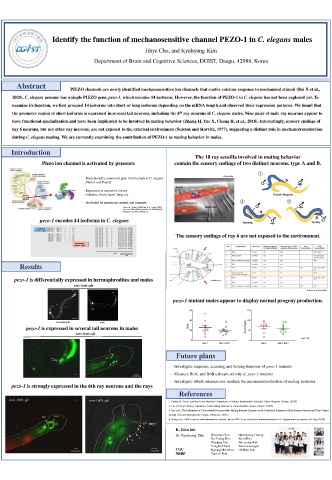
Identify the function of mechanosensitive channel PEZO-1 in C. elegans males

                                                Jihye Cho, and Kyuhyung Kim
                    < Ray identity >
                                Department of Brain and Cognitive Sciences, DGIST, Daegu, 42988, Korea


      Abstract          PIEZO channels are newly identified mechanosensitive ion channels that confer calcium response to mechanical stimuli (Bai X et al.,

     2020). C. elegans genome has a single PIEZO gene, pezo-1, which encodes 14 isoforms. However, the function of PEZO-1 in C. elegans has not been explored yet. To
     examine its function, we first grouped 14 isoforms into short or long isoforms depending on the mRNA length and observed their expression patterns. We found that
                                                           th
     the promoter region of short isoforms is expressed in several tail neurons, including the 6 ray neurons of C. elegans males. Nine pairs of male ray neurons appear to
     have functional specialization and have been implicated to be involved in mating behavior (Zhang H, Yue X, Cheng H, et al., 2018). Interestingly, sensory endings of
     ray 6 neurons, but not other ray neurons, are not exposed to the external environment (Sulston and Horvitz, 1977), suggesting a distinct role in mechanotransduction
     during C. elegans mating. We are currently examining the contribution of PEZO-1 to mating behavior in males.

     Introduction
                                                                The 18 ray sensilla involved in mating behavior
               Piezo ion channel is activated by pressure  contain the sensory endings of two distinct neurons, type A and B.
                                                                                     ①
                            - Evolutionarily conserved gene from human to C. elegans
                             ; Piezo1 and Piezo2
                            - Expressed in numerous tissues
                             ; intestine, brain, heart, lung, etc.                        Contact / Response
                            - Activated by membrane stretch and pressure       ②              ③
                                         Costeet al., Science (2010),Jing  et al., Nature (2014),
                                         Lee et al., PNAS (2014), Ranade et al., PNAS (2014),
                                         Gudipaty et al., Nature (2017), etc.
              pezo-1 encodes 14 isoforms in C. elegans                          Scanning              Turning
             Long isoform
             promoter region
                                                          The sensory endings of ray 6 are not exposed to the environment.
                         Short isoform
                         promoter region
                                      lsk51
                                          2kb
       Results

      pezo-1 is differentially expressed in hermaphrodites and males
                         pezo-1p(s)::gfp
                                                                                                     Referred from Wormbook
                                      tail
                                                         pezo-1 mutant males appear to display normal progeny production.
                               head
                                                               60                150
                                                               40                100
                   hermaphrodite  male
          pezo-1 is expressed in several tail neurons in males  Male  20         Total progeny  50
                          pezo-1p(s)::gfp
                                                                                                   n=9~10
                                                               0                  0
                                                                   him-5  him-5;lsk51  him-5  him-5;lsk51
                                                          Future plans
                                                        - Investigate response, scanning and turning behavior of pezo-1 mutants
                                                        - Measure R6A, and R6B calcium activity of pezo-1 mutants
                                            Dorsal view
                                                        - Investigate which interneurons mediate the mechanotransduction of mating behavior
     pezo-1 is strongly expressed in the 6th ray neurons and the rays
                                                           References
    pezo-1p(S)::gfp      DiI  pezo-1p(S)::gfp           1. Costeet al., Piezo1 and Piezo2 Are Essential Components of Distinct Mechanically Activated Cation Channels. Science. (2010)
                                                        2. Liu, K.S et al., Sensory regulation of male mating behavior in Caenorhabditis elegans. Neuron. (1995)
                                                        3. Koo et al., The Robustness of Caenorhabditis elegans Male Mating Behavior Depends on the Distributed Properties of Ray Sensory  Neurons and Their Output
                                                        through Core and Male-Specific  Targets. J Neurosci. (2011)
               R6B  R6A
                                                        4. Zhang at al., OSM-9 and an amiloride-sensitive channel, but not PKD-2, are involved in mechanosensation in C. elegans male ray neurons. Sci Rep. (2018)
                                               6 th  rays
                                                5         K. Kim lab
                                               4
                                                          Dr. Kyuhyung Kim   Woochan Choi  Hyeonjeong Hwang
                                              3                       Do-Young Kim   Jimin Kim
                                            2
                                           1                          Woojung Heo  Seo young Kim
                                                                      YongJin Cheon  Semin Hwangbo
                                                          CGC         Kyeong Min Moon  Ok Hwa Kim
                        Dorsal view               Dorsal view
                                                          NBRP        Yeon-Ji Park

