


Page 71 - Q. Neuroscience
P. 71
Study on molecular mechanisms of gait switching in C. elegans

                                     Kyeong Min Moon, Jihye Cho, Jimin Kim, and Kyuhyung Kim

                                   Department of Brain and Cognitive sciences, DGIST, Daegu, 42988, Republic of Korea

      Abstract
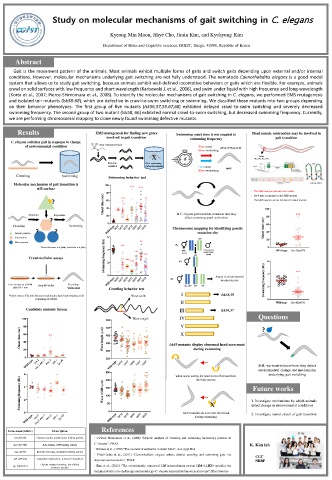
     Gait is the movement pattern of the animals. Most animals exhibit multiple forms of gaits and switch gaits depending upon external and/or internal
    conditions. However, molecular mechanisms underlying gait switching are not fully understood. The nematode Caenorhabditis elegans is a good model
    system that allows us to study gait switching, because animals exhibit well-defined locomotive behaviors or gaits which are flexible. For example, animals
    crawl on solid surfaces with low frequency and short wavelength (Karbowski J, et al., 2006), and swim under liquid with high frequency and long-wavelength
    (Korta et al., 2007; Pierce-Shimomura et al., 2008). To identify the molecular mechanisms of gait switching in C. elegans, we performed EMS mutagenesis
    and isolated ten mutants (lsk56-68), which are defective in crawl-to-swim switching or swimming. We classified these mutants into two groups depending
    on their behavior phenotypes. The first group of five mutants (lsk56,57,59,67,68) exhibited delayed crawl-to-swim switching and severely decreased
    swimming frequency. The second group of two mutant (lsk58, 66) exhibited normal crawl-to-swim switching, but decreased swimming frequency. Currently,
    we are performing chromosomal mapping to clone newly found swimming defective mutants.

       Results                  EMS mutagenesis for finding new genes    Swimming onset time is not coupled to   Head muscle contraction may be involved in
                                    involved in gait transition  swimming frequency        gait transition
     C. elegans switches gait in response to change
         of environmental condition  Ethyl methanesulfonate       Slow onset   lsk56,57,59,66,67,68
                                                                  Slow swimming
                                                  x                                  SMBs
                                    Random      Pick swimming                       (DL, DR, VL, VR)
                                    mutation    defective mutant  Fast onset
                                                                  Slow swimming  lsk58
      Crawling       Swimming       Swimming behavior test
     Molecular mechanism of gait transition is   100                                                  Kim et al., (2015)
             still unclear                 ***  ***
                                    80                                             - The SMB neurons innervate neck muscle
                                                                                   - lim-4 gene is expressed  in the SMB neurons
                                   Onset time (sec)  40                                100
                  ?                 60  ***     **                                 - The SMB neurons are not functional in lim-4 mutants
          Serotonin  Dopamine       20                     In C. elegans gait transition, transition time may   80  ***
                 ?
                                                             affect swimming speed and motion
     Crawling          Swimming     0  lsk56  lsk57  lsk58  lsk59  lsk66  lsk67  lsk68  Chromosome mapping for identifying genetic   60
             ?     ?                Wild-type                                          Onset time (sec)  40
      Sensory neuron                                             mutation site
      Interneuron                   6                            GFP
                                   Swimming frequency (Hz)  ***  mutant  GFP   marker worm
      Motorneuron                              **                                       20
              T.Pierce-Shimomura et al.,(2008), Vidal-Gadea et al.,(2011)     4  ***  ***  P 0  EMS   Chromosome   0  Wild-type  lim-4(ky403)
                                                                    (male)
          Crawl-to-Swim assays      2     ***  ***         F1                           6
                                    0                                  Assay in chromosomal   4  ***
                                    Wild-type  lsk56  lsk57  lsk58  lsk59  lsk66  lsk67  lsk68  F2  marker strains  Swimming frequency (Hz)
    Free moving on a NGM   Drop M9 buffer   Recording
     plate for 1 min   *Swim onset  Crawling behavior test   Non-GFP   GFP   GFP        2
    *Swim onset = The time between touching the liquid and initiating a full   Wave width  I  lsk58,59
            swimming movement.                                                          0
                                                            II                             Wild-type  lim-4(ky403)
          Candidate mutants Screen                          III          lsk56,57
        100                                 Wave length    IV                        Questions
                                   500
         80                        450    ***   *           V                         ?
        Onset time (sec)  60  **  Wave length (µm)  400  **  X
         40
                                   350
                                                                during swimming
         20                        300                  lsk59 mutants display abnormal head movement
         0                         250
         Wild-type  lon-2 lon-2 mec-7  mec-2  tph-1  lgc-40  Wild-type  lsk56  lsk57  lsk66  lsk67  lsk68  Still, we want to know how they detect
                                   250          ***                                  environmental change and mechanisms
         6       *  *              200                    when worm swims, its head moves first and then   underlying gait switching
        Swimming frequency (Hz)  4 2  Wave width (µm)  150  *        x             1. Investigate mechanisms by which animals
                                                                 the body moves
                                                                                   Future works
                                   100
                                    50
         0                          0   lsk56  lsk57  lsk66  lsk67  lsk68  lsk59 mutants do not move their head   detect change in environmental conditions
                                                                                   2. Investigate neural circuit of gait transition
         Wild-type  lon-2 lon-2 mec-7  mec-2  tph-1  lgc-40  Wild-type  during swimming.
    Gene name(Allele)  Description  References
      lon-2(e678)  Glypican family, growth factor binding activity  〮 T.Pierce-Shimomura et al., (2008) “Genetic analysis of crawling and swimming locomotory patterns in
                                C. elegans”, PNAS
     mec-7(e1506)  Beta-tubulin, GTP binding activity                             K. Kim lab
                                〮 Wallece et al., (1959) “The moment of eelworms in water films”, Ann Appl Biol
      mec-2(e75)  Stomatin homolog, cholesterol binding activity
                                〮 Vidal-Gadea et al., (2011) “Caenorhabditis elegans selects distinct crawling and swimming gaits via
      tph-1(n4622)  Tryptophan hydroxylase,  serotonin biosynthesis  dopamine and serotonin”, PNAS  CGC
                                                                                    NBRP
     lgc-40(n4545)  Glycine receptor homolog,  low-affinity   〮 Kim et al., (2015) “The evolutionarily conserved LIM homeodomain protein LIM-4_LHX6 specifies the
                  serotonin receptor
                                terminal identity of a cholinergic and peptidergic C. elegans sensory/inter/motor neuron-type”, Plos Genetics

