


Page 7 - Q. Neuroscience
P. 7
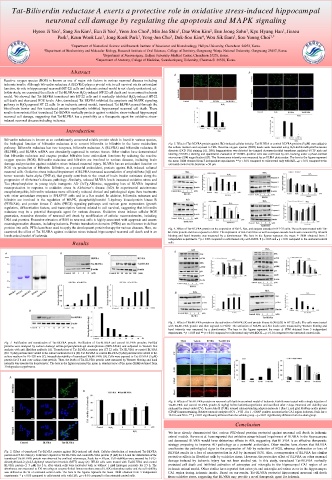
Tat-Biliverdin reductase A exerts a protective role in oxidative stress-induced hippocampal
                neuronal cell damage by regulating the apoptosis and MAPK signaling

            Hyeon Ji Yeo , Sang Jin Kim , Eun Ji Yeo , Yeon Joo Choi , Min Jea Shin , Dae Won Kim , Eun Jeong Sohn , Kyu Hyung Han , Jinseu
                    1
                              1
                                                                                 1
                                                                                             1
                                                 1
                                                           1
                                                                     2
                                      1
                                                                   4
                                                                             1
                                  1
                    Park , Keun Wook Lee , Jong Kook Park , Yong-Jun Cho , Duk-Soo Kim , Won Sik Eum , Soo Young Choi 1,*
                                              1
                                                        3
                       1
                        1 Department of Biomedical Science and Research Institute of Bioscience and Biotechnology, Hallym University, Chuncheon 24252, Korea.
               2 Department of Biochemistry and Molecular Biology, Research Institute of Oral Sciences, College of Dentistry, Gangneung-Wonju National University, Gangneung 25457, Korea.
                                  3 Department of Neurosurgery, Hallym University Medical Center, Chuncheon 24253, Korea.
                                4 Department of Anatomy, College of Medicine, Soonchunhyang University, Cheonan-Si 31538, Korea.
                        Abstract                                                  B
                                                          A
  Reactive oxygen species (ROS) is known as one of major risk factors in various neuronal diseases including
  ischemic insults. Although biliverdin reductase A (BLVRA) plays a pivotal role in cell survival via its antioxidant
  function, its role in hippocampal neuronal (HT-22) cells and ischemic animal model is not clearly understood yet.
  In this study, we examined the effects of Tat-BLVRA on H 2 O 2 -induced HT-22 cell death and in an animal ischemia
  model. We showed that Tat-BLVRA transduced into HT-22 cells and it markedly inhibited H 2 O 2 -induced HT-22
  cell death and decreased ROS levels. Also, transduced Tat-BLVRA inhibited the apoptosis and MAPK signaling
  pathway in H 2 O 2 exposed HT-22 cells. In an ischemic animal model, transduced Tat-BLVRA passed through the
  blood-brain barrier and this transduced protein significantly inhibited hippocampal neuronal cell death. These
  results demonstrated that transduced Tat-BLVRA markedly protects against oxidative stress-induced hippocampal
  neuronal cell damage, suggesting that Tat-BLVRA has a possibility as a therapeutic agent for oxidative stress-
  induced neuronal diseases including ischemia.
                       Introduction
  Biliverdin reductase is known as an evolutionarily conserved soluble protein which is found in various species,
  the biological function of biliverdin reductase is to convert biliverdin to bilirubin in the heme metabolism  Fig. 3. Effect of Tat-BLVRA protein against H2O2-induced cellular toxicity. Tat-BLVRA or control BLVRA proteins (5 μM) were added to
  pathway. Biliverdin reductase has two isozymes, biliverdin reductase A (BLVRA) and biliverdin reductase B  the culture medium and exposed to H2O2. Reactive oxygen species (ROS) levels were measured using 20,70-dichlorodihydrofluorescein
  (BLVRB), and BLVRA mRNA was abundantly expressed in various tissues. Other studies have demonstrated  diacetate (DCF-DA) staining (A). DNA fragmentation was detected by terminal deoxynucleotidyl transferase mediated dUTP nick end
  that biliverdin reductase and enzyme product bilirubin have antioxidant functions by reducing the reactive  labeling (TUNEL) staining and quantitative evaluation of TUNEL-positive cells was confirmed by cell counting under a phase-contrast
                                                        microscope (X200 magnification) (B). The fluorescence intensity was measured by an ELISA plate reader. The bars in the figures represent
  oxygen species (ROS). Biliverdin reductase and bilirubin are involved in various diseases, including brain  the mean SEM obtained from 3 independent experiments. ** p < 0.01 compared to cells treated only with H2O2. ##p < 0.01 compared to the
  damage and protection against oxidative stress-induced neuronal injury. BLVRA has an antioxidant function on  untreated control cells. Scale bar = 50 μm.
  ROS via production of bilirubin. Bilirubin, as a powerful antioxidant, protects against H2O2-induced cultured
  neuronal cells. Oxidative stress-induced impairment of BLVRA increased accumulation of amyloid beta (Aβ) and
  tumor necrosis factor-alpha (TNF-α), that greatly contribute to the onset of brain insulin resistance along the
  progression of Alzheimer’s disease pathology. Similarly, reduced BLVRA levels increased oxidative stress and
  Tau phosphorylation in young triple transgenic AD (3xTg-AD)mice, suggesting loss of BLVRA impaired
  neuroprotection in response to oxidative stress in Alzheimer’s disease (AD). In experimental autoimmune
  encephalomyelitis, biliverdin reductase more efficiently reduced clinical and pathological signs than treatments
  with other antioxidant enzymes in SH-SY5Y cells and in a Rat model. In addition, biliverdin reductase and
  bilirubin are involved in the regulation of MAPK, phosphatidylinositol 3-hydroxy kinase/protein kinase B
  (PI3K/Akt), and protein kinase C delta (PKCδ) signaling pathways and various gene expressions (growth
  regulators, differentiation factors, and transcription factors) related to cell survival, suggesting that biliverdin
  reductase may be a potential therapeutic agent for various diseases. Oxidative stress induces cellular ROS
  generation, excessive elevation of neuronal cell death by modification of cellular macromolecules, including
  DNA and proteins. Excessive elevation of ROS in neuronal cells is highly associated with apoptosis and causes
  neurodegenerative diseases, including ischemia. Protein transduction domains (PTDs) are well known to deliver
  proteins into cells. PTDs have been used to apply the development protein therapy for various diseases. Here, we  Fig. 4. Effect of Tat-BLVRA protein on the expression of Bcl-2, Bax, and caspase cascades in HT-22 cells. The cells were treated with Tat-
  examined the effect of Tat-BLVRA against oxidative stress-induced hippocampal neuronal cell death and in an  BLVRA protein and then exposed to H2O2. The expression of Bcl-2 and Bax as well as caspase cascade levels were measured by Western
  insult animal model of ischemia.                      blotting and band intensity was measured by a densitometer. The bars in the figures represent the mean ± SEM obtained from 3
                                                        independent experiments. * p < 0.05 compared to cells treated only with H2O2. # p < 0.05 and ## p < 0.01 compared to the untreated control
                         Results                        cells.
                                                          A
   A                 B              C
                                                          B
          D
                                                        Fig. 5. Effect of Tat-BLVRA protein on the activation of MAPK (A) and protein kinase B (Akt) (B) in HT-22 cells. The cells were treated
                                                        with Tat-BLVRA protein and then exposed to H2O2. The activation of MAPK and Akt levels were measured by Western blotting and
                                                        band intensity was measured by a densitometer. The bars in the figures represent the mean ± SEM obtained from 3 independent
                                                        experiments. * p < 0.05 and ** p < 0.01 compared to cells treated only with H2O2. ## p < 0.01 compared to the untreated control cells.
  Fig. 1. Purification and transduction of Tat-BLVRA protein. Purification of Tat-BLVRA and control BLVRA proteins. Purified
  proteins were analyzed by sodium dodecyl sulfate-polyacrylamide-gel electrophoresis (SDS-PAGE) and subjected to Western blot
  analysis with anti-Histidine antibody (A). Transduction of Tat-BLVRA proteins into HT-22 cells. Tat-BLVRA or control BLVRA
  (0.5–5 μM) proteins were added to the culture medium for 2 h (B). Tat-BLVRA or control BLVRA (5 μM) proteins were added to the
  culture medium for 10–120 min (C). Intracellular stability of transduced Tat-BLVRA (D). Cells were exposed to Tat-BLVRA (5 μM)
  protein for 2 h and over various time periods. Then, the levels of Tat-BLVRA protein were measured by Western blotting and band
  intensity was assessed by densitometer. The bars in the figures represent the mean ± standard error of the mean (SEM) obtained from
  3 independent experiments.
    A
                            B
                                                        Fig. 6. Effects of Tat-BLVRA protein on neuronal cell death in an animal model of ischemia. Gerbils were treated with a single injection of
                                                        Tat-BLVRA and control BLVRA protein (2 mg/kg) before ischemia-reperfusion and sacrificed after 7 days. Neuronal cell viability was
                                                        analyzed by cresyl violet (CV), fluoro-Jade B (F-JB), ionized calcium-binding adaptor molecule 1 (Iba-1), and glial fibrillary acidic protein
                                                        (GFAP) immunostaining. Relative numeric analysis of CV-, F-JB-, Iba-1-, GFAP-positive neurons in the CA1 region is shown. Scale bar =
                                                        18.8 m and 50 m. ** p < 0.01 significantly different from the vehicle group. ##p < 0.01 significantly different from the sham group.
                                                                              Conclusion
                                                        We have already demonstrated that various PTD-fused proteins protected against neuronal cell death in ischemic
                                                        animal models. Barone et al. have reported that oxidative stress-induced impairment of BLVRA in the hippocampus
                                                        and decreased BLVRA would have deleterious effects in AD, suggesting that BLVRA is an effective therapeutic
                                                        strategy proposing to improve AD pathology as a powerful antioxidant. Other studies have shown that BLVRA
                                                        ameliorates the pathological signs in the progression of AD by reduction of ROS, whereas dysfunction or loss of
  Fig. 2. Effect of transduced Tat-BLVRA protein against H2O2-induced cell death. Cellular distribution of transduced Tat-BLVRA  BLVRA results in a loss of neuroprotection in AD by increased ROS. Also, overexpression of BLVRA has similar
  protein in HT-22 cells (A). Cells were exposed to Tat-BLVRA and control BLVRA protein (5 μM) for 2 h and the distribution of the  protective effects in fibroblast cells by oxidative stress. However, the protective effect of BLVRA on other neuronal
  transduced Tat-BLVRA protein was observed by confocal microscopy. Scale bar = 50 μm. Cell viabilities were assessed by 3-(4,5-
  dimethylthiazol-2-yl)-2,5-diphenyl terazolium bromide (MTT) assay (B). HT-22 cells were treated with Tat-BLVRA and control  damage induced by ischemic injury has not been studied yet. In this study, transduced Tat-BLVRA markedly
  BLVRA protein (1–5 μM) for 2 h, after which cells were incubated with or without 1 mM hydrogen peroxide for 2.5 h. The  protected cell death and inhibited activation of astrocytes and microglia in the hippocampal CA1 region of an
  absorbance was measured at 570 nm using an enzyme-linked immunosorbent assay (ELISA) microplate reader and the cell viability  ischemic animal model. Other studies have reported that astrocyte and microglia activation occur in the hippocampus
  was defined as the % of untreated control cells. The bars in the figures represent the mean SEM obtained from 3 independent  CA1 region during ischemic insults. Based on our results, Tat-BLVRA protected hippocampal neuronal cell death
  experiments. * p < 0.05 compared to cells treated only with H2O2. ##p < 0.01 compared to the untreated control cells.  from oxidative stress, suggesting that BLVRA may provide a novel therapeutic agent for ischemia.

