


Page 5 - Q. Neuroscience
P. 5
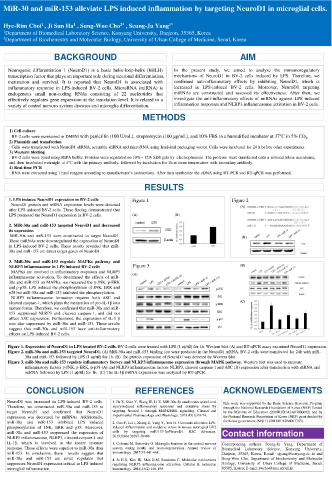
MiR-30 and miR-153 alleviate LPS induced inflammation by targeting NeuroD1 in microglial cells.

                                        2*
                         1
               1
  Hye-Rim Choi , Ji Sun Ha , Sung-Woo Cho , Seung-Ju Yang 1*
  1 Department of Biomedical Laboratory Science, Konyang University, Daejeon, 35365, Korea
  2 Department of Biochemistry and Molecular Biology, University of Ulsan College of Medicine, Seoul, Korea
                   BACKGROUND                                                  AIM


    Neurogenic differentiation 1 (NeuroD1) is a basic helix-loop-helix (bHLH)  In the present study, we aimed to analyze the immunoregulatory
    transcription factor that plays an important role during neuronal differentiation,  mechanisms of NeuroD1 in BV-2 cells induced by LPS. Therefore, we
    maturation and survival. It is reported that NeuroD1 is associated with  confirmed anti-inflammatory effects by inhibiting NeuroD1, which is
    inflammatory response in LPS-induced BV-2 cells. MicroRNA (miRNA) is  increased in LPS-induced BV-2 cells. Moreover, NeuroD1 targeting
    endogenous small non-coding RNAs consisting of 22 nucleotides that  miRNAs are constructed and assessed its effectiveness. After then, we
    effectively regulates gene expression at the translation level. It is related to a  investigate the anti-inflammatory effects of miRNAs against LPS induced
    variety of central nervous system diseases and microglia differentiation.  inflammation responses and NLRP3 inflammasome activation in BV-2 cells.
                                               METHODS

    1) Cell culture
    : BV-2 cells were maintained in DMEM with penicillin (100 U/mL), streptomycin (100 μg/mL), and 10% FBS in a humidified incubator at 37°C in 5% CO 2 .
    2) Plasmids and transfection
    : Cells were transfected with NeuroD1 shRNA, scramble shRNA and microRNA using lentiviral packaging vector. Cells were incubated for 24 h before other experiments.
    3) Western blotting
    : BV-2 cells were lysed using RIPA buffer. Proteins were separated on 10% - 12% SDS gels by electrophoresis. The proteins were transferred onto a nitrocellulose membrane,
    and then incubated overnight at 4℃ with the primary antibody, followed by incubation for 1h at room temperature with secondary antibody.
    4) Real-time PCR
    : RNA were extracted using Trizol reagent according to manufacturer’s instructions. After then synthesize the cDNA using RT-PCR and RT-qPCR was performed.

                                                RESULTS

    1. LPS induces NeuroD1 expression in BV-2 cells  Figure 1               Figure 2
     NeuroD1 protein and mRNA expression levels were detected                  (A)
    after LPS induced BV-2 cells. These finding demonstrated that
    LPS promoted the NeuroD1 expression in BV-2 cells.  (A)  (B)
    2. MiR-30a and miR-153 targeted NeuroD1 and decreased
    its expression
    MiR-30a and miR-153 were constructed to target NeuroD1.                     (B)
    These miRNAs were downregulated the expression of NeuroD1
    in LPS-induced BV-2 cells. These results revealed that miR-
    30a and miR-153 are direct target genes of NeuroD1.
    3. MiR-30a and miR-153 regulate MAPKs pathway and
    NLRP3 inflammasome in LPS induced BV-2 cells  Figure 3                     (B)
     MAPKs are involved in inflammatory responses and NLRP3
    inflammasome activation. To determined the effects of miR-  (A)
    30a and miR-153 on MAPKs, we measured the p-JNK, p-ERK
    and p-p38. LPS induced the phosphorylation of JNK, ERK and
    p38 but miR-30a and miR-153 inhibited the phosphorylation.
     NLRP3 inflammasome formation requires both ASC and
    cleaved caspase-1, which plays the maturation of pro-IL-1β into            (C)
    mature forms. Therefore, we confirmed that miR-30a and miR-
    153 suppressed NLRP3 and cleaved caspase-1, and did not
    affect ASC expression. Furthermore, the expression of IL-1 β
    was also suppressed by miR-30a and miR-153. These results
    suggest that miR-30a and miR-153 have anti-inflammatory
    effects on LPS-induced BV-2 cells.

    Figure 1. Expression of NeuroD1 in LPS treated BV-2 cells. BV-2 cells were treated with LPS (1 ㎍/㎖) for 1h. Western blot (A) and RT-qPCR assay examined NeuroD1 expression.
    Figure 2. miR-30a and miR-153 targeted NeuroD1. (A) MiR-30a and miR-153 binding site were predicted in the NeuroD1 mRNA. BV-2 cells were transfected for 24h with miR-
         30a and miR-153 followed by LPS (1 ㎍/㎖) for 1h. (B) The protein expression of NeuroD1 was detected by Western blot.
    Figure 3. miR-30a and miR-153 regulate inflammatory factors and NLRP3 inflammasome expression through MAPK pathway. Western blot was used to measure
         inflammatory factors p-JNK, p-ERK, p-p38 (A) and NLRP3 inflammasome factors NLRP3, cleaved caspase-1 and ASC (B) expression after transfection with shRNA and
         miRNA followed by LPS (1 ㎍/㎖) for 1h. (C) The IL-1β mRNA expression was analyzed by RT-qPCR.

          CONCLUSION                         REFERENCES                   ACKNOWLEDGEMENTS

   NeuroD1 was increased in LPS-induced BV-2 cells.  1. Fu X, Shen Y, Wang W, Li X. MiR‐30a‐5p ameliorates spinal cord  This work was supported by the Basic Science Research Program
   Therefore, we constructed miR-30a and miR-153 to  injury‐induced inflammatory responses and oxidative stress by  through the National Research Foundation of Korea (NRF) funded
   target  NeuroD1  and  confirmed  that  NeuroD1  targeting Neurod 1 through MAPK/ERK signalling. Clinical and  by the Ministry of Education (2018R1D1A3A03000692) and by
   expression was decreased by miRNAs. Additionally,  Experimental Pharmacology and Physiology. 2018;45(1):68-74.  the National Research Foundation of Korea (NRF) grant funded by
   miR-30a  and  miR-153  inhibited  LPS  induced  2. Gao F, Lei J, Zhang Z, Yang Y, You H. Curcumin alleviates LPS-  the Korea government (MSIT) (2018R1A2B6001743).
   phosphorylation of JNK, ERK and p38. Moreover,  induced inflammation and oxidative stress in mouse microglial BV2
   miR-30a and miR-153 suppressed the expression of  cells  by  targeting  miR-137-3p/NeuroD1.  RSC  Advances.  Contact information
   NLRP3 inflammasome, NLRP3, cleaved caspase-1 and  2019;9(66):38397-38406.
   IL-1β, which is involved in the innate immune  3. Colonna M, Butovsky O. Microglia function in the central nervous  Corresponding authors. Seung-Ju Yang, Department of
   response. These effects were superior to miR-30a than  system during health and neurodegeneration. Annual review of  Biomedical  Laboratory  Science,  Konyang  University,
   miR-153. In conclusion, these  results suggest that  immunology. 2017;35:441-468.  Daejeon, 35365, Korea; E-mail: sjyang@konyang.ac..kr and
   miR-30a and miR-153 are novel regulator that  4. Jo E-K, Kim JK, Shin D-M, Sasakawa C. Molecular mechanisms  Sung-Woo Cho, Department of biochemistry and Molecular
   suppresses NeuroD1 expression critical in LPS induced  regulating NLRP3 inflammasome activation. Cellular & molecular  Biology, University of Ulsan College of Medicine, Seoul,
   microglial inflammation.           immunology. 2016;13(2):148-159.    05505, Korea; E-mail: swcho@amc.seoul.kr

