


Page 1 - Q. Neuroscience
P. 1
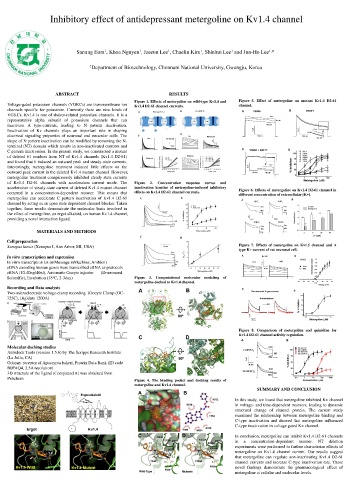
Inhibitory effect of antidepressant metergoline on Kv1.4 channel
1,
1
Sanung Eom , Khoa Nguyen , Jaeeun Lee , Chaelin Kim , Shinhui Lee and Jun-Ho Lee *
1
1
1
1
1 Department of Biotechnology, Chonnam National University, Gwangju, Korea
ABSTRACT RESULTS
Figure 1. Effects of metergoline on wild-type Kv1.4 and Figure 5. Effect of metergoline on mutant Kv1.4 D2-61
Voltage-gated potassium channels (VGKCs) are transmembrane ion Kv1.4 D2-61 channel currents. channel.
channels specific for potassium. Currently there are nine kinds of
VGKCs. Kv1.4 is one of shaker-related potassium channels. It is a
representative alpha subunit of potassium channels that can
inactivate A type-currents, leading to N pattern inactivation.
Inactivation of Kv channels plays an important role in shaping
electrical signaling properties of neuronal and muscular cells. The
shape of N pattern inactivation can be modified by removing the N-
terminal (NT) domain which results in non-inactivated currents and
C pattern inactivation. In the present study, we constructed a mutant
of deleted 61 residues from NT of Kv1.4 channels (Kv1.4 D2-61)
and found that it induced an outward peak and steady-state currents.
Interestingly, metergoline treatment induced little effects on the
outward peak current in the deleted Kv1.4 mutant channel. However,
metergoline treatment conspicuously inhibited steady state currents
of Kv1.4 D2-61 channels with acceleration current mode. The Figure 2. Concentration response curves and
acceleration of steady-state current of deleted Kv1.4 mutant channel inactivation kinetics of metergoline-induced inhibitory Figure 6. Effects of metergoline on Kv1.4 D2-61 channel in
occurred in a concentration-dependent manner. This means that effects on Kv1.4 D2-61 channel currents. different concentration of extracellular [K+].
metergoline can accelerate C pattern inactivation of Kv1.4 D2-61
channel by acting as an open state dependent channel blocker. Taken
together, these results demonstrate the molecular basis involved in
the effect of metergoline, an ergot alkaloid, on human Kv1.4 channel,
providing a novel interaction ligand.
MATERIALS AND METHODS
Cell preparation
Xenopus laevis (Xenopus I, Ann Arbor, MI, USA) Figure 7. Effects of metergoline on Kv1.5 channel and A
type K+ current of rat neuronal cell.
In vitro transcription and expression
In vitro transcription kit (mMessage mMachine; Ambion)
cDNA encoding human genes were transcribed cRNA as protocols
cRNA (10-40ng/40nl), Automatic Oocyte injector (Drummond
Scientific), Incubation (18℃, 2-3day) Figure 3. Computational molecular modeling of
metergoline docked to Kv1.4 channel.
Recording and Data analysis
Two-microelectrode voltage-clamp recording (Oocyte Clamp (OC-
725C), Digidata 1200A)
Figure 8. Comparison of metergoline and quinidine for
Kv1.4 D2-61 channel activity regulation.
Molecular docking studies
Autodock Tools (version 1.5.6) by The Scripps Research Institute
(La Jolla, CA)
Odorant receptor of Apocrypta bakeri, Protein Data Bank (ID code
B0FAQ4, 3.5A resolution)
3D structure of the ligand (Compound A) was obtained from
Pubchem
Figure 4. The binding pocket and docking results of
metergoline and Kv1.4 channel.
SUMMARY AND CONCLUSION
In this study, we found that metergoline inhibited K+ channel
in voltage- and time-dependent manners, leading to dynamic
structural change of channel protein. The current study
examined the relationship between metergoline binding and
C-type inactivation and showed that metergoline influenced
C-type inactivation in voltage gated K+ channel.
In conclusion, metergoline can inhibit Kv1.4 D2-61 channels
in a concentration-dependent manner. NT deletion
experiments were performed to further characterize effects of
metergoline on Kv1.4 channel current. Our results suggest
that metergoline can regulate non-inactivating Kv1.4 D2-61
channel currents and increase C-type inactivation rate. These
novel findings demonstrate the pharmacological effect of
metergoline at cellular and molecular levels.

