


Page 11 - Q. Neuroscience
P. 11
Neuroprotection of PEP-1-GSTA2 against oxidative stress-induced ischemic injury


                   Yeon Joo Choi , Hyeon Ji Yeo , Eun Ji Yeo , Min Jea Shin , Dae Won Kim , Jinseu Park , Kyu Hyung Han ,
                                               1
                                                         1
                             1,
                                       1
                                                                    2
                                                                            1
                                                                                        1
                               1
                    Keun Wook Lee , Jong Kook Park , Sung-Woo Cho , Duk-Soo Kim , Won Sik Eum , Soo Young Choi 1,*
                                                      3
                                                                4
                                                                          1
                                          1
                  1 Department of Biomedical Science and Research Institute of Bioscience and Biotechnology, Hallym University, Chuncheon 24252, Korea.
         2 Department of Biochemistry and Molecular Biology, Research Institute of Oral Sciences, College of Dentistry, Gangneung-Wonju National University, Gangneung 25457, Korea.
                       3 Department of Biochemistry and Molecular Biology, University of Ulsan College of Medicine, Seoul 05505, Korea.
                           4 Department of Anatomy, College of Medicine, Soonchunhyang University, Cheonan-Si 31538, Korea.
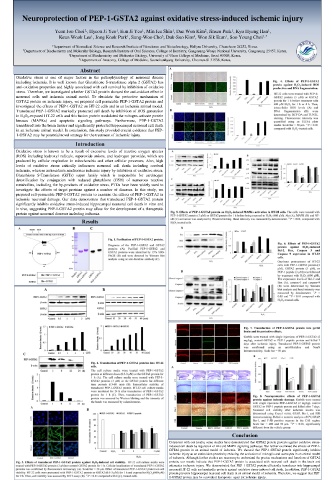
      Oxidative stress is one of major factors in the pathophysiology of neuronal disease
      including ischemia. It is well known that Glutathione S-transferase alpha 2 (GSTA2) has
      anti-oxidative properties and highly associated with cell survival by inhibition of oxidative
      stress. Therefore, we investigated whether GSTA2 protein showed the anti-oxidant effect in
      neuronal cells and ischemia animal model. To elucidate the protective mechanism of
      GSTA2 protein on ischemic injury, we prepared cell permeable PEP-1-GSTA2 protein and
      investigated the effects of PEP-1-GSTA2 on HT-22 cells and in an ischemia animal model.
      Transduced PEP-1-GSTA2 markedly protected cell death by inhibition of ROS generation
      in H 2 O 2 -exposed HT-22 cells and this fusion protein modulated the mitogen-activate protein
      kinases (MAPKs) and apoptotic signaling pathways. Furthermore, PEP-1-GSTA2
      transduced into the brain tissues and significantly protected hippocampal neuronal cell death
      in an ischemic animal model. In conclusion, this study provided crucial evidence that PEP-
      1-GSTA2 may be potential novel strategy for the treatment of ischemic injury.
      Oxidative stress is known to be a result of excessive levels of reactive oxygen species
      (ROS) including hydroxyl radicals, superoxide anions, and hydrogen peroxide, which are
      produced by cellular respiration in mitochondria and other cellular processes. Also, high
      levels of oxidative stress critically influences neuronal cell death including cerebral
      ischemia, whereas antioxidants ameliorates ischemic injury by inhibition of oxidative stress.
      Glutathione S-Transferase (GSTs) super family which is responsible for carcinogen
      detoxification by conjugation with reduced glutathione (GSH) of numerous reactive
      metabolites, including the by-products of oxidative stress. PTDs have been widely used to
      investigate the effects of target proteins against a number of diseases. In this study, we
      prepared cell-permeable PEP-1-GSTA2 protein to examine the effects of PEP-1-GSTA2 in
      ischemic neuronal damage. Our data demonstrate that transduced PEP-1-GSTA2 protein
      significantly inhibits oxidative stress-induced hippocampal neuronal cell death in vitro and
      in vivo, suggesting PEP-1-GSTA2 protein may allow for the development of a therapeutic
      protein against neuronal diseases including ischemia.


                                                        Consistent with our results, some studies have demonstrated that GSTA2 protein protects against oxidative stress-
                                                        induced cell death by regulation of Akt and MAPK signaling pathways. We further examined the effects of PEP-1-
                                                        GSTA2 protein in an animal model of ischemia. We showed that PEP-1-GSTA2 protein significantly inhibits
                                                        ischemic injury as an antioxidant protein by reducing the activation of microglia and astrocytes in an animal model
                                                        of ischemia. Although further studies are necessary to understand the precise mechanisms and functions of GSTA2
                                                        protein, our results indicate that PEP-1-GSTA2 protein is associated with neuronal cell death in the brain and
                                                        attenuates ischemic injury. We demonstrated that PEP-1-GSTA2 protein efficiently transduces into hippocampal
                                                        neuronal HT-22 cells and markedly protects against oxidative stress-induced cell death. In addition, PEP-1-GSTA2
                                                        protein prevents hippocampal neuronal cell death in an animal model of ischemia. Therefore, we suggest that PEP-
                                                        1-GSTA2 protein may be a potential therapeutic agent for ischemic injury.

