


Page 15 - Q. Neuroscience
P. 15
Intraneuronal Delivery Of Parkin Protects Neurons
                             By Replacing Damaged Mitochondria

      Jiae Park, Eunna Chung, Wonheum Nah, Joonno Lee, Soyoung Park, Shinyoung Kang, Jaehyung Park and Daewoong Jo
              Drug Development Team, Cellivery R&D Institute, Cellivery Therapeutics, Inc., Seoul 03929, Korea.

                     BACKGROUND                                                     AIM
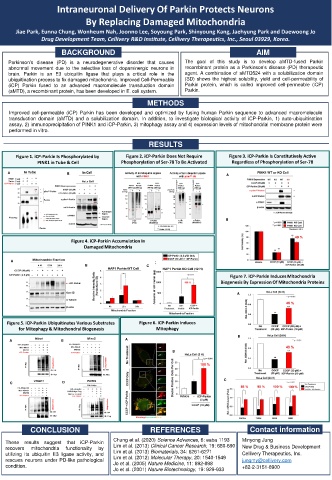
    Parkinson’s disease (PD) is a neurodegenerative disorder that causes  The goal of this study is to develop aMTD-fused Parkin
    abnormal movement due to the selective loss of dopaminergic neurons in  recombinant protein as a Parkinson’s disease (PD) therapeutic
    brain. Parkin is an E3 ubiquitin ligase that plays a critical role in the  agent. A combination of aMTD524 with a solubilization domain
    ubiquitination process to fix damaged mitochondria. Improved Cell-Permeable  (SD) shows the highest solubility, yield and cell-permeability of
    (iCP) Parkin fused to an advanced macromolecule transduction domain  Parkin protein, which is called improved cell-permeable (iCP)
    (aMTD), a recombinant protein, has been developed in E. coli system.  Parkin.
                                                 METHODS
    Improved cell-permeable (iCP) Parkin has been developed and optimized by fusing human Parkin sequence to advanced macromolecule
    transduction domain (aMTD) and a solubilization domain. In addition, to investigate biological activity of iCP-Parkin, 1) auto-ubiquitination
    assay, 2) immunoprecipitation of PINK1 and iCP-Parkin, 3) mitophagy assay and 4) expression levels of mitochondrial membrane protein were
    performed in vitro.
                                                 RESULTS

      Figure 1. iCP-Parkin Is Phosphorylated by  Figure 2. iCP-Parkin Does Not Require   Figure 3. iCP-Parkin Is Constitutively Active
             PINK1 in Tube & Cell       Phosphorylation of Ser-78 To Be Activated  Regardless of Phosphorylation of Ser-78

    A                  B                                                   A


                                                                           B


                        Figure 4. iCP-Parkin Accumulation In
                            Damaged Mitochondria

     A
                             B                   C
                                                                            Figure 7. iCP-Parkin Induces Mitochondria
                                                                         Biogenesis By Expression Of Mitochondria Proteins
                                                                              A


   Figure 5. iCP-Parkin Ubiquitinates Various Substrates  Figure 6. iCP-Parkin Induces
       for Mitophagy & Mitochondral Biogenesis      Mitophagy
                                                                              B
    A                B                    A
                                                         B


                                                                          C
    C                D


           CONCLUSION                             REFERENCES                      Contact information

   These  results  suggest  that  iCP-Parkin  Chung et al. (2020) Science Advances, 6: eaba 1193  Minyong Jung
   recovers  mitochondria  functionality  by  Lim et al. (2013) Clinical Cancer Research, 19: 680-690  New Drug & Business Development
   utilizing its ubiquitin E3 ligase activity, and  Lim et al. (2013) Biomaterials, 34: 6261-6271  Cellivery Therapeutics, Inc.
   rescues neurons under PD-like pathological  Lim et al. (2012) Molecular Therapy, 20: 1540-1549  jungmy@cellivery.com
   condition.                         Jo et al. (2005) Nature Medicine, 11: 892-898  +82-2-3151-8900
                                      Jo et al. (2001) Nature Biotechnology, 19: 929-933

