


Page 17 - Q. Neuroscience
P. 17
Reciprocal connections between mediodorsal thalamus and prefrontal cortex

                                        Yelin Lee, Hyeonyeong Jeong, Eunji Cheong*
                    Department of Biotechnology, College of Life Science and Biotechnology, Yonsei University, Seoul 120-752, Korea


  BACKGROUND
   Prefrontal cortex (PFC)–mediodorsal thalamus (MD) interactions are critical for cognition. In addition, executive functions, such as working memory and cognitive control,
  majorly depend on PFC integrity. Most of the current knowledge about the thalamocortical (TC) projection organization has been obtained by relying on neuronal circuit-
  tracing approaches; however, the underlying circuits are unclear, and the results of previous studies are inconsistent. Therefore, to investigate the connections between
  the MD and various PFC regions, this study focused on specific MD–PFC connections using anterograde and retrograde tools. Anterograde and retrograde tools were
  injected into the MD of mice, and different MD and PFC subdivisions were examined. In addition, the quantitative and qualitative features of the MD–medial prefrontal
  cortex (mPFC) pathway were analyze using direct comparisons of labeling. Different MD subdivisions characterized differential TC connectivity. The MD received
  excitatory inputs from the motor region (primary and secondary motor cortex [M1 and M2]), mPFC (anterior cingulate area, prelimbic and infralimbic areas), orbitofrontal
  cortex, and agranular insular cortex and inhibitory inputs from the reticular nucleus of the thalamus and the zona incerta. The results provided insight into a new
  corticothalamic circuit and the consciousness-related function of the MD, which will help understand the TC connectivity of this region and determine its functional role.
  AIM
   MD plays a role in memory and other cognitive tasks. Anatomical tracing studies have confirmed at least three different MD subdivisions: medial MD (MDm), central MD
  (MDc), and lateral MD (MDl). Each is differentially interconnected to the PFC. The most anterior part of frontal lobes is the part of the cortex innervated primarily by
  afferents from the mediodorsal nucleus of the thalamus. Interest in understanding the functional contribution of thalamic inputs to cortical functions and of different
  thalamic afferents has significantly increased as it may provide insight into the relative specialization of PFC subdivisions. This study focused on specific connections
  from the MD to the PFC through direct comparisons of labeling produced by anterograde and retrograde tracing injections in different subdivisions of the PFC in mice.
  The differential TC connectivity characterizes different clusters of cells in the MD, and MD projections to the PFC are related to different MD neuronal populations. The
  data collected will reveal the neuronal architecture of MD projections to the PFC and provide a better understanding of the quantitative and qualitative features of MD–
  PFC pathways. In addition, a clearer anatomical and functional understanding of thalamic-frontal circuitry will clarify how its alteration might contribute to cognitive
  dysfunction in psychiatric conditions.
  METHODS                               RESULTS
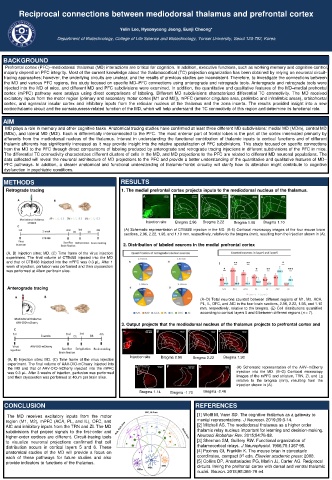
   Retrograde tracing                   1. The medial prefrontal cortex projects inputs to the mediodorsal nucleus of the thalamus.
                                                A         B       C         D         E

                                                 l  c
                                               m
                                                Injection site  Bregma 2.96  Bregma 2.22  Bregma 1.98  Bregma 1.10
                                         (A) Schematic representation of CTB488 injection in the MD. (B-E) Confocal microscopy images of the four mouse brain
                                         sections, 2.96, 2.22, 1.98, and 1.10 mm, respectively, relative to the bregma (mm), resulting from the injection shown in (A).
                                         2. Distribution of labeled neurons in the medial prefrontal cortex
   (A, B) Injection sites: MD. (C) Time frame of the virus injection
   experiment. The final volume of CTB488 injected into the MD
   and that of CTB488 injected into the mPFC was 0.3 μL. After 1
   week of injection, perfusion was performed and then cryosection
   was performed at 40um per brain slice.

   Anterograde tracing
                                                                  (A–D) Total neurons counted between different regions of M1, M2, ACA,
                                                                  PL, IL, OFC, and AIC in the four brain sections, 2.96, 2.22, 1.98, and 1.10
                                                                  mm, respectively, relative to the bregma. (E) Cell distributions quantified
                                                                  according to cortical layers 5 and 6 between different regions (n = 7).
                                         3. Output projects that the mediodorsal nucleus of the thalamus projects to prefrontal cortex and
                                         A subcortex.  B      C         D


                                           Injection site  Bregma 2.96  Bregma 2.22  Bregma 1.98
    (A, B) Injection sites: MD. (C) Time frame of the virus injection
    experiment. The final volume of AAV-DIO-mCherry injected into
    the MD and that of AAV-DIO-mCherry injected into the mPFC  E  F  G        (A) Schematic representation of the AAV–mCherry
    was 0.3 μL. After 3 weeks of injection, perfusion was performed           injection into the MD. (B–G) Confocal microscopy
    and then cryosection was performed at 40um per brain slice.               images of the mPFC and striatum, TRN, ZI, and Lg
                                                                              relative to the bregma (mm), resulting from the
                                                                              injection shown in (A).
                                              Bregma 1.14  Bregma -1.70  Bregma -2.46
  CONCLUSION                                                     REFERENCES
   The MD receives excitatory inputs from the motor              [1] Wolff M, Vann SD. The cognitive thalamus as a gateway to
   region (M1, M2), mPFC (ACA, PL, and IL), OFC, and             mental representations. J Neurosci. 2019;39:3-14.
   AIC and inhibitory inputs from the TRN and ZI. The MD         [2] Mitchell AS. The mediodorsal thalamus as a higher order
   subdivisions that project signals to the first-order and      thalamic relay nucleus important for learning and decision-making.
   higher-order cortices are different. Circuit-tracing tools    Neurosci Biobehav Rev. 2015;54:76-88.
   to visualize neuronal projections confirmed that cell         [3] Sherman SM, Guillery RW. Functional organization of
   distribution occurs in cortical layers 5 and 6. These         thalamocortical relays. J Neurophysiol. 1996;76:1367-95.
   anatomical studies of the MD will provide a focus on          [4] Paxinos Gf, Franklin K. The mouse brian in stereotaxic
                                                                                rd
   each of these pathways for future studies and also            coordinates, compact 3 edn. Elsevier academic press: 2008.
   provide indicators to functions of the thalamus.              [5] Collins DP, Anastasiades PG, Marlin JJ, Carter AG. Reciprocal
                                                                 circuits linking the prefrontal cortex with dorsal and ventral thalamic
                                                                 nuclei. Neuron. 2018;98:366-79 e4

