


Page 5 - N. Metabolism and metabolic diseases
P. 5
Positive Regulation Of JAK/STAT Signaling With SOCS3 Drived
        Cell-Permeable Binding Domain To ObR Induces Anti-Obesity Effect

                   Kuysook Lee, Jisook Jeon, Sujeong Kim, Hyuntae Kang, Youngsil Choi and Daewoong Jo
               Metabolic Disease Team,  Cellivery R&D Institute, Cellivery Therapeutics, Inc., Seoul 03929, Korea

                   BACKGROUND                                                   AIM
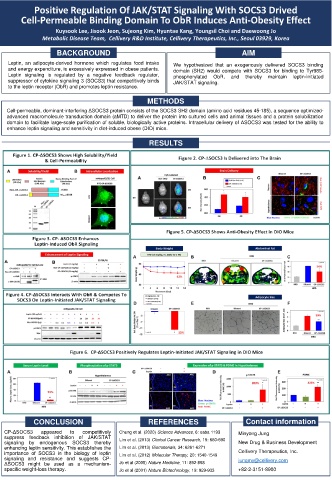
    Leptin, an adipocyte-derived hormone which regulates food intake  We hypothesized that an exogenously delivered SOCS3 binding
    and energy expenditure, is excessively expressed in obese patients.  domain (SH2) would compete with SOCS3 for binding to Tyr985-
    Leptin signaling is regulated by a negative feedback regulator,  phosphorylated  ObR,  and  thereby  maintain  leptin-initiated
    suppressor of cytokine signaling 3 (SOCS3) that competitively binds  JAK/STAT signaling.
    to the leptin receptor (ObR) and promotes leptin resistance.

                                                 METHODS
   Cell-permeable, dominant-interfering ΔSOCS3 protein consists of the SOCS3 SH2 domain (amino acid residues 45-185), a sequence optimized-
   advanced macromolecule transduction domain (aMTD) to deliver the protein into cultured cells and animal tissues and a protein solubilization
   domain to facilitate large-scale purification of soluble, biologically active proteins. Intracellular delivery of ΔSOCS3 was tested for the ability to
   enhance leptin signaling and sensitivity in diet-induced obese (DIO) mice.

                                                 RESULTS


            CONCLUSION                           REFERENCES                      Contact information
  CP-ΔSOCS3   appeared  to  competitively  Chung et al. (2020) Science Advances, 6: eaba 1193  Minyong Jung
  suppress  feedback  inhibition of  JAK/STAT
  signaling  by  endogenous  SOCS3  thereby  Lim et al. (2013) Clinical Cancer Research, 19: 680-690  New Drug & Business Development
  enhancing leptin sensitivity. This establishes the  Lim et al. (2013) Biomaterials, 34: 6261-6271
  importance of SOCS3 in the biology of leptin  Lim et al. (2012) Molecular Therapy, 20: 1540-1549  Cellivery Therapeutics, Inc.
  signaling and resistance and suggests CP-                                    jungmy@cellivery.com
  ΔSOCS3 might be used as a mechanism-  Jo et al (2005) Nature Medicine, 11: 892-898
  specific weight-loss therapy.         Jo et al (2001) Nature Biotechnology, 19: 929-933  +82-2-3151-8900

