


Page 27 - N. Metabolism and metabolic diseases
P. 27
Carbonic anhydrase regulates anabolic and catabolic factors in
articular chondrocytes
Yunhui Min1, Dahye Kim2, Godagama Gamaarachchige Dinesh Suminda1, Xiangyu Zhao1, Mangeun Kim2, Young-Ok Son1,2*
1 Interdisciplinary Graduate Program in Advanced Convergence Technology and Science, Jeju National University, Jeju Special Self-Governing
Province, 63243, Republic of Korea.
2Department of Animal Biotechnology, Faculty of Biotechnology, College of Applied Life Sciences, Jeju National University, Jeju Special Self-
Governing Province, 63243, Republic of Korea.
Introduction
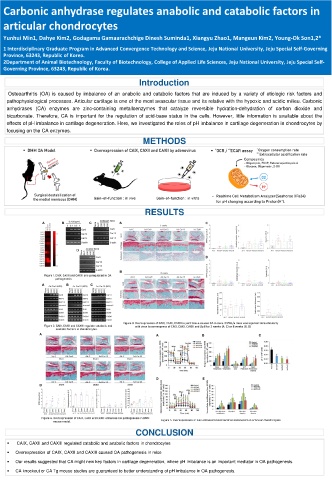
Osteoarthritis (OA) is caused by imbalance of an anabolic and catabolic factors that are induced by a variety of etiologic risk factors and
pathophysiological processes. Articular cartilage is one of the most avascular tissue and its relative with the hypoxic and acidic milieu. Carbonic
anhydrases (CA) enzymes are zinc-containing metalloenzymes that catalyze reversible hydration-dehydration of carbon dioxide and
bicarbonate. Therefore, CA is important for the regulation of acid-base status in the cells. However, little information is available about the
effects of pH imbalance in cartilage degeneration. Here, we investigated the roles of pH imbalance in cartilage degeneration in chondrocytes by
focusing on the CA enzymes.
METHODS
RESULTS
CONCLUSION
CAIX, CAXII and CAXIII regulated catabolic and anabolic factors in chondrocytes
Overexpression of CAIX, CAXII and CAXIII caused OA pathogenesis in mice
Our results suggested that CA might new key factors in cartilage degeneration, where pH imbalance is an important mediator in OA pathogenesis.
CA knockout or CA Tg mouse studies are guaranteed to better understanding of pH imbalance in OA pathogenesis.

