


Page 25 - N. Metabolism and metabolic diseases
P. 25
The study of Hes1 in hepatic steatosis development

                                Jaegyeong Lee    1,2 and Kyung-Hee Chun     1,2
                                                                                                       2
  1 Department of Biochemistry & Molecular Biology, Yonsei University College of Medicine, 50 Yonsei-ro, Seadaemun-gu, Seoul 120-752,  Brain
                              Korea 21 Plus Project for Medical Science, Yonsei Universiry, Korea
                                             BACKGROUND
    Non-alcoholic fatty liver disease (NAFLD) is one of the most common liver disease that can progress to non-alcoholic steatohepatitis (NASH) and hepatocellular carcinoma (HCC). The
    pathophysiology of NASH remains unknown, and there are no-FDA-approved drugs to treat NASH 1 . Therefore, the drug to treat liver disease and molecular mechanism research is needed for
    effective molecular-targeted therapy.
    Notch signaling pathway is an evolutionarily highly conserved cell signaling system present in most animal 2 . Mammals are composed of four homologous Notch receptors (Notch1-4), which can
    bind various ligands; Delta-like (Dll1, 3, and 4), Jagged (Jagged1 and 2) 3 . These ligands induce Notch receptor and then the Notch intracellular domain (NICD) is cleaved by g-secretase, which
    leads to translocation of the NICD into the nucleus. In the nucleus, NICD interacts with the transcriptional factor RBP-J to transcript of transcriptional repressor such as Hairy and enhancer of
    split (Hes) family and Hes-related proteins (Hey) 4, 5, 6 . Most of all, other researches indicate that hairy and enhancer of split-1 (Hes1) is related to lipid accumulation.
    Yes-associated protein (YAP) and transcriptional coactivator with PDZ-binding motif (TAZ) are known for being the effectors of Hippo pathway. Hippo pathway, also known as the Slavador-
    Warts-Hippo (SWH) pathway, regulates cell proliferation and apoptosis. Transcriptional enhanced associate domain (TEAD) functions in response to highly conserved Hippo pathway to regulate
    cell growth and proliferation 7 .YAP/TAZ is related to liver fibrosis through activation in hepatic stellate cells (HSCs) which are important for hepatic integrity 8 . It is expected that Hes1 is correlated
    to YAP/TAZ and TEAD. However, the correlation between Hes1 and Hippo pathway in liver has not been clarified.
                                                    AIM

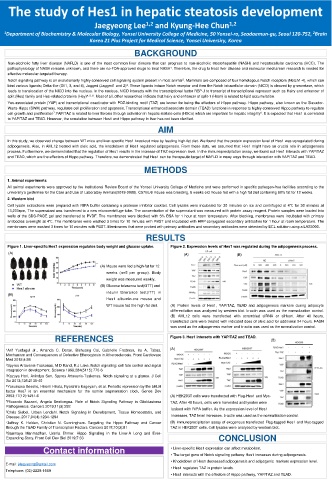
   In this study, we observed change between WT mice and liver-specific Hes1 knockout mice by feeding high-fat diet. We found that the protein expression level of Hes1 was upregulated during
   adipogenesis. Also, in AML12 treated with oleic acid, the knockdown of Hes1 regulated adipogenesis. From these data, we assumed that Hes1 might have an crucial role in adipogenesis
   process. Furthermore, we demonstrated that the regulation of Hes1 results in the increase of TAZ expression level. In the immunoprecipitation assay, we found out Hes1 interacts with YAP/TAZ
   and TEAD, which are the effectors of Hippo pathway. Therefore, we demonstrated that Hes1 can be therapeutic target of NAFLD in many ways through interaction with YAP/TAZ and TEAD.
                                                METHODS

   1. Animal experiments
   All animal experiments were approved by the Institutional Review Board of the Yonsei University College of Medicine and were performed in specific pathogen-free facilities according to the
   university’s guidelines for the Care and Use of Laboratory Animals(2019-0088). C57BL/6 mouse was breeding, 8 weeks old mouse fed with a high fat diet containing 60% fat for 12 weeks.
   2. Western blot
   Cell lysate extractions were prepared with RIPA buffer containing a protease inhibitor cocktail. Cell lysates were incubated for 30 minutes on ice and centrifuged at 4℃ for 30 minutes at
   13,200rpm, The supernatant was transferred to a new microcentrifuge tube. The concentration of the supernatant was measured with protein assay reagent. Protein samples were loaded into
   wells of the SDS-PAGE gel and transferred to PVDF. The membranes were blocked with 5% BSA for 1 hour at room temperature. After blocking, membranes were incubated with primary
   antibodies overnight at 4℃. The membranes were washed 3 times for 10 minutes with PBST and incubated with HRP-conjugated secondary antibodies for 1 hour at room temperature. The
   membranes were washed 3 times for 10 minutes with PBST. Membranes that were probed with primary antibodies and secondary antibodies were detected by ECL solution using a LAS3000.
                                                 RESULTS

   Figure 1. Liver-specific Hes1 expression regulates body weight and glucose uptake.  Figure 2. Expression levels of Hes1 was regulated during the adipogenesis process.
    (A)                                                      (A)              (B)

                                  (A) Mouse were fed a high-fat for 12
                                    weeks (n=5 per group). Body
                                    weight was measured weekly.
                                  (B) Glucose tolerance test(GTT) and
                                    insulin tolerance test(ITT) in
    (B)
                                    Hes1 albumin-cre mouse and
                                    WT mouse fed the high-fat diet.  (A) Protein levels of Hes1, YAP/TAZ, TEAD and adipogenesis markers during adipocyte
                                                        differentiation was analyzed by western blot. b-actin was used as the normalization control.
                                                        (B) AML12 cells were transfected with scrambled siRNA or siHes1. After 40 hours,
                                                        transfected cells were treated with indicated dose of oleic acid for additional 24 hours. FASN
                                                        was used as the adipogenesis marker and b-actin was used as the normalization control.
                   REFERENCES                           Figure 3. Hes1 interacts with YAP/TAZ and TEAD.  (B)

   1 Arif Yurdagul Jr., Amanda C. Doran, Bishuang Cai, Gabrielle Fredman, Ira A. Tabas.  (A)
   Mechanism and Consequences of Defective Efferocytosis in Atherosclerosis. Front Cardiovasc
   Med 2018;4:86
   2 Spyros Artavanis-Tsakonas, M D Rand, R J Lake. Notch signaling: cell fate control and signal
   integration in development. Science 1999;284(5115):770-6
   3 Kazuya Hori, Anindya Sen, Spyros Artavanis-Tsakonas. Notch signaling at a glance. J Cell
   Sci 2013;126:2135-40
   4 Yasumasa Bessho, Hiromi Hirata, Ryoichiro Kageyam, et al. Periodic repression by the bHLH
   factor Hes7 is an essential mechanism for the somite segmentation clock. Genes Dev
   2003;17(12):1451-6                                   (A) HEK293T cells were transfected with Flag-Hes1 and Myc-
   5 Riccardo Bazzoni, Angela Bentivegna. Role of Notch Signaling Pathway in Glioblastoma  TAZ. After 48 hours, cells were harvested and lysates were
   Pathogenesis. Cancers 2019;11(3):292
   6 Chris Siebel, Urban Lendahl. Notch Signaling in Development, Tissue Homeostasis, and  lysised with RIPA buffer. As the expression level of Hes1
   Disease. 2017;94(4):1234-1294                         increases, TAZ level increases. b-actin was used as the normalization control.
   7 Jeffrey K. Holden, Christian N. Cunningham. Targeting the Hippo Pathway and Cancer  (B) Immunoprecipitation assay of exogenous transfected Flag-tagged Hes1 and Myc-tagged
   through the TEAD Family of Transcription Factors. Cancers 2018;10(3):81  TAZ in HEK293T cells. Cell lysates were analyzed by western blot.
   8 Saumaya Manmadhan, Ursnla Ehmer. Hippo Signaling in the Liver-A Long and Ever-
   Expanding Story. Front Cell Dev Biol 2019;7:33                       CONCLUSION
               Contact information                       • Liver-specific Hes1 expression can affect metabolism.
                                                         • The target gene of Notch signaling pathway Hes1 increases during adipogenesis.
                                                         • Knockdown of Hes1 decreased adipogenesis and adipogenic markers expression level.
   E-mail: j4egyeong@gmail.com
                                                         • Hes1 regulates TAZ in protein levels.
   Telephone: (02)-2228-1669
                                                         • Hes1 interacts with the effectors of Hippo pathway, YAP/TAZ and TEAD.

