


Page 1 - N. Metabolism and metabolic diseases
P. 1
Gymnaster koraiensis extract alleviated metabolic
syndrome symptoms with UCP1-independent energy
expenditure in diet induced obese mice model
Da Seul Jung¹,², Yang-Ju Son¹, Ji Min Shin¹, Saruul Erdenebileg¹, Chang Ho Lee², Chu Won Nho¹
¹Smart Farm Reserch Center, Korea Institute of Science and Technology (KIST) Gangneung Institute of Natural Products, Gangneung Gangwon-do, Korea
²Biology, Gangneung-Wonju National University, Gangneung Gangwon-do, Korea
Abstract & Purpose
Metabolic syndrome is a medical term that represents a state of co-occurrence of
more than three pathologic risk factors like abdominal obesity, insulin resistance,
hypertension, hyperglycemia, and hyperlipidemia. Metabolic syndrome can lead to
serious diseases such as diabetes and cardiovascular disease, and since so far single
drug used to treat each symptom, we are looking for a functional food material for
anti-obesity and metabolic syndrome with multi-target effect. Gymnaster koraiensis
(GK) is an edible plant of Korea known for its anti-cancer, anti-oxidative, and
hepatoprotective properties. In this study, we hypothesized that the GK ethanol extract
could be utilized for treating obesity and metabolic syndrome. Administration of
100mg/kg GK extract to high-fat dietary induced obese (DIO) mice effectively reduced
body weight, weight of fat tissues, and size of white adipose tissues. It also
ameliorated cardiovascular disease risk by regulating hyperlipidemia and adiponectin
contents. Moreover, GK extract improved insulin resistance by lowering fasting blood
glucose levels, mitigating oxidative stress and inflammation. In addition,
supplementation of GK extract in DIO mice resulted in elevated energy expenditure in
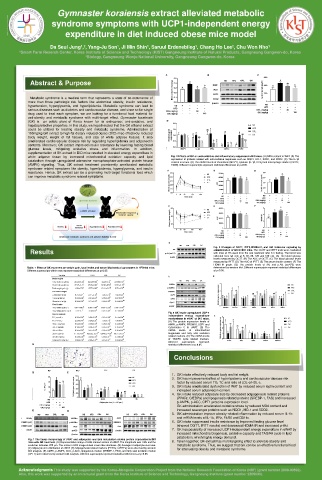
white adipose tissue by increased mitochondrial oxidative capacity and lipid Fig. 2 Effects of GK on anti-oxidative and inflammatory responses in DIO mice. (A) MDA content in WAT. (B) The
catabolism through upregulated adenosine monophosphate-activated protein kinase expression of proteins related with anti-oxidative responses such as NQO1, HO-1, SOD1, and SOD2. (C) The IL-1β
content in serum. (D) The mRNA levels of chemokine (MCP1), cytokine (IL-1β, IFNγ) and macrophage marker (CD11c,
(AMPK) signaling. Thus, GK extract treatment prominently ameliorated metabolic F4/80). Different superscripts represent statistical differences at p<0.05.
syndrome related symptoms like obesity, hyperlipidemia, hyperglycemia, and insulin
resistance. Hence, GK extract can be a promising multi-target functional food which
can improve metabolic syndrome related symptoms.
Fig. 3 Changes of OGTT, IPITT, HOMA-IR, and Akt molecular signaling by
Results administration of GK in DIO mice. The OGTT and IPITT tests were conducted
with mice at 7th week from the oral treatment after 6 h fasting. The blood was
collected from tail vein at 0, 30, 60, 120 and 180 min. (A) The blood glucose
levels measured by OGTT. (B) The AUC of OGTT. (C) The blood glucose levels
measured by IPITT. (D) The AUC of IPITT. (E) The serum insulin content. (F) The
HOMA-IR graph. (G) The protein levels of Akt and p-Akt (ser473) were
Table. 1 Effect of GK treatment on weight gain, food intake and serum biochemical parameters in HFD-fed mice. determined by western blot. Different superscripts represent statistical differences
Different superscripts within rows represent statistical differences at p<0.05. at p<0.05.
Fig 4 GK intake upregulated UCP-1
independent energy expenditure
mechanisms in eWAT of DIO mice.
(A) The protein expression levels of
AMPK, p-AMPK, PRDM16, UCP1 and
Cytochrome C in eWAT. (B) The
mRNA levels of mitochondrial
biogenesis and fatty acid oxidation
related markers. (C) The mRNA levels
of TAG/FA cycle related markers.
Different superscripts represent
statistical differences at p<0.05.
Conclusions
1. GK intake effectively reduced body and fat weight.
2. GK has improvement effect of hyperlipidemia and cardiovascular disease risk
factor by reduced serum TG, TC and ratio of LDL-c/HDL-c.
3. GK intake ameliorated dysfunction of WAT by reduced serum leptin content and
increased serum adiponectin content.
4. GK intake reduced adipocyte size by decreased adipogenesis related proteins
(PPARr, C/EBPa) and lipogenesis related proteins (SREBP-1, FAS) and increased
p-AMPK, p-ACC, CPT1 proteins expression level.
GK administration ameliorated oxidative stress by reduced MDA content and
increased scavenger proteins such as NQO1, HO-1 and SOD2.
5. GK administration improve obesity-related inflammation by reduced serum IL-1b
and mRNA levels of IL-1b, IFNr, F4/80 and CD11c.
6. GK intake suppressed insulin resistance by improved fasting glucose level
(showed OGTT, IPITT results) and decreased HOMA-IR and increased p-Akt
7. GK has possibility of increased UCP1-independent energy expenditure in eWAT by
increased mitochondria biogenesis, oxidative capacity and TAG/FA cycle in lipid
catabolism, which highly energy demand.
Fig. 1 The tissue morphology of eWAT and adipogenic and lipid metabolism related protein expression in DIO
mice with GK treatment. (A) Representative image of H&E stained section of eWAT. The magnitude was 100x and the 8. Taken together, GK extract has multi targeting effect to alleviate obesity and
scale bar indicates 200 μm. The arrow in HFD image shows crown like structures. (B) Average of adipocyte size area. metabolic syndrome. Thus, we suggest that GK can be an effective functional food
(C) Adipocyte size distribution of eWAT. (D) Adipogenesis related markers (PPARγ, C/EBPα) were observed by western for attenuating obesity and metabolic syndrome.
blot analysis. (E) AMPK, p-AMPK, ACC, p-ACC, lipogenesis marker (SREBP-1, FAS), and fatty acid oxidation marker
(CPT1) were observed by western blot analysis. Different superscripts represent statistical differences at p<0.05.
Acknowledgments This study was supported by the Korea–Mongolia Cooperation Project from the National Research Foundation of Korea (NRF) (grant number 2008-00592).
Also, this work was supported by an intramural grant from the Korea Institute of Science and Technology, Gangneung Institute (grant number 2Z05630).

