


Page 91 - D. Cancer biology
P. 91
[D-60]     Downregulation of TMEM176B protein is promotes Oncogenic-Ras activated
                                          tumor progression.

                                             Hong-Beum Kim
          Department of Premedical Course, Chosun University School of Medicine, 309 Pilmun-daero, Dong-gu,

                                      Gwang-ju 61452,Republic of Korea

   Abstract      The neoplastic transformation by mutant RAS is thought to require remodeling of expression of an entire set of genes. However, the
               mechanism underlying Ras-activated tumor metastasis remains unclear. Here we show that oncogenic Ras decreases TMEM176B transcript
               production in mouse fibroblast NIH3T3 cells. TMEM176B transcript was undetectable in H460, A549, and H1299 cells exhibiting high Ras
               activity, but was relatively abundant in DMS53 cells containing low Ras activity. Furthermore, we demonstrate that TMEM176B transcription
               downregulated by oncogenic H-Ras. The ectopic expression of TMEM176B inhibited the epidermal growth factor (EGF)-stimulated ERK1/2
               phosphorylation in H-RasV12-transformed NIH3T3 cells. Finally, our results show that TMEM176B inhibits Ras-induced cell proliferation
               and tumor formation by oncogenic H-RasV12-transformed NIH3T3 cells. This study identifies the downregulation of TMEM176B as a
               potentially important mechanism by which oncogenic Ras-mediated tumor progression.

  Result


   Fig.1. DMS53, DLD-1 and HT-1080 cells were lysed and
   subjected to quantitation of active Ras-GTP by pull-down
   assays followed by immunoblotting as described in Material
   and Methods. Samples of lysates were also subjected to the
   determination of total levels of Ras by immunoblotting.


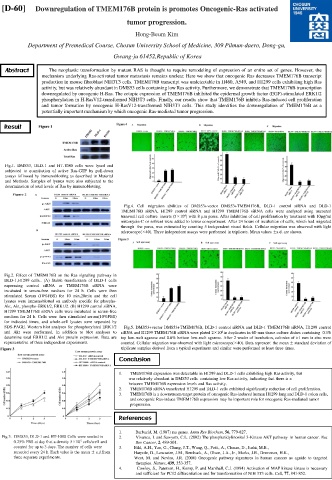
                                         Fig.4. Cell migration abilities of DMS53+vector DMS53+TMEM176B, DLD-1 control siRNA and DLD-1
                                        TMEM176B siRNA, H1299 control siRNA and H1299 TMEM176B siRNA cells were analysed using uncoated
                                                             4
                                        transwell cell culture inserts (5×10 ) with 8 µm pores. After inhibition of cell proliferation by treatment with 10µg/ml
                                        mitomycin-C or solvent were added to lower compartment. After 24 hours of incubation of cells, which had migrated
                                        through the pores, was estimated by counting 5 independent visual fields. Cellular migration was observed with light
                                        microscope(×40). Three independent assays were performed in triplicate. Mean values ±s.d. are shown.


  Fig.2. Effect of TMEM176B on the Ras signaling pathway in
  DLD-1,H1299 cells.. (A) Stable transfectants of DLD-1 cells
  expressing control siRNA or TMEM176B siRNA were
  incubated in serum-free medium for 24 h. Cells were then
  stimulated Serum (10%FBS) for 10 min,20min and the cell
  lysates were immunoblotted on antibody specific for phospho-
  Akt, Akt, phospho-ERK1/2, ERK1/2. (B) H1299 control siRNA,
  H1299 TMEM176B siRNA cells were incubated in serum-free
  medium for 24 h. Cells were then stimulated serum(10%FBS)
  for indicated times, and whole-cell lysates were separated by
  SDS-PAGE. Western blot analyses for phosphorylated ERK1/2  Fig.5. DMS53+vector DMS53+TMEM176B, DLD-1 control siRNA and DLD-1 TMEM176B siRNA, H1299 control
  and Akt were performed, in addition to blot analyses to  siRNA and H1299 TMEM176B siRNA were plated 2×10 in duplicates in 60-mm tissue culture dishes containing 0.3%
                                                                         4
  determine total ERK1/2 and Akt protein expression. Data are  top low-melt agarose and 0.6% bottom low-melt agarose. After 2 weeks of incubation, colonies of >1 mm in size were
  representative of three independent experiments.  counted. Cellular migration was observed with light microscope(×40). Data represent the mean ± standard deviation of
                                        triplicate samples derived from a typical experiment and similar were performed at least three times.
                                        Conclusion

                                        1.  TMEM176B expression was detectable in H1299 and DLD-1 cells exhibiting high Ras activity, but
                                           was relatively abundant in DMS53 cells  containing low Ras activity, indicating that there is a
                                           between TMEM176B expression levels and Ras activity.
                                        2.  TMEM176B siRNA transfected H1299 and DLD-1 cells exhibited significantly reduction of cell proliferation.
                                        3.  TMEM176B is a downstream target protein of oncogenic Ras-induced human H1299 lung and DLD-1 colon cells,
                                           and oncogenic Ras-induce TMEM176B expression may be important role for oncogenic Ras-mediated tumor
                                           progression.
                                        References

                                        1.   Barbacid, M. (1987) ras genes. Annu Rev Biochem, 56, 779-827.
  Fig.3. DMS53, DLD-1 and HT-1080 Cells were seeded in  2.  Vivanco, I. and Sawyers, C.L. (2002) The phosphatidylinositol 3-Kinase AKT pathway in human cancer. Nat
                           5
     0.25% FBS at day 0 at a density 5×10 cells/well and  Rev Cancer, 2, 489-501.
     counted for up to 3 days. The number of cells were  3.  Bild, A.H., Yao, G., Chang, J.T., Wang, Q., Potti, A., Chasse, D., Joshi, M.B.,
     recorded every 24 h. Each value is the mean ± s.d.from  Harpole, D., Lancaster, J.M., Berchuck, A., Olson, J.A., Jr., Marks, J.R., Dressman, H.K.,
     three separate experiments.             West, M. and Nevins, J.R. (2006) Oncogenic pathway signatures in human cancers as aguide to targeted
                                             therapies. Nature, 439, 353-357.
                                        4.    Cowley, S., Paterson, H., Kemp, P. and Marshall, C.J. (1994) Activation of MAP kinase kinase is necessary
                                             and sufficient for PC12 differentiation and for transformation of NIH 3T3 cells. Cell, 77, 841-852.

