


Page 85 - D. Cancer biology
P. 85
Inhibition of Chk1 by miR-320c increases oxaliplatin
                             susceptibility in triple negative breast cancer

                                        Soo-Been Lee, Yesol Kim, Sera Lim and Jong Hoon Park*
                            Department of Biological Science, Sookmyung Women’s University, Seoul 04310, Republic of Korea
                   BACKGROUND                                                  AIM
   Breast cancer is the most common cancers in women worldwide, and  DNA damage activates DNA damage response (DDR) by signaling
   triple-negative breast cancer (TNBC) is one of its most aggressive forms.  pathways mediated by Rad9-Hus1-Rad1(9-1-1)-ATR-Chk1. In
   In general, the survival of cancer cells relies on buffering the  addition, it was reported that there are several miRNAs known to
   consequences of increased stress levels, such as DNA damage and  regulate Chk1 in non-small cell lung cancer. However, there is no
   replication stress, induced during the tumorigenic process. MicroRNAs  study about the effect of miRNA on the responsiveness to
   (miRNAs) are small non-coding RNAs, which regulate gene expression  oxaliplatin in TNBC by regulating Chk1. In this study, we
   by binding to the 3' -untranslated region (UTR) of target mRNAs and it  demonstrate that miR-320c may serve as a prognostic marker of
   may play a role in drug responsiveness and resistance by altering target  oxaliplatin by regulating DDR through the expression of Chk1.
   gene expression in breast cancer.
                                               METHODS
   ▪ Cell viability assay  ▪ Alkaline Comet assay  ▪ Immunofluorescence(ICC/IF) microscopy ▪ Analysis of human breast tumor microarray data
   ▪ Dual-Luciferase reporter assay ▪ Apoptosis analysis (FACS) ▪ Caspase-3 activation assay  ▪ Xenograft mice and intratumoral miRNA transfection
                                                RESULTS
   A                              B                    A                             C


                                                       B                             D


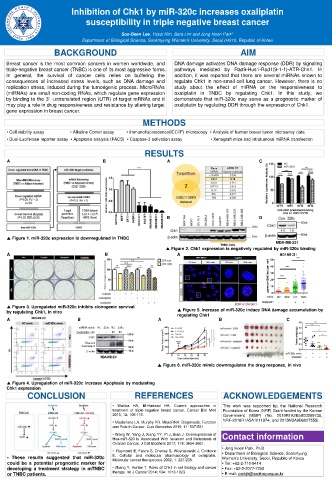
   ▲ Figure 1. miR-320c expression is downregulated in TNBC
                                                       ▲ Figure 2. Chk1 expression is negatively regulated by miR-320c binding
   A                               B                       A


   ▲ Figure 3. Upregulated miR-320c inhibits clonogenic survival
   by regulating Chk1, in vitro                            ▲ Figure 5. Increase of miR-320c induce DNA damage accumulation by
                                                           regulating Chk1
   A                      B                         A                   B                     C


                                                    ▲ Figure 6. miR-320c mimic downregulates the drug response, in vivo

   ▲ Figure 4. Upregulation of miR-320c increase Apoptosis by modulating
   Chk1 expression
          CONCLUSION                         REFERENCES                   ACKNOWLEDGEMENTS

                                      ▪ Wahba HA, El-Hadaad HA. Current approaches in  This work was supported by; the National Research
                                      treatment of triple-negative breast cancer. Cancer Biol Med  Foundation of Korea (NRF) Grant funded by the Korean
                                      2015; 12: 106-116.                  Government  (MSIP)  (No.  2019R1A2B5B03069738,
                                                                          NRF-2016R1A5A1011974, and 2015M3A9B6027555).
                                      ▪ Macfarlane LA, Murphy PR. MicroRNA: Biogenesis, Function
                                      and Role in Cancer. Curr Genomics 2010; 11: 537-561.
                                      Hsa-miR-320 Is Associated With Invasion and Metastasis of Contact information
                                      ▪ Wang W, Yang J, Xiang YY, Pi J, Bian J. Overexpression of
                                      Ovarian Cancer. J Cell Biochem 2017; 118: 3654-3661.
                                                                         ▪ Jong Hoon Park, Ph.D.
                                      ▪ Raymond E, Faivre S, Chaney S, Woynarowski J, Cvitkovic  ▪ Department of Biological Science, Sookmyung
   ▪ These results suggested that miR-320c  E. Cellular and molecular pharmacology of oxaliplatin.  Women’s University, Seoul, Republic of Korea
                                      Molecular cancer therapeutics 2002; 1: 227-235.
   could be a potential prognostic marker for                            ▪ Tel: +82-2-710-9414
   developing a treatment strategy in mTNBC  ▪ Zhang Y, Hunter T. Roles of Chk1 in cell biology and cancer  ▪ Fax: +82-2-2077-7258
   or TNBC patients.                  therapy. Int J Cancer 2014; 134: 1013-1023.  ▪ E-mail: parkjh@sookmyung.ac.kr

