


Page 61 - D. Cancer biology
P. 61
Development of Antibody Drug Conjugate Targeting c-Kit and
                                   Validation of Effectiveness in Cancer

                                           Jin-Ock Kim , and Sang Gyu Park 1,2
                                                       1
                       1 College of Pharmacy, Ajou University, Gyeonggi-do, 16499, Republic of Korea
                                 2 NoveltyNobility, Gyeonggi-do, 13477, Republic of Korea
                  BACKGROUND                                                METHODS

  c-Kit is a member of the Type III receptor tyrosine kinase family. c-Kit is activated by  Antibody Internalization Assay. GIST cells were stained with PE-labeled
  stem cell factor (SCF), which plays a critical role in the differentiation, proliferation,  NN2101 at 4℃. After washing, cells were incubated at 37℃ for 30minutes.
  and survival of hematopoietic stem cells, melanocytes, and germ cells. Gain-of-  And then cells were fixed and stained with APC-labeled LAMP-1 antibody,
  function mutations resulting in constitutive c-Kit activation play a central pathogenic  lysosomal marker.
  role in gastrointestinal stromal tumors (GIST), subsets of melanoma, acute  ADC Conjugation. Mixture of NN2101 and SMCC-DM1 (MedChemExpress)
  myelogenous leukemia (AML), and acute systemic mastocytosis (ASM).  was incubated in sodium phosphate buffer. NN2101-DM1 was separated
  Imatinib which targets c-Kit, platelet‐derived growth factor receptor (PDGFR), and  using PD-10 desalting column (GE Healthcare).
  BCR‐ABL, was approved as a first‐line treatment and shown to induce a good  Cytotoxicity Assay. Cells were plated onto 96-well plate (3000~8000
  response in patients including leukemia, GIST, and systemic mastocytosis. Although  cells/well) and incubated with NN2101 and NN2101-DM1 (up to 400 ug/ml) at
  Imatinib is successful as therapeutics, some patients occurring c-Kit mutations within  37℃ for 3 or 4 days. Live cells were stained with Calcein AM (Invitrogen) or
  2 to 5 years after starting therapy have been shown resistance to Imatinib. Of c-Kit  Hoechst 33342 (Thermo Scientific) and counted using Celigo Imaging
  mutations, activating mutation not only induces SCF-independent c-Kit activation but  Cytometer (Nexcelom Bio-science) to determine the cell viability.
  also is one of the causes of resistance to anti-tumor drug.  In Vivo Studies in Tumor Xenograft model. Cancer cells mixed with
  Here, we characterized a human anti-c-Kit antibody (NN2101) that blocks the SCF/c-  Matrigel (Corning) were injected subcutaneously into right flank of 6-wk-old
  Kit pathway following the high affinity (KD = 2.83 x 10 -12  M) against the  CB17-SCID mice. When tumor approximately 200 mm in size, the mice were
                                                                                            3
  immunoglobulin-like domain 2 of c-Kit. Also, we developed Antibody Drug Conjugate  treated with NN2101, NN2101-DM1, IgG-DM1, and Imainib via i.V. or oral
  (ADC) using SMCC-DM1 and examined its therapeutic efficacy in vitro and in vivo.  administration. Tumor size were measured once in three days with a caliper.
                                                 RESULTS

                                 A                        B                      C          *
                                                                c-Kit Binding test


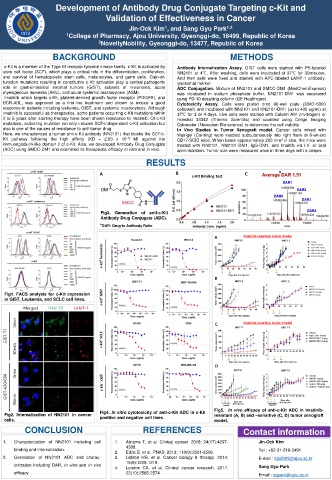
                                  Fig3. Generation of anti-c-Kit
                                  Antibody Drug Conjugate (ADC).
                                  *DAR: Drug to Antibody Ratio

                                                                                Imatinib-resistant tumor model


  Fig1. FACS analysis for c-Kit expression
  in GIST, Leukemia, and SCLC cell lines.


                                                                                Imatinib-sensitive tumor model


  Fig2. Internalization of NN2101 in cancer  Fig4. In vitro cytotoxicity of anti-c-Kit ADC in c-Kit  Fig5. In vivo efficacy of anti-c-Kit ADC in Imatinib-
                                                                       resistant (A, B) and –sensitive (C, D) tumor xenograft
  cells.                         positive and negative cell lines.     model.
         CONCLUSION                            REFERENCES                       Contact information
  1.  Characterization of NN2101 including cell  1.  Abrams T, et al. Clinical cancer. 2018; 24(17):4297-  Jin-Ock Kim
                                          4308.
      binding and internalization.                                                   Tel : +82-31-219-3491
                                      2.  Edris B, et al. PNAS. 2013; 110(9):3501-3506.
  2.  Generation of NN2101 ADC and charac-  3.  Lebron MB, et al. Cancer biology & therapy. 2014;  E-mail : kjo8909@ajou.ac.kr
                                          15(9):1208-1218.
      terization including DAR, in vitro and in vivo                                 Sang Gyu Park
                                      4.  London CA, et al. Clinical cancer research. 2017;
      efficacy.                           23(10):2565-2574.                          Email : sgpark@ajou.ac.kr

