


Page 65 - D. Cancer biology
P. 65
Induction of HYOU1 via reciprocal crosstalk between
NSCLC cells and HUVECs control cancer progression
and chemoresistance in multicellular tumor spheroids
1
1
2
1
1
1
3
Minji Lee , Yeonhwa Song , Su-Yeon Lee , Sanghwa Kim , Inhee Choi ,Jiho Kim ,Joo Hwan No , Se-Hyuk Kim ,
4
and Haeng Ran Seo *
1
1 Cancer Biology Laboratory, 2 Medicinal Chemistry, 3 Screening Discovery Platform, 4 Leishmania Research Laboratory, Institut Pasteur Korea,
16, Daewangpangyo-ro 712 beon-gil, Bundang-gu, Seongnam-si, Gyeonggi-do, 13488, Korea
BACKGROUND
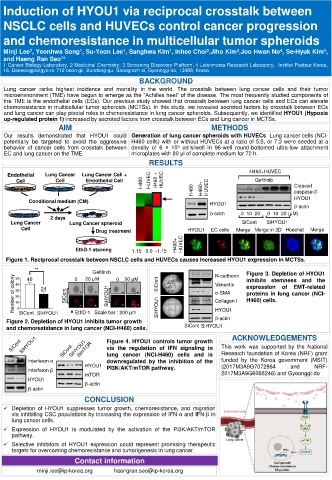
Lung cancer ranks highest incidence and mortality in the world. The crosstalk between lung cancer cells and their tumor
microenvironment (TME) have begun to emerge as the “Achilles heel” of the disease. The most frequently studied components of
the TME is the endothelial cells (ECs). Our previous study showed that crosstalk between lung cancer cells and ECs can elevate
chemoresistance in multicellular tumor spheroids (MCTSs). In this study, we revealed secreted factors by crosstalk between ECs
and lung cancer can play pivotal roles in chemoresistance in lung cancer spheroids. Subsequently, we identified HYOU1 (Hypoxia
up-regulated protein 1) increased by secreted factors from crosstalk between ECs and lung cancer in MCTSs.
AIM METHODS
Our results demonstrated that HYOU1 could Generation of lung cancer spheroids with HUVECs Lung cancer cells (NCI-
potentially be targeted to avoid the aggressive H460 cells) with or without HUVECs at a ratio of 5:5, or 7:3 were seeded at a
behavior of cancer cells from crosstalk between density of 6 × 10 cells/well in 96-well round-bottomed ultra-low attachment
3
EC and lung cancer on the TME. microplates with 80 μl of complete medium for 72 h.
RESULTS
H460+HUVEC
Endothelial Lung Cancer Lung Cancer Cell +
Cell Cell Endothelial Cell HUVEC H460 + HUVEC Gefitinib
H460 Cleaved
H460 H460+ HUVEC caspase-3
Conditional medium (CM) HYOU1 HYOU1
β-actin
b-actin 0 10 20 0 10 20 (μM)
2 days
Lung Cancer Lung Cancer spheroid SiCont SiHYOU1
Cell Drug treatment HYOU1 EC cells Merge Merge in 3D Hoechst Merge
H460+ HUVEC
EthD-1 staining 1.15 0.0 -1.15
Figure 1. Reciprocal crosstalk between NSCLC cells and HUVECs causes increased HYOU1 expression in MCTSs.
** 0 20 μM 0 20 μM N-cadherin Figure 3. Depletion of HYOU1
Gefitinib
Number of colony 40 24 SiCont SiHYOU1 SiCont Vimentin expression of EMT-related
40
50
inhibits stemness and the
30
α-SMA
proteins in lung cancer (NCI-
20
H460) cells.
Collagen I
10
0
EthD-1 Scale bar : 200 μm
SiCont SiHYOU1
β-actin
Figure 2. Depletion of HYOU1 inhibits tumor growth SiHYOU1 HYOU1
and chemoresistance in lung cancer (NCI-H460) cells. SiCont SiHYOU1
ACKNOWLEDGEMENTS
Figure 4. HYOU1 controls tumor growth
via the regulation of IFN signaling in This work was supported by the National
lung cancer (NCI-H460) cells and is Research foundation of Korea (NRF) grant
Interferon α downregulated by the inhibition of the funded by the Korea government (MSIT)
HYOU1 PI3K/AKT/mTOR pathway. (2017M3A9G7072864 and NRF-
Interferon β
mTOR 2017M3A9G6068246) and Gyeonggi-do
HYOU1
β-actin
β-actin
CONCLUSION
Depletion of HYOU1 suppresses tumor growth, chemoresistance, and migration
via inhibiting CSC populations by increasing the expression of IFN-α and IFN-β in
lung cancer cells.
Expression of HYOU1 is modulated by the activation of the PI3K/AKT/mTOR
pathway.
Selective inhibitors of HYOU1 expression could represent promising therapeutic
targets for overcoming chemoresistance and tumorigenesis in lung cancer.
Contact information
minji.lee@ip-korea.org haengran.seo@ip-korea.org

