


Page 17 - D. Cancer biology
P. 17
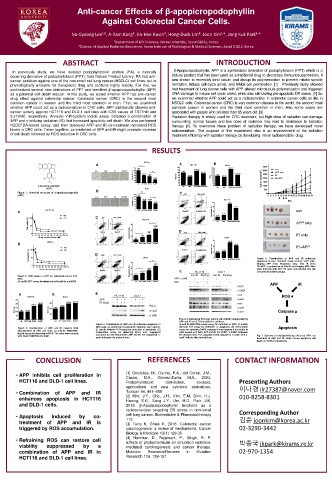
Anti-cancer Effects of β-apopicropodophyllin
                                  Against Colorectal Cancer Cells.

                                                                                     ,
                                                                         ,
                        Na-Gyeong Lee¹², A-Ram Kang², Jin-Hee Kwon², Hong-Duck Um², Joon Kim¹*, Jong Kuk Park²*
                                   ,
                                      ¹Department of Life Sciences, Korea University, Seoul 02841, Korea
                           ²Division of Applied Radiation Bioscience, Korea Institute of Radiological & Medical Sciences, Seoul 01812, Korea
                     ABSTRACT                                          INTRODUCTION
     In previously study, we have isolated podophyllotoxin acetate (PA), a naturally  β-Apopicropodophyllin, APP is a synthesized derivative of podophyllotoxin (PPT) which is a
    occurring derivative of podophyllotoxin (PPT), from Natural Product Library. PA had anti-  natural product that has been used as a traditional drug to decrease immunosuppression. It
    cancer activities against one of the non-small cell lung cancer (NSCLC) cell lines, but is  was shown to reversibly bind tubulin and disrupt its polymerization to prevent mitotic spindle
    physiologically unstable for therapeutic drug and contains highly toxicity. For that, we  formation, induce cell cycle arrest, and inhibit cell proliferation. [1]  Previously study showed
    synthesized several new derivatives of PPT and identified β-apopicropodophyllin (APP)  that treatment of lung cancer cells with APP altered microtubule polymerization and triggered
    Proviral integration site for Moloney murine leukemia virus-1 (Pim-1) is a serine/threonine kinase that regulates multiple cellular functions such   DNA damage to induce cell cycle arrest, while also stimulating pro-apoptotic ER stress. [2] So
    as a potential cell death inducer. In this study, we tested whether APP has anti-cancer
    as cell cycle, cell survival, drug resistance. Aberrant elevation of Pim-1 kinase is associated with numerous types of cancer. Pim-1 plays an
    drug effect against colorectal cancer. Colorectal cancer (CRC) is the second most  we examined whether APP could act as a radiosensitizer in colorectal cancer cells as like in
    important role in cancer cell survival. Ent-7beta-hydroxy-15-oxokaur-16-en-18-yl acetate (HOA) is a natural compound, which has been isolated
    from the leaves of Croton tonkinensis Gagnep. In the present study, we investigated degradation of Pim-1 by HOA. Treating HOA with time, cell
    death increased and the expression of Pim-1 was decreaed. PARP, cleaved PARP and cleaved Caspase-3 of PC-3 cell was identified through ined  NSCLC cells. Colorectal cancer (CRC) is very common disease in the world, the second most
    common cancer in women and the third most common in men. First, we exam
    whether APP could act as a radiosensitizer in CRC cells. APP additionally showed  common cancer in women and the third most common in men. Also some cases are
    Western Blot and showed apoptosis. The degree of apoptosis was confirmed by FACS. Pim-1 didn't show any change in RNA expression level  anti-
    detected through RT-PCR. Our results demonstrated  that Pim-1 was degraded by proteasome,  confirmed by treating Lactacystin and Chloro- in
    PC-3 cell. activity against HCT116 and DLD-1 cell lines with IC50 values of 7.877nM and
    cancer                                               associated with people who are less than 65 years old. [3]
    8.219nM, respectively. Annexin V-Propidium iodide assay indicated a combination of  Radiation therapy is widely used for CRC treatment, but high dose of radiation can damage
    APP and γ-ionizing radiation (IR) that increased apoptotic cell death. We also performed  surrounding normal tissues and low dose of radiation may lead to resistance to radiation
    H2DCFDA-based assay, and then observed APP and IR co-treatment increased ROS  therapy [4]. To overcome these problem of radiation therapy, we have developed novel
    levels in CRC cells. Taken together, co-treatment of APP and IR might promote increase  radiosensitizer. The purpose of this experiment also is an improvement of the radiation
    of cell death followed by ROS induction in CRC cells.  treatment efficiency with radiation therapy by developing novel radiosensitizer drug.
                                                  RESULTS
                                                HCT116                 B
                                A              ***         A   HCT116     DLD-1        3500
                                            120  100       140        180  169.71         con
                                con  APP  IR  IR+APP  100 80  **  120 100  100  114.06  93.78  160 140  3000  APP only
                                            Cell viability (%)  60 40  59.73  53.06  25.62  ROS (%)  80 60  67.28  ROS  120 100 80  100  88.06  111.29  Tumor size(mm 3 )  2500  IR IR+APP
                                                                                       2000
                                             0 20  con  APP 7.5nM IR 3Gy  IR+APP  40 20  60 40 20  1500
             b-Apopicropodophyllin                         0  con  NAC  IR+APPIR+APP+NAC  0  con  NAC  IR+APPIR+APP+NAC  1000
                (APP)           B               DLD-1                                  500
       Figure 1. Chemical structure of β-apopicropodophyllin  120  ***  C  con          0
       (APP).                                 100                NAC 5mM                0 2 4 6 8 10 12 14 16 18 20 22 24 26 28 30 32 34
                                con  APP  IR  IR+APP  100 80  67.30  63.90  *
                                            Cell viability (%)  60 40  45.69  20  HCT116 18.27  Day
                                             20                       15     13.73
       A        HCT116                       0  con  APP 7.5nM IR 3Gy  IR+APP  IR+APP  IR+APP+NAC  Apoptosis (%)  10  con
                      48h       C  con  APP 7.5nM                     5  3.76  5.79
          100
                      72h
          Cell viability (%)  50            30  HCT116  *  22.36      0  con  NAC  IR+APPIR+APP+NAC  APP only
                                  IR 3Gy  IR+APP  20  *  12.31  D
           0                               Apoptosis (%)     con  NAC 1mM
            0  10 20 30 40 50 60 70 80 90 100 110  10  8.43                                      IR only
              Drug concentration (nM)        4.3                          DLD-1
                                                                      15   13.19
       B        DLD-1                       0  con  APP 7.5nM IR 3Gy  IR+APP  10.70
                                                                      Apoptosis (%)
                      48h                                             10                         IR+APP
    Proviral integration site for Moloney murine leukemia virus-1 (Pim-1) is a serine/threonine kinase that regulates multiple cellular functions such as cell cycle, cell survival, drug resistance. Aberrant elevation of Pim-1 kinase is associated with numerous types of cancer. Pim-1 plays an important role in cancer cell
                                                            IR+APP
                      72h
          Cell viability (%)  50  con  APP 7.5nM  DLD-1               0              Figure 6. Combination of APP and IR enhances
           100
                                                                         5.66
                                                                 IR+APP+NAC
    survival. Ent-7beta-hydroxy-15-oxokaur-16-en-18-yl acetate (HOA) is a natural compound, which has been isolated from the leaves of  5  4.47
                                D
                                            30    **                    con  NAC  IR+APPIR+APP+NAC  apoptosis in vivo: ‘Control’, mock control; ‘APP only’,
                                                                                     5mg/kg APP only; ‘Radiation only’, 3Gy IR only;
           0                                       23.71                             ‘IR+APP’, combination of 3Gy IR and 5mg/kg APP; Mice
            0  10 20 30 40 50 60 70 80 90 100 110  *
              Drug concentration (nM)       20   16.58                               were injected with HCT116 cells and divided into the
                                  IR 3Gy  IR+APP  Apoptosis (%)  11.91  E  HCT116  DLD-1  indicated treatment groups.
       Figure 2. IC50 values of APP for colorectal cancer cell  10  8.03  non-IR IR(3Gy)  non-IR  IR(3Gy)
       lines.                                             APP (7.5nM)  -  +    -  - +     +  -  +    -  - +     +
       (A and B) MTT assay for detection cell viability and IC50.  0  con  APP 7.5nM IR 3Gy  IR+APP  NAC  - -  +     - -  +  - -  +     - -  +  APP  IR
                                                                              PARP
                                                                              c-PARP
       A          B             E                                             cas3
          HCT116      DLD-1           HCT116  DLD-1                                          ROS
      250                        APP  -  +    - +  -  +    - +                c-cas3
             192.53  150  146.09 150.28  IR (3Gy)  -  -  +   +  -  -  +   +   cas9
      200
           169.25   114.80                        Bcl-xl
      ROS (%)  150 100  100  98.28  ROS (%)  100  100  c-cas3                 c-cas9        Caspase
                                                                              b-actin
      50         50                               b-actin
       0          0                                        Figure 5. Refraining ROS can restore cell viability suppressed by
        con  APP 7.5nM IR 3Gy  IR+APP  con  APP 7.5nM IR 3Gy  IR+APP  APP and IR in HCT116 and DLD-1 cell lines.
                                Figure 4. Combination of APP and IR enhances apoptosis in  (A and B) H2DCFDA-based assay for detection of ROS. (C and D)
                                CRC cells. (A and B) Cell counting for detection cell viability.  Annexin V-PI assay for detection of apoptosis. (E) Immunoblot
       Figure 3. Combination of APP and IR induces ROS  (C and D) Annexin V-PI assay for detection of apoptosis. (E)  assay for detecting PARP, caspase-3 and caspase-9 activation in  Apoptosis
       accumulation in CRC cell lines. (A and B) H2DCFDA-  Immunoblot assay for detecting Bcl-xl and  caspase-3  cells treated with NAC, APP and IR. For PARP, ‘c-PARP’ indicates
       based assay for detection of ROS. The cells were stained  activation in cells treated with APP and IR. For caspases3 ‘c-  the cleaved form. For caspases-3 and caspase-9, ‘c-cas3’ and ‘c-
       with 25μM H2DCFDA for 5min.                                                   Fig. 7. Scheme of radiosensitizing effect by APP: co-
                                cas3’ indicates the cleaved form.  cas9’ indicate the cleaved form.  treatment of APP and IR could induce apoptotic cell
                                                                                     death via ROS accumulation.
             CONCLUSION                          REFERENCES                  CONTACT INFORMATION
      • APP inhibits cell proliferation in  [1] Gordaliza, M., García, P.A., del Corral, J.M.,
                                                                   2004.
       HCT116 and DLD-1 cell lines.       Castro,  M.A.,  Gómez-Zurita,  M.A., sources,  Presenting Authors
                                                       distribution,
                                          Podophyllotoxin:
                                          applications  and  new  cytotoxic  derivatives.  이나경 ilr27387@naver.com
      • Combination  of  APP  and  IR     Toxicon 44, 441–459
       enhances apoptosis in HCT116       [2] Kim, J.Y., Cho, J.H., Kim, E.M, Shin, H.J.  010-8258-8301
                                          Hwang, S.G., Song J.Y., Um, H.D., Park, J.K.
       and DLD-1 cells.                   2019.  β-Apopicropodophyllin  functions  as a
                                          radiosensitizer targeting ER stress in non-small
      • Apoptosis  induced  by  co-       cell lung cancer. Biomedicine & Pharmacotherapy  Corresponding Author
                                          113
       treatment  of  APP  and  IR  is    [3] Tariq K, Ghias K, 2016. Colorectal cancer  김준 joonkim@korea.ac.kr
       triggered by ROS accumulation.     carcinogenesis: a review of mechanisms. Cancer  02-3290-3442
                                          Biology & Medicine 13(1) 120-35
      • Refraining ROS can restore cell   [4] Nambiar, D., Rajamani, P., Singh, R. P.
                                          Effects of phytochemicals on ionization radiation-
       viability  suppressed  by  a       mediated carcinogenesis and cancer therapy.  박종국 jkpark@kirams.re.kr
       combination of APP and IR in       Mutation  Research/Reviews  in  Mutation  02-970-1354
       HCT116 and DLD-1 cell lines.       Research 113, 139-157

