


Page 13 - D. Cancer biology
P. 13
DDX3 expression by Serotonin receptor 7 through p53 via the AC-PKA-
ERK signaling pathway
Sanung Eom, Jaeeun Lee, Chaelin Kim, Shinhui Lee, Seong-Gene Lee* and Jun-Ho Lee*
Department of Biotechnology, Chonnam National University, Gwangju, Korea
ABSTRACT si-5-HT7 receptor for two hours. Analyzed by using a Figure 5. cAMP/PKA signaling activates phosphorylation of
cAMP-level ELISA assay kit (Sigma-Aldrich, St. Louis, ERK1/2.
DDX3 is a host viral factor that can inhibit the hepatitis B virus MO, USA P7626).
induced innate immune responses. In this study, the 20 bioactive
compounds were screened the effects on DDX3 and we found that RESULTS
5-HT upregulated DDX3 promoter activity via the 5-HT7 receptor
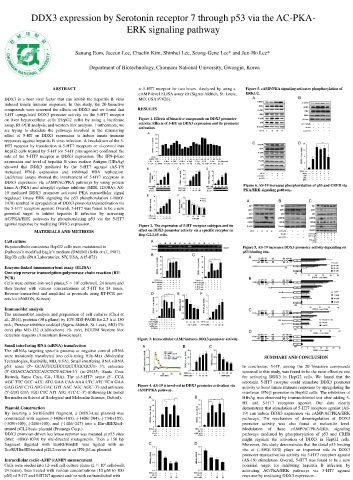
on liver hepatocellular cells (HepG2 cells) by using a luciferase Figure 1. Effects of bioactive compounds on DDX3 promoter
assay, RT-PCR analysis, and western blot analysis. Furthermore, we activity. Effects of 5-HT on DDX3 expression and its promoter
are trying to elucidate the pathways involved in the stimulating activation
effect of 5-HT on DDX3 expression to induce innate immune
responses against hepatitis B virus infection. A knockdown of the 5-
HT7 receptor by transfection si-5-HT7 receptors or si-control into
HepG2 cells treated by 5-HT (or 5-HT plus agonist) confirmed the
role of the 5-HT7 receptor in DDX3 expression. The IFN-β-Luc
expression and level of hepatitis B virus surface Antigen (HBsAg)
showed that DDX3 mediated by the 5-HT7 agonist (AS-19)
increased IFN-β expression and inhibited HBV replication.
Luciferase assays showed the involvement of 5-HT7 receptors in
DDX3 expression via cAMP/AC/PKA pathways by using protein
kinas A (PKA) and adenylyl cyclase inhibitor (MDL 12330A). AS- Figure 6. AS-19 increases phosphorylation of p53 and CREB via
PKA/ERK signaling pathway.
19 mediated DDX3 promoter activated PKA extracellular signal
regulated kinase ERK signaling the p53 phosphorylation (-1080/-
1070) resulted in upregulation of DDX3 promoter transactivation via
the 5-HT7 receptors agonist. Overall, 5-HT7 was found to be a new
potential target to inhibit hepatitis B infection by activating
AC/PKA/ERK pathways by phosphorylating p53 via the 5-HT7
agonist response by mediating DDX3 expression.. Figure 2. The expression of 5-HT receptor subtypes and its
MATERIALS AND METHODS effect on DDX3 promoter activity via a specific receptor in
Hep G2.2.15 cells.
Cell culture
Hepatocellular carcinoma HepG2 cells were maintained in Figure 5. AS-19 increases DDX3 promoter activity depending on
Dulbecco’s modified Eagle’s medium (DMEM) (Sells et al., 1987). p53 binding site.
Hep3B cells (PAA Laboratories, NY, USA, A15-073)
Enzyme-linked immunosorbent assay (ELISA)
One-step reverse transcription-polymerase chain reaction (RT-
PCR)
5
Cells were culture (six-well plates,5 × 10 cells/well, 24 hours) and
then treated with various concentrations of 5-HT for 24 hours.
Reverse-transcribed and amplified as protocols using RT-PCR pre-
mix kit (iNtRON, Korean)
Immunoblot analysis
The immunoblot analysis and preparation of cell cultures (Choi et
al., 2014), proteins (30 µg/lane) by 10% SDS-PAGE for 2.5 h at 130
mA., Protease inhibitor cocktail (Sigma-Aldrich, St. Louis, MO) 1%
(v/v) plus MG-132 (Calbiochem) 1% (v/v), ECLTM Western blot
detection reagents (Amersham Biosciences).
Figure 3. Intracellular cAMP induces DDX3 promoter activity.
Small interfering RNA (siRNA) transfection
The siRNAs targeting specific proteins or negative control siRNA
were transiently transfected into cells using Hily-Max (Molecular SUMMARY AND CONCLUSION
Technologies, Rockville, MD, USA). Small interfering RNA siRNA
p53: sense (5′- GCAUUCGUCCGGUUGCGCUtt- 3′); antisense In conclusion, 5-HT, among the 20 bioactive compounds
(5‘-GGACCACCGCAUCUCUACAtt-3′) (sc-29435; Santa Cruz screened in this study, was found to be the most effective one
Biotech, Santa Cruz, CA, USA). The si-5-HT7: sense (5′- CCA for activating DDX3 in HepG2 cells. We found that the
AGC TTC GCC ACC ATG GAA CAA AAA CTC ATC TCA GAA serotonin 5-HT7 receptor could stimulate DDX3 promoter
GAG GAT CTG ATG GAC GTT AAC AGC AGC -3′) and antisense Figure 4. AS-19 is involved in DDX3 promoter activation via activity to boost innate immune responses by upregulating the
(5′-GTG GTA TGG CTC ATT ATG ATC C -3′) (following Dr. Isabel cAMP/PKA pathway. interferon IFN-β promoter in HepG2 cells. The inhibition of
Bermudez in School of Biological and Molecular Science, Oxford). HBsAg was observed by immunoblotted test after adding 5-
HT and 5-HT7 receptors agonist. Our data clearly
Plasmid Construction demonstrate that stimulation of 5-HT7 receptors agonist (AS-
By inserting a SalI/HindIII fragment, a DDX3-Luc plasmid was 19) can induce DDX3 expression via cAMP/AC/PKA/ERK
constructed with regions (-1406/+105), (-1406/-204), (-734/+105), pathways. The mechanism of downregulation of DDX3
(-309/+105), (-246/+105), and (-1406/-247) into a Hin-dIII/XhoI- promoter activity was also found at molecular level.
treated pGL2 basic plasmid (Promega Corp.). Modulation of these cAMP/AC/PKA/ERK signaling
DDX3 promoter-driven luciferase reporter was mutated at p53 sites pathways mediated by phosphorylation of p53 and CREB
(Mul; -1080/-1070) by site-directed mutagenesis. Then a 156 bp might regulate the activation of DDX3 in HepG2 cells.
fragment digested with EcoRI/HindIII was ligated with an Moreover, this study demonstrates that the distal p53 binding
EcoRI/HindIII-treated pGL2-vector in an IFN-β-Luc plasmid. site at (-1080/-1070) plays an important role in DDX3
promoter transactivation activity via 5-HT7 receptors agonist
Intracellular cyclic-AMP (cAMP) measurement (AS-19) stimulation. Overall, 5-HT7 was found to be a new
Cells were seeded into 12-well cell culture plates (2 × 10 cells/well, potential target for inhibiting hepatitis B infection by
4
24 hours), then treated with various concentrations (10 µM to 100 activating AC/PKA/ERK pathways via 5-HT7 agonist
µM) of 5-HT and 5-HTR7 agonist and/ or with co-transfected with response by mediating DDX3 expression. .

