


Page 15 - D. Cancer biology
P. 15
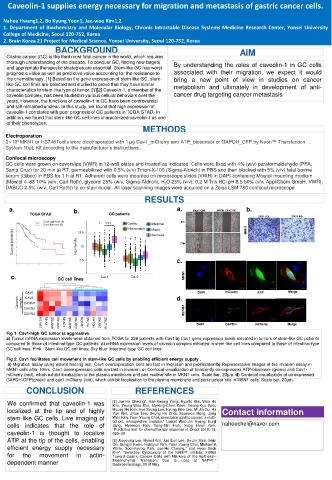
Caveolin-1 supplies energy necessary for migration and metastasis of gastric cancer cells.

  Nahee Hwang1,2, Bo Kyung Yoon1, Jae-woo Kim1,2
  1. Department of Biochemistry and Molecular Biology, Chronic Intractable Disease Systems Medicine Research Center, Yonsei University
  College of Medicine, Seoul 120-752, Korea
  2. Brain Korea 21 Project for Medical Science, Yonsei University, Seoul 120-752, Korea
                   BACKGROUND                                                  AIM
   Gastric cancer (GC) is the third most fatal cancer in the world, which requires
   thorough understanding of the disease. To conquer GC, finding new targets   By understanding the roles of caveolin-1 in GC cells
   and appropriate therapeutic strategies are essential. Stem-like GC has worst
   prognostic value as well as predictive value accounting for the resistance to   associated with their migration, we expect it would
   the chemotherapy. [1] Based on the gene expression of stem-like GC, stem-  bring a new point of view in studies on cancer
   like GC cell lines are selected and studied to prove that they have similar   metabolism and ultimately in development of anti-
   characteristics to stem-like type of tumor. [1][2] Caveolin-1, a member of the
   caveolin complex, has been studied in various cellular behaviors over the   cancer drug targeting cancer metastasis
   years. However, the functions of caveolin-1 in GC have been controversial
   and still remained unclear. In this study, we found that high expression of
   caveolin-1 correlates with poor prognosis of GC patients in TCGA STAD. In
   addition, we found that stem-like GC cell lines characterized caveolin-1 as one
   of their phenotypes.
                                               METHODS
   Electroporation
       5
   2×10 MKN1 or HS746Tcells were electroporated with 1 µg Cav1_mCherry and ATP_biosensor or GAPDH_GFP by Neon™ Transfection
   System 10μL Kit according to the manufacturer’s instructions.
   Confocal microscopy
   GC cells were grown on coverslips (VWR) in 12-well plates and treated as indicated. Cells were fixed with 4% (w/v) paraformaldehyde (PFA,
   Santa Cruz) for 20 min at RT, permeabilized with 0.5% (v/v) Triton-X-100 (Sigma-Aldrich) in PBS and then blocked with 5% (v/v) fetal bovine
   serum (Gibco) in PBS for 1 h at RT. Adherent cells were mounted on microscope slides (VWR) in DAPI-containing Mowiol mounting medium
   (Mowiol 4–88 10% (w/v, Carl Roth), glycerol 25% (w/v, Sigma-Aldrich), H 2 O 25% (v/v), 0.2 M Tris HCl pH 8.5 50% (v/v, AppliChem GmbH, VWR),
   DABCO 2.5% (w/v, Carl Roth)) to co-stain nuclei. All laser scanning images were acquired on a Zeiss LSM 780 confocal microscope.
                                                RESULTS

    a.                   b.                                a.   MKN1 Ctrl  MKN1 CAV1 OE  b.
           TCGA STAD                GC patients
                                                                                     CAV1 KD    CAV1 KD
               Cav1-high (n=113)                            0hr
               Cav1-low (n=113)    ***    Gastric  Intestinal
                                          Inflammatory  Mixed                    MKN1
     Survival probability  Log intensity  10                72hr
                          12.5
                                                  Stem-like
                           7.5                             c.

     c.             GC cell lines  Cav1     Cav2             MKN1


         CAV1                                                    DAPI     mCherry    ATP       Merge
         CAV2
       Caveolin  complex  CAVIN1                           d.
         CAVIN2
         CAVIN3                                              HS746T
                                                                 DAPI     GAPDH     mCherry    Merge
                MKN1
                             SNU16
                      MKN74
              HS746T
                           NCIN87
                               KATOIII
                  SNU668
                    SNU484
                                 SNU601
                                   SNU719
                       SNU638
                         SNU620
   Fig 1. Cav1-high GC tumor is aggressive.
   a) Tumor mRNA expression levels were obtained from TCGA for 226 patients with Cav1 b) Cav1 gene expression levels elevated in tumors of stem-like GC patients
   compared to those of intestinal-type GC patients. c) mRNA expression levels of caveolin complex elevated in stem-like cell lines compared to those of intestinal-type
   GC cell lines. Pink : Stem-like GC cell lines; Sky blue: Intestinal-type GC cell lines.
   Fig 2. Cav1 facilitates cell movement in stem-like GC cells by enabling efficient energy supply .
    a) Migration assay using wound healing test. Cav1 overexpression cells are fast in migration and proliferation b) Representative images of the invasion assay in
   MKN1 cells after 10hrs. Cav1 overexpression cells are fast in invasion. c) Confocal visualization of transiently co-expressed ATP-biosensor (green) and Cav1-
   mCherry (red), which exhibit localization to the plasma membrane and peri-nuclear site in MKN1 cells. Scale bar, 20μm. d) Confocal visualization of co-expressed
   GAPDH-GFP(green) and cav1-mCherry (red), which exhibit localization to the plasma membrane and peri-nuclear site in MKN1 cells. Scale bar, 20μm.
          CONCLUSION                         REFERENCES
   We confirmed that caveolin-1 was   [1] Jae-Ho Cheong*, Han-Kwang Yang, Hyunki Kim, Woo Ho
                                      Kim, Young-Woo Kim, Myeong-Cherl Kook, Young-Kyu Park,
   localized at the tip and of highly  Yan Kim, Jinae Lee, Seung Ho Choi, Soonwon Hong, Jong Contact information
                                      Hyung-Ho Kim, Hye Seung Lee, Kyung Hee Lee, Mi Jin Gu, Ha
   stem-like GC cells. Live imaging of  Won Kim, Yoon Young Choi, resectable gastric cancer: a multi-
                                      cohort, retrospective analysis.” Lancet Woo Jin Hyung, Eunji
   cells indicates that the role of   Jang, Hyeseon Kim, Yong-Min Huh, Sung Hoon Noh.  naheechel@naver.com
   caveolin-1 is thought to localize  “Predictive test for chemotherapy response in Oncol 2018; 19:
                                      629–38
   ATP at the tip of the cells, enabling  [2] Jooyoung Lee, Hyosil Kim, Jae Eun Lee, Su-Jin Shin, Sejin
   efficient energy supply necessary  Oh, Sungjin Kwon, Hakhyun Kim, Yoon Young Choi, Michael A.
                                      White, Soonmyung Paik, Jae-Ho Cheong,* and Hyun Seok
   for  the   movement    in  actin-  Kim*. “Selective Cytotoxicity of the NAMPT Inhibitor FK866
                                      Toward Gastric Cancer Cells with Markers of the Epithelial–
   dependent manner                   Mesenchymal  Transition,  Due  to  Loss  of  NAPRT.”
                                      Gastroenterology, 2018 May

