


Page 293 - ebook
P. 293
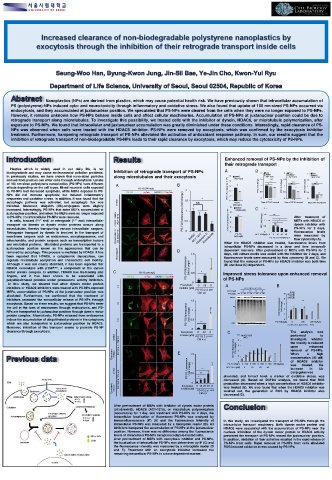
Nanoplastics (NPs) are derived from plastics, which may cause potential health risk. We have previously shown that intracellular accumulation of
PS (polystyrene)-NPs induced cyto- and neuro-toxicity through inflammatory and oxidative stress. We also found that uptake of 100 nm-sized PS-NPs occurred via
endocytosis, and they accumulated at juxtanuclear position. We speculated that PS-NPs were cleared from the cells when they were no longer exposed to PS-NPs.
However, it remains unknown how PS-NPs behave inside cells and affect cellular machineries. Accumulation of PS-NPs at juxtanuclear position could be due to
retrograde transport along microtubules. To investigate this possibility, we treated cells with the inhibitor of dynein, HDAC6, or microtubule polymerization, after
exposure to PS-NPs. We found that intracellular and juxtanuclear accumulation was greatly diminished under these conditions. Interestingly, rapid clearance of PS-
NPs was observed when cells were treated with the HDAC6 inhibitor. PS-NPs were removed by exocytosis, which was confirmed by the exocytosis inhibitor
treatment. Furthermore, hampering retrograde transport of PS-NPs alleviated the activation of antioxidant response pathway. In sum, our results suggest that the
inhibition of retrograde transport of non-biodegradable PS-NPs leads to their rapid clearance by exocytosis, which may reduce the cytotoxicity of PS-NPs.
Enhanced removal of PS-NPs by the inhibition of
their retrograde transport
Plastics which is widely used in our daily life, is not
biodegradable and may cause environmental pollution problems. Inhibition of retrograde transport of PS-NPs A B 2 Con 2 Con 2 Con
In previously studies, we have shown that nano-sized particles along microtubules and their exocytosis 15 DMSO DMSO DMSO DMSO
ACY-1215
ACY-1215
ACY-1215
derived from plastics can enter cells through endocytosis. Uptake 12 ACY-1215 1.5 NS 1.5 1.5
of 100 nm-sized polystyrene nanoplastics (PS-NPs) have different B * *** *** *** *** ***
effects depending on the cell types. Mixed neuronal cells exposed A PS-YG 200 mg/L FITC (Fluorescence X10 3 ) 9 ** FITC (fold change) 1 FITC (fold change) 1 * FITC (fold change) 1
to PS-NPs had increased apoptosis, while MEFs exposed to PS- PS-YG α-Tub DAPI/PS-YG/α-Tub 2 6 0.5 0.5 0.5
NPs did not increase apoptosis; but induced inflammatory 3 **
responses and oxidative stress. In addition, it was found that the * 0 1 d 0 2 d 0
3 d
autophagic pathway was activated, but autophagic flux was DMSO 1.5 NS 0 PS-YG Days of PS-YG removal Days of PS-YG removal Days of PS-YG removal
inhibited. Moreover, ubiquitin (Ub)-conjugates were slightly (200 mg/L)
increased. Interestingly, PS-NPs that enter MEFs accumulated at 1 15 DMSO C 2
CiliobrevinD
juxtanuclear position, and when the MEFs were no longer exposed PS-YG fluorescence (fold change) 12 1.5
to PS-NPs, the intracellular PS-NPs were removed. 9 ** *** After treatment of
In cells, forward (“+” end) or retrograde (“-” end) intracellular HDAC6 Inhibitor (ACY-1215) 0.5 FITC (Fluorescence X10 3 ) FITC (fold change) 1 ** MEFs with HDAC6 or
transport via kinesin or dynein motor proteins occurs along 6 0.5 NS * dynein inhibitor with
microtubules, thereby transporting various intracellular cargoes. 3 PS-NPs for 2 days,
Retrograde transport by dynein is involved in the transport of 0 0 PS-YG 0 fluorescence levels
10
0
40
20
membrane cargoes such as endosomes, autophagosomes, and Dynein Inhibitor (Ciliobrevin D) DMSO ACY-1215 Nocodazole (200 mg/L) ACY-1215(µM) 0 PS-YG 2 d / removal 2 d were measured by
mitochondria, and protein cargoes such as transcription factors Ciliobrevin D flow cytometry (A).
and misfolded proteins. Misfolded proteins are transported to a When the HDAC6 inhibitor was treated, fluorescence levels from
intracellular PS-NPs decreased in a dose and time (removal)-
juxtanuclear position known as the aggresomes that can be dependent manners. After pretreatment of MEFs with PS-NPs for 2
removed by autophagy. This process is mediated by HDAC6. It has Nocodazole D 1.5 days, cell culture media was added with the inhibitor for 2 days, and
been reported that HDAC6, a cytoplasmic deacetylase, can fluorescence levels were measured by flow cytometry (B and C). We
regulate microtubule acetylation and chemotactic cell motility. found that the removal of PS-NPs by HDAC6 inhibitor was both time
Although it was not clearly identified, it has been reported that 1 (B) and dose (C) dependent.
HDAC6 colocalizes with p150 glued , a component of the dynein PS-YG fluorescence (fold change)
motor protein complex. In addition, HDAC6 has Ub-binding zinc C PS-YG 200 mg/L 0.5 * Improved stress tolerance upon enhanced removal
fingers, and it has been shown to be associated with PS-YG α-Tub DAPI/PS-YG/α-Tub
polyubiquitinated proteins under proteasome activity inhibition. of PS-NPs
In this study, we showed that when dynein motor protein Exocytosis 0 0 20 0
inhibitors or HDAC6 inhibitors were treated with PS-NPs-exposed 2 d inhibitor (µM) PS-YG 2 d con A PS 2 d / CM 2 d (+ ACY-1215) B
MEFs, accumulation of PS-NPs at the juxtanuclear position was CM 2d ACY-1215 (µM) 0 10 20 40 0 uM
alleviated. Furthermore, we confirmed that the treatment of PS-YG (mg/L) 200 0 200 0 200 0 200 0 200 10 10 uM
20 uM
inhibitors promoted the extracellular release of PS-NPs through 1.5 Hmox1 ► 8 40 uM **
exocytosis. Based on these results, we suggest that PS-NPs enter 4 d 6
the cell in the form of endosomes through endocytosis, and PS- Ub n DCFDA fluorescence (fold change) 4
NPs are transported to juxtanuclear position through dynein motor 1
protein complex. Alternatively, PS-NPs released from endosomes PS-YG fluorescence (fold change) 2
induce the accumulation of ubiquitinated proteins in the cytoplasm, 6 d 0.5 0
which are also transported to juxtanuclear position by HDAC6. ** α-Tub ► PS-YG(mg/L) 0 200 200 NaAsO 2
Moreover, inhibition of this transport seems to promote PS-NP 0 2 d PS / 2 d ACY-1215 2 PS
clearance through exocytosis. Exocytosis 0 20 0 C The analysis was
to
DMSO inhibitor(µM) PS-YG 2 d con 10 8 6 ACY-1215 performed whether
W/O
investigate
CM 4 d
the toxicity is reduced
removal of PS-NPs.
Exocytosis inhibitor PS-YG 2 d / CM 2 d E 1.5 DCFDA fluorescence (fold change) 4 2 0 upon HDAC6 a enhanced
When
high
concentration (40 uM)
inhibitor
of
PS-YG (mg/L)
treated,
the
was
0 200 0 200 0 200 0 200 200 NaAsO 2
10
40
20
0
ACY-1215 (µM)
increase
Ub
in
DMSO PS-YG fluorescence (fold change) 0.5 1 * ** ** alleviated, and Hmox1 level, a marker of oxidative stress, was
conjugates was
decreased (A). Based on DCFDA analysis, we found that ROS
Exocytosis inhibitor PS-YG 2 d / CM 4 d inhibitor(µM) 0 0 10 20 40 0 con production decreased when a high concentration of HDAC6 inhibitor
Exocytosis
was treated (B). We also found that when the HDAC6 inhibitor was
PS-YG 2 d
washed out, the generation of ROS by HDAC6 inhibitor also
CM 4 d
decreased (C).
After pretreatment of MEFs with inhibitor of dynein motor protein
(ciliobrevinD), HDAC6 (ACY-1215), or microtubule polymerization
(nocodazole) for 1 day, and treatment with PS-NPs for 2 days, the
intracellular localization of fluorescent PS-NPs was analyzed by
immunofluorescence (IF) (A) and the fluorescence intensity of In this study, we investigated the transport of PS-NPs through the
intracellular PS-NPs was measured by a microplate reader (B). All intracellular transport machinery. Both dynein motor protein and
inhibitors hampered the accumulation of PS-NPs at the juxtanuclear HDAC6 were associated with the accumulation of PS-NPs near the
position. However, there was no difference among the fluorescence nucleus. Inhibition of the dynein motor protein or HDAC6 activity
levels of intracellular PS-NPs except nocodazole-treated cells. prevented the transport of PS-NPs toward the juxtanuclear position.
After pretreatment of MEFs with exocytosis inhibitor and PS-NPs, In addition, inhibition of their activities resulted in the rapid release of
the localization of intracellular PS-NPs was determined by IF (C) and PS-NPs from cells. Rapid removal of PS-NPs from cells alleviated
the fluorescence intensity was measured by a microplate reader (D ROS-induced oxidative stress caused by PS-NPs.
and E). Treatment with an exocytosis inhibitor increased the
remaining intracellular PS-NPs in a dose dependent manner.

