


Page 185 - ebook
P. 185
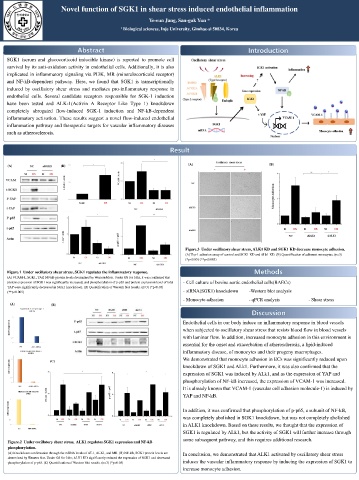
Novel function of SGK1 in shear stress induced endothelial inflammation
Ye-eun Jang, San-guk Yun *
1 Biological sciences, Inje University, Gimhae-si 50834, Korea
SGK1 (serum and glucocorticoid inducible kinase) is reported to promote cell
survival by its anti-oxidation activity in endothelial cells. Additionally, it is also
implicated in inflammatory signaling via PI3K, MR (mineralocorticoid receptor)
and NF-kB-dependent pathway. Here, we found that SGK1 is transcriptionally
induced by oscillatory shear stress and mediates pro-inflammatory response in
endothelial cells. Several candidate receptors responsible for SGK-1 induction
have been tested and ALK-1(Activin A Receptor Like Type 1) knockdown
completely abrogated flow-induced SGK-1 induction and NF-kB-dependent
inflammatory activation. These results suggest a novel flow-induced endothelial
inflammation pathway and therapeutic targets for vascular inflammatory diseases
such as atherosclerosis.
(A) (B)
(A) (B)
Figure.3 Under oscillatory shear stress, ALK1 KD and SGK1 KD decrease monocyte adhesion.
(A)Thp-1 adhesion assay of control and SGK1 KD and ALk1 KD. (B) Quantification of adherent monocytes. (n=3)
(*p<0.05) (**p<0.005)
Figure.1 Under oscillatory shear stress, SGK1 regulates the inflammatory response.
(A) VCAM-1, SGK1, YAP, NF-kB protein levels determined by Western blots. Under OS for 16hr, it was confirmed that
protein expression of SGK1 was significantly increased, and phosphorylation of p-p65 and protein expression level of total - Cell culture of bovine aortic endothelial cells(BAECs)
YAP were significantly decreased in SGK1 knockdown. (B) Quantification of Western blot results. (n=3) (*p<0.05)
(**p<0.005) - siRNA(SGK1) knockdown -Western blot analysis
- Monocyte adhesion - qPCR analysis - Shear stress
(A) (B)
Endothelial cells in our body induce an inflammatory response in blood vessels
when subjected to oscillatory shear stress that resists blood flow in blood vessels
with laminar flow. In addition, increased monocyte adhesion in this environment is
essential for the onset and exacerbation of atherosclerosis, a lipid-induced
inflammatory disease, of monocytes and their progeny macrophages.
We demonstrated that monocyte adhesion in ECs was significantly reduced upon
(C)
knockdown of SGK1 and ALk1. Furthermore, it was also confirmed that the
expression of SGK1 was induced by ALk1, and as the expression of YAP and
phosphorylation of NF-kB increased, the expression of VCAM-1 was increased.
It is already known that VCAM-1 (vascular cell adhesion molecule-1) is induced by
YAP and NF-kB.
In addition, it was confirmed that phosphorylation of p-p65, a subunit of NF-kB,
was completely abolished in SGK1 knockdown, but was not completely abolished
in ALK1 knockdown. Based on these results, we thought that the expression of
SGK1 is regulated by ALk1, but the activity of SGK1 will further increase through
some subsequent pathway, and this requires additional research.
Figure.2 Under oscillatory shear stress, ALK1 regulates SGK1 expression and NF-kB
phosphorylation.
(A) Knockdown confirmation through the mRNA levels of AT-1, ALK1, and MR. (B) NF-kB, SGK1 protein levels are In conclusion, we demonstrated that ALK1 activated by oscillatory shear stress
determined by Western blot. Under OS for 16hr, ALK1 KD significantly reduced the expression of SGK1 and decreased
phosphorylation of p-p65. (C) Quantification of Western blot results. (n=3) (*p<0.05) induces the vascular inflammatory response by inducing the expression of SGK1 to
increase monocyte adhesion.

