


Page 187 - ebook
P. 187
Discovering Therapeutic agonists to stimulate TLR3-mediated
     signaling in regeneration


     Yukyung Park¹, Jiyeon Moon¹, Wooyoung Lee¹, Minji Kim¹, Garyung Kwon¹, Mina Ma¹, Dongwon Kim¹*
     1 Bio-chemical Engineering, Dongseo University, Busan 47011, Korea
     (** Presenting Author : Yukyung Park , *Corresponding Author: dwkim@dongseo.ac.kr)
                            ¹
    Introduction                                         Results

   Toll-Like-Receptor 3 (TLR3) is a family of Toll-Like-Receptor (TLR)  A  8
   which recognize pathogen associated molecular patterns (PAMPs)
   from microbes and its associated Innate immune response. A Recent  6
   study demonstrated that damaged tissue induced noncoding dsRNA  4
   which activates TLR3 and promotes retinoic acid in the body. this  TLR3-mRNA   0 (Fold increase)  2
   mechanism induces skin regeneration. ¹˒² There is the only compound
   Poly I:C to stimulate TLR3, but it has severe cytotoxicity because of  CON  PIC  3A  3B  3C  3D  3E  3F  3G  3H  4A  4B  4C  4D  4E  4F  4G  4H  5A  5B  5C  5D  5E  5F  5G  5H
   inaccurate structural. To solve this problem, it is important to discover  B  10
   other agonists to stimulate TLR3 through chemical compound libraries.
   Developed  biologically  active  substances  can  promote  skin  KRT15-mRNA   (Fold increase)  5
   regeneration also it may offer new therapy for skin diseases in
   intractable patients who can not get operation.            0    PIC  3A  3B  3C  3D  3E  3F  3G  3H  4A  4B  4C  4D  4E  4F  4G  4H  5A  5B  5C  5D  5E  5F  5G  5H
   Representation of Wound-Induced                               CON
   Hair Neogenesis (WIHN). Damaged                        C   10
   tissues release dsRNA to activate TLR3
   signaling. Further, it activates                         KRT19-mRNA   (Fold increase)  5
   endogenous RA synthesis and signaling
   to regulate regeneration                                   0    PIC  3A  3B  3C  3D  3E  3F  3G  3H  4A  4B  4C  4D  4E  4F  4G  4H  5A  5B  5C  5D  5E  5F  5G  5H
                                                                 CON
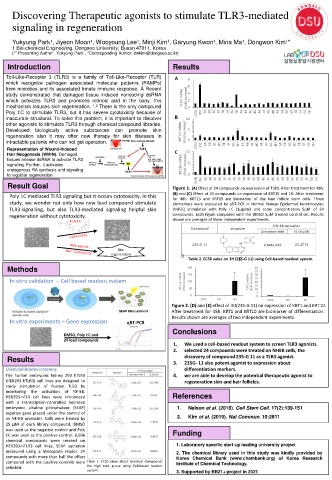
   Result Goal                                           Figure 1. (A) Effect of 24 compounds on expression of TLR3. After treatment for 48h.
                                                         (B) and (C) Effect of 24 compounds on expression of KRT15 and 19. After treatment
    Poly I:C mediated TLR3 signaling but it occurs cytotoxicity. In this
                                                         for 48h. KRT15 and KRT19 are biomarker of the hair follicle stem cells. Three
    study, we wonder not only how new lead compound stimulate  biomarkers were evaluated by qRT-PCR in Normal Human Epidermal Keratinocytes
    TLR3-signalling, but also TLR3-mediated signaling helpful skin  (NHEK) stimulated with Poly I:C (1µg/ml) and same concentration 5µM of 24
    regeneration without cytotoxicity.                   compounds. Each figure compared with the DMSO 5µM treated control set. Results
                        Poly I:C                         shown are averages of three independent experiments.


                                       Skin
                                     regeneration
                                                            D
                                                              Table 2. EC50 value on 3H (235-G 11) using Cell-based readout system.
                                                                               E
   Methods                                                    200                   40
                                                                                    35
                                                            KRT 10 mRNA  (Fold increase)  100  KRT 1 mRNA  (Fold increase)  20
                                                                                    25
    In vitro validation  – Cell based readout system          150                   30
                                                                                    15
                                                               50
                                                                                    10
                                                                                    5
                                                               0                    0
                                                                  CON   PIC  3H         CON   PIC   3H
                                                         Figure 2. (D) and (E) effect of 3H(235-G 11) on expression of KRT1 and KRT10.
                                        SEAP Measurement  After treatment for 48h. KRT1 and KRT10 are biomarker of differentiation.
                                                         Results shown are averages of two independent experiments.
    In vitro experiments – Gene expression  qRT-PCR
                                                         Conclusions
                      DMSO, Poly I:C and
                      24 lead compounds
                                                         1.  We used a cell-based readout system to screen TLR3 agonists.
                                                         2.  selected 24 compounds were treated on NHEK cells, the
   Results                                                   discovery of compound 235-G 11 as a TLR3 agonist.
                                                         3.  235G- 11 also potent agonist to expression about
   Chemical libraries screening                              differentiation markers.
   The human embryonic kidney 293 hTLR3                  4.  we are able to develop the potential therapeutic agonist to
   (HEK293-hTLR3) cell lines are designed to                 regeneration skin and hair follicles.
   study stimulation of human TLR3 by
   monitoring  the  activation  of  NF-kB.
   HEK293-hTLR cell lines were introduced                References
   with a transcription-controlled Secreted
   embryonic alkaline phosphatase (SEAP)                   1.  Nelson et al. (2016). Cell Stem Cell. 17(2):139-151
   reporter gene placed under the control of
   an NF-KB promoter. Cells were treated by                2.  Kim et al. (2019). Nat Commun. 10:2811
   25 µM of each library compound, DMSO
   was used as the negative control and Poly             Funding
   I:C was used as the positive control. 6,696
   chemical compounds were treated on
   HEK293-hTLR3 cell lines, SEAP secretion                1. Laboratory specific start-up leading university project
   measured using a Microplate reader. 24                 2. The chemical library used in this study was kindly provided by
   compounds with more than half the effect               Korea Chemical Bank (www.chembank.org) of Korea Research
   compared with the positive controls were Table 1. EC50 value about chemical Compounds  Institute of Chemical Technology.
                             the high rank group using Cell-based readout
   selected.
                             system.                      3. Supported by BB21+ project in 2021

