


Page 30 - ebook
P. 30
The function of DPBF2 transcription factor on the regulation
of fatty acid composition
1
2
Inyoung Kim , Sujeong Jeong , Hyun Uk Kim 1,2,*
1 Department of Molecular Biology, Sejong University, Seoul, 05006, Republic of Korea,
2 Department of Bioindustry and Bioresource Engineering, Plant Engineering Research Institute, Sejong University, Seoul, 05006, Republic of Korea
ABSTRACT (a) (b)
Triacylglycerol (TAG) is synthesized during seed maturation and controlled by the LEAFY
COTYLEDON2 (LEC2), FUSCA3 (FUS3) and ABSCISIC ACID INSENSITIVE3 (ABI3) known as master
regulators of seed maturation in transcriptional regulation. In this study, we identified the seed-specific
DC3 PROMOTER-BINDING FACTOR2 (DPBF2) transcription factor activated by the regulation of
LEC2. In leaf tissue, DPBF2 is upregulated by LEC2 expression and downregulated in developing seed of
lec2-1 mutant. In dpbf2-1 homozygous T-DNA mutant seeds, the 18:2 and 20:1 fatty acid content was
higher, the 18:1 and 18:3 content was lower than in wild-type (WT) seeds. While the transcript levels of
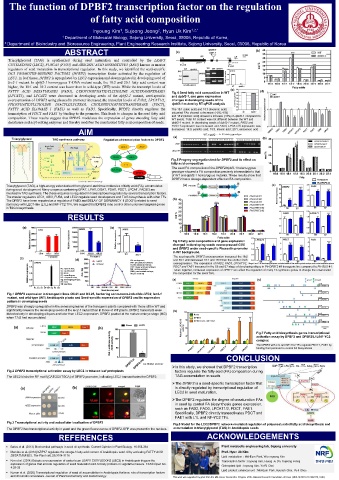
FATTY ACID DESATURASE3 (FAD3), LYSOPHOSPHATIDYLCHOLINE ACYLTRANSFERASE1 Fig.4 Seed fatty acid composition in WT (c) (d)
(LPCAT1), and LPCAT2 were decreased in developing seeds of the dpbf2-1 mutant, seed-specific and dpbf2-1, and gene expression
overexpression of DPBF2 using phaseolin promoter increased the transcript levels of FAD2, LPCAT1/2, changes in developing seeds of the
PHOSPHATIDYLCHOLINE DIACYLGLYCEROL CHOLINEPHOSPHOTRANSFERASE (PDCT), dpbf2-1 mutant by RT-qPCR analysis
FATTY ACID ELONASE 1 (FAE1) as well as FAD3. Specifically, DPBF2 directly regulates the The 18:1 (oleic acid) and 18:3 (linolenic acid)
transcription of PDCT and FAE1 by binding to the promoter. This leads to changes in the seed fatty acid saturated FAs showed a decrease (~2%,~6%)
composition. These results suggest that DPBF2 modulates the expression of genes encoding fatty acid and 18:2 (linoleic acid) showed a increase (~8%) in dpbf2-1 compared to
WT seeds. Total FA content was not different between the WT and
desaturase and acyl-editing enzymes and thereby modifies the unsaturated fatty acid composition of seeds. dpbf2-1 mutant. In developing seeds of dpbf2-1 mutant, FAD2 and
PDCT1 expression was increased and FAD3, LPCAT1/2 expression was
AIM decreased. 16:0, palmitic acid; 18:0, stearic acid; 20:1, eicosenoic acid
(a)
Triacylglycerol TAG synthesis pathway Regulation of transcription factors to DPBF2 (b)
Fig.5 Progeny segregation test for DPBF2 and its effect on
fatty acid composition
The seed FA composition of the DPBF2/dpbf2-1 heterozygous
genotype showed a FA composition precisely intermediate to that
of WT and dpbf2-1 homozygous mutants. These results show that
DPBF2 has a dosage-dependent effect on FA composition.
Triacylglycerol (TAG), a high-energy ester derived from glycerol and three molecules of fatty acid (FA), accumulates (a) (c)
during seed development. Many enzymes containing GPAT, LPAT, DGAT, PDAT, PDCT, LPCAT, FAD2/3 are
involved in TAG synthesis. The these enzymes is regulated in transcriptional regulation by several transcription factors.
The master regulators LEC1, ABI3, FUS3, and LEC2 regulate seed development and TAG biosynthesis with other TFs.
The DPBF2 have been reported as a regulator of FAD3 and DELAY OF DORMANCY 1 (DOG1) related to seed (b)
dormancy with LEC1-like (L1L) and NF-YC2 TFs. We suggest that DPBF2 may control other unknown targeted genes
in TAG biosynthesis.
RESULTS
(a) (b)
Fig.6 Fatty acid composition and gene expression
changed in developing seeds overexpressed GUS
and DPBF2 under seed-specific Phaseolin promoter
in WT background.
The seed-specific DPBF2 overexpression increased the 18:2
(c) (d) and 20:1 and decreased 18:1 and 18:3 than the control GUS
OV: embryo sac;
24H: pre-globular embryo; overexpression. The expression of FAD2, FAD3, LPCAT1/2, Stage 6 and 7 of developing siliques included seeds of the walking-stick embryo and curled cotyledon phase
GLOB: globular embryo;
COT: linear and bent embryo; PDCT and FAE1 increased in the S6 and S7 stage of developing silique in Ph-DPBF2 #2 transgenic line compared to Ph-GUS #1.
RL: rosette leaf; MG: mature embryo; Taken together, increased expression of DPBF2 can affect the regulation of many FA synthesis genes to change the unsaturated
CL: cauline leaf; PMG: post mature embryo;
St: stem; SDLG: seedling FA composition for the seed TAG.
OF: open flower;
UF: unopen flower; (a) (c)
Sq: developing silique;
Rt: root;
Sd: seedling
Fig.1 DPBF2 expression in transgenic lines OIL21 and OIL25, harboring senescence-inducible LEC2, lec2-1
mutant, and wild-type (WT) Arabidopsis plants and Seed-specific expression of DPBF2 and its expression
pattern in developing seeds
DPBF2 was strongly upregulated in the senescing leaves of the transgenic plants compared with those of the WT and
significantly lower in the developing seeds of the lec2-1 mutant than in those of WT plants. DPBF2 transcripts were (b)
detected only in developing siliques and later than LEC2 expression. DPBF2 peaked at the mature embryo stage (MG)
when TAG had accumulated.
(a) (b)
Fig.7 Fatty acid biosynthesis genes transcriptional
activation assay by DPBF2 and DPBF2/L1L/NF-YC2
complex
The DPBF2 with L1L and NF-YC2 TFs regulate PDCT1, FAE1 by
binding their promoter to control FA biosynthesis
CONCLUSION
mp: Mutated promoter
In this study, we showed that DPBF2 transcription
Fig.2 DPBF2 transcriptional activation assay by LEC2 in tobacco leaf protoplasts factors regulate the fatty acid (FA) composition during
The LEC2 binds the RY motif (CATGCATGCA) of DPBF2 promoter, indicating LEC2 transactivates the DPBF2. TAG accumulation in seeds.
The DPBF2 is a seed-specific transcription factor that
(a) (b) is directly regulated by transcriptional regulation of
LEC2 in seed maturation.
The DPBF2 regulates the degree of unsaturation FAs
in seed by control FA biosynthesis genes expression,
such as FAD2, FAD3, LPCAT1/2, PDCT, FAE1.
Specifically, DPBF2 directly transactivates PDCT and
FAE1 with L1L and NF-YC2 TFs.
Fig.3 Transcriptional activity and subcellular localization of DPBF2
Fig.8 Model for the LEC2/DPBF2 network-mediated regulation of polyunsaturated fatty acid biosynthesis and
The DPBF2 has transcriptional activity in yeast and the green fluorescence of DPBF2-GFP was present in the nucleus. accumulation in triacylglycerol (TAG) in Arabidopsis seeds
REFERENCES ACKNOWLEDGEMENTS
Bates et al. (2013) Biochemical pathways in seed oil synthesis. Current Opinion in Plant Biology. 16:358-364 Plant metabolic engineering lab, Sejong university
Mendes et al. (2013) bZIP67 regulates the omega-3 fatty acid content of Arabidopsis seed oil by activating FATTY ACID Prof. Hyun Uk Kim
DESATURASE3. The Plant cell. 25:3104-3116 Lipid metabolism : Mid-Eum Park, Won nyeong Kim
Kim et al. (2014) Ectopic overexpression of castor bean LEAFY COTYLEDON2 (LEC2) in Arabidopsis triggers the Transcription factor : Inyoung Kim, Hyung Ju Do, Sujeong Jeong
expression of genes that encode regulators of seed maturation and oil body proteins in vegetative tissues. FEBS Open bio. Chloroplast lipid : Inyoung Kim, Yu-Ri Choi
4:25-32
Lipid product enhancement : Mid-Eum Park, Hyunah Choi, Yu-li Choe
Kumar et al. (2020) Transcriptional regulation of seed oil accumulation in Arabidopsis thaliana: role of transcription factors
and chromatin remodelers. Journal of Plant biochemistry and biotechnology. This work was supported by grant from the Mid-Career Researcher Program of the National Research Foundation of Korea (NRF-2020R1A2C2008175, KHU)

