


Page 7 - ebook
P. 7
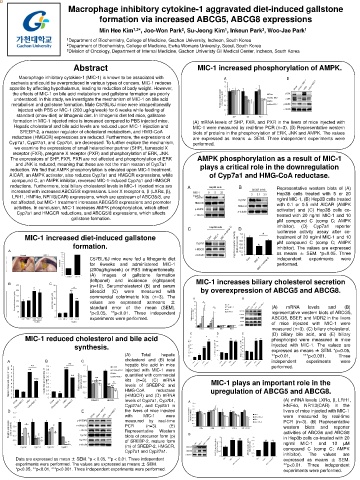
Macrophage inhibitory cytokine-1 aggravated diet-induced gallstone
formation via increased ABCG5, ABCG8 expressions
Min Hee Kim *, Joo-Won Park , Su-Jeong Kim , Inkeun Park , Woo-Jae Park 1
1
1,2
3
2
1 Department of Biochemistry, College of Medicine, Gachon University, Incheon, South Korea
2 Department of Biochemistry, College of Medicine, Ewha Womans University, Seoul, South Korea
3 Division of Oncology, Department of Internal Medicine, Gachon Univeristy Gil Medical Center, Incheon, South Korea
Abstract MIC-1 increased phosphorylation of AMPK.
Macrophage inhibitory cytokine-1 (MIC-1) is known to be associated with
cachexia and could be overproduced in various types of cancers. MIC-1 reduces
appetite by affecting hypothalamus, leading to reduction of body weight. However,
the effects of MIC-1 on bile acid metabolism and gallstone formation are poorly
understood. In this study, we investigate the mechanism of MIC-1 on bile acid
metabolism and gallstone formation. Male C57BL/6J mice were intraperitoneally
injected with PBS or MIC-1 (200 ug/kg/week) for 6 weeks while feeding of
standard (chow diet) or lithogenic diet. In lithogenic diet fed mice, gallstone
formation in MIC-1 injected mice is increased compared to PBS injected mice. (A) mRNA levels of SHP, FXR, and PXR in the livers of mice injected with
Hepatic cholesterol and bile acid levels are reduced upon MIC-1 injection and MIC-1 were measured by real-time PCR (n=3). (B) Representative western
SREBP-2, a master regulator of cholesterol metabolism, and HMG-CoA blots of proteins in the phosphorylation of ERK, JNK and AMPK. The values
reductase (HMGCR) expressions are reduced. Furthermore, the expressions of are expressed as means ± SEM. Three independent experiments were
Cyp7a1, Cyp27a1, and Cyp7b1, are decreased. To further explore the mechanism, performed.
we examine the expressions of small heterodimer partner (SHP), farnesoid X
receptor (FXR), pregnane X receptor (PXR) and phosphorylation of ERK, JNK.
The expressions of SHP, FXR, PXR are not affected and phosphorylation of ERK AMPK phosphorylation as a result of MIC-1
and JNK is reduced, meaning that these are not the main reason of Cyp7a1 plays a critical role in the downregulation
reduction. We find that AMPK phosphorylation is elevated upon MIC-1 treatment.
AICAR, an AMPK activator, also reduces Cyp7a1 and HMGCR expressions, while of Cyp7a1 and HMG-CoA reductase.
compound C, an AMPK inhibitor, reversed MIC-1-induced Cyp7a1 and HMGCR
reductions. Furthermore, total biliary cholesterol levels in MIC-1 injected mice are Representative western blots of (A)
increased with increased ABCG5/8 expressions. Liver X receptor α, β (LXRα, β), Hep3B cells treated with 5 or 20
LRH1, HNF4α, NR1I3(CAR) expressions, which are upstream of ABCG5/8, are ng/ml MIC-1, (B) Hep3B cells treated
not affected, but MIC-1 treatment increases ABCG5/8 expressions and promoter with 0.1 or 0.5 mM AICAR (AMPK
activities. In conclusion, MIC-1 increases AMPK phosphorylation, which affect activator) and (C) Hep3B cells co-
Cyp7a1 and HMGCR reductions, and ABCG5/8 expressions, which affects treated with 20 ng/ml MIC-1 and 10
gallstone formation. μM compound C (comp C; AMPK
inhibitor). (D) Cyp7a1 reporter
luciferase activity assay after co-
MIC-1 increased diet-induced gallstone treatment of 20 ng/ml MIC-1 and 10
formation. μM compound C (comp C; AMPK
inhibitor). The values are expressed
as means ± SEM. *p<0.05. Three
C57BL/6J mice were fed a lithogenic diet independent experiments were
for 6weeks and administered MIC-1 performed.
(200ug/kg/week) or PBS intraperitoneally.
(A) images of gallstone formation
(leftpanel) and incidence (rightpanel) MIC-1 increases biliary cholesterol secretion
(n=10). Serumcholesterol (B) and serum
bileacid (C) were measured with by overexpression of ABCG5 and ABCG8.
commercial colorimetric kits (n=3). The
values are expressed asmeans ±
standard error of the mean (SEM). (A) mRNA levels and (B)
*p<0.05, **p<0.01. Three independent representative western blots of ABCG5,
experiments were performed. ABCG8, BSEP, and MDR2 in the livers
of mice injected with MIC-1 were
measured (n=3). (C) biliary cholesterol,
(D) biliary bile acid, and (E) biliary
MIC-1 reduced cholesterol and bile acid phospholipid were measured in mice
synthesis. injected with MIC-1. The values are
expressed as means ± SEM. *p<0.05,
(A) Total hepatic **p<0.01, ***p<0.001. Three
cholesterol and (B) total independent experiments were
hepatic bile acid in mice performed.
injected with MIC-1 were
quantified with commercial
kits (n=3). (C) mRNA MIC-1 plays an important role in the
levels of SREBP-2 and
HMG-CoA reductase upregulation of ABCG5 and ABCG8.
(HMGCR) and (D) mRNA
levels of Cyp7a1, Cyp7b1, (A) mRNA levels LXRα, β, LRH1,
Cyp27a1, and Cyp8b1 in HNF4α, NR1I3(CAR) in the
the livers of mice injected livers of mice injected with MIC-1
with MIC-1 were were measured by real-time
measured by real-time PCR (n=3). (B) Representative
PCR (n=3). (E) western blots and reporter
Representative Western activities of ABCG5 and ABCG8
blots of precursor form (p) in Hep3b cells co-treated with 20
of SREBP-2, mature form ng/ml MIC-1 and 10 μM
(m) of SREBP-2, HMGCR, compound C (comp C; AMPK
Cyp7a1 and Cyp27a1.
inhibitor). The values are
Data are expressed as mean ± SEM. *p < 0.05, **p < 0.01. Three independent expressed as means ± SEM.
experiments were performed. The values are expressed as means ± SEM. **p<0.01. Three independent
*p<0.05, **p<0.01, ***p<0.001. Three independent experiments were performed. experiments were performed.

