


Page 5 - ebook
P. 5
Notch-1 suppressor conjugated Cell membrane-derived

                        nanoparticles promote hypoxic cell–cell packing and
                              suppress angiogenesis as a two-edged sword


                    Hye-Seon Kim , Young Min Shin , Seyong Chung , Dan Bi Park , Sewoom Baek , Jeongeun Park , Si Yeong Kim , Dae-Hyun Kim ,
                                                Ӭ
                                                                                              1
                                 Ӭ
                                                                     2
                                                                                                         1
                                                                                 1
                                                                                                                     3
                                                          1
                                                                                                2,
                    Se Won Yi , Songhyun Lee , Jung Bok Lee , Seong Mi Yu , Hyun-Su Ha , Chan Hee Lee , Mi-Lan Kang *, and Hak-Joon Sung *
                                                                                    1
                                                              1
                                                                         1
                                                   4
                           2
                                        1
                                                                                                                 1,
                    1 Yonsei University College of Medicine,  2 TMD LAB Co., Ltd.,  3 Chungnam National University, and  4 Sookmyung Women’s University
                                                  INTRODUCTION
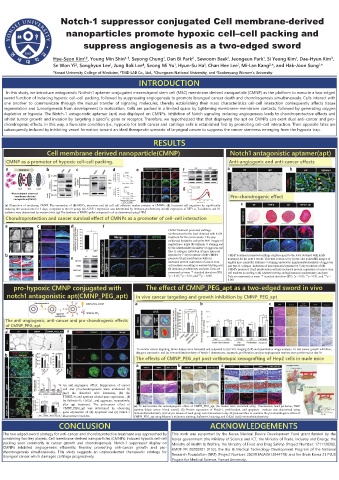
   In this study, we introduce antagonistic Nothch1 aptamer conjugated mesenchymal stem cell (MSC) membrane derived nanoparticle (CMNP) as the platform to execute a two-edged
  sword function of inducing hypoxic cell–cell packing, followed by suppressing angiogenesis to promote laryngeal cancer death and chondrogenesis simultaneously. Cells interact with
  one another to communicate through the mutual transfer of signaling molecules, thereby establishing their mass characteristics cell-cell interaction consequently affects tissue
  regeneration and tumorigenesis from development to maturation. Cells are packed in a limited space by tightening membrane–membrane contacts, followed by generating oxygen
  depletion or hypoxia. The Notch-1 antagonistic aptamer (apt) was displayed on CMNPs. Inhibition of Notch signaling inducing angiogenesis leads to chondroprotective effects and
  inhibit tumor growth and invasion by targeting a specific gene or receptor. Therefore, we hypothesized that that displaying the apt on CMNPs can exert dual anti-cancer and pro-
  chondrogenic effects. In this way, a favorable condition (i.e., hypoxia) for both cancer and cartilage cells is established first by promoting cell–cell interaction. Their opposite fates are
  subsequently induced by inhibiting vessel formation toward an ideal therapeutic scenario of laryngeal cancer to suppress the cancer stemness emerging from the hypoxia trap.
                                                       RESULTS
                  Cell membrane derived nanoparticle(CMNP)                        Notch1 antagonistic aptamer(apt)
                                                                                                         p
                                                                                               g
                                                                                                                  p
   CMNP as a promoter of hypoxic cell–cell packing.                              Anti-angiogenic and anti-cancer effects
   a             b b        c            d d     e               f               a                     b
                                                                 g
     Mesenchymal stem cell
      membrane derived                                                            Pro-chondrogenic effect
      nanoparticle(CMNP)
   (a) Illustration of producing CMNP. The expression of (b) MSCs, exosomes and (c) cell–cell adhesion marker proteins in CMNPs. (d) Increased cell migration by significantly  c
   reducing the wound area for 3 days, compared to the n/t group.(e) AJAP-1 expression was determined by immunocytochemistry and (f) expression of HIF1-Į  E-cadherin, and N-
   cadherin were determined by western blots. (g) The hardness of BMSC pellet compared to n/t as determined using UTM
   Chondroprotection and cancer survival effect of CMNPs as a promoter of cell–cell interaction    .  .  .
   a          c           d d        f f
                                                            CMNP treatment promoted cartilage
                                                            reinforcement to the level obtained with KGN
                                                            treatment for the next 6 weeks. This was
                                                            evidenced by (a) the end-point MRI images of
                                                            sagittal knee joints (b) Safranin-O staining and
                                                            (c) the immunohistochemistry of aggrecan and
                                                            type II collagen. Induction of inner spheroid
   b                                                        hypoxia by 7-day treatment of (d) CMNPs   CMNP treatment promoted cartilage reinforcement to the level obtained with KGN
                          e                                 promoted Hep2 proliferation with (e)   treatment for the next 6 weeks. This was evidenced by (a) the end-point MRI images of
                                                            increased protein expression of cancer stem   sagittal knee joints (b) Safranin-O staining and (c) the immunohistochemistry of aggrecan
                                                            cell markers according to western blotting and  and type II collagen. Induction of inner spheroid hypoxia by 7-day treatment of (d)
                                                            (f) immunocytochemistry analyses. Data are   CMNPs promoted Hep2 proliferation with (e) increased protein expression of cancer stem
                                                            expressed as mean s standard deviation (SD).   cell markers according to (f) western blotting and (g) immunocytochemistry analyses.
                                                            * p < 0.05,  ** p < 0.01, and  *** p < 0.001  Data are expressed as mean s standard deviation (SD).  * p < 0.05,  ** p < 0.01, and  *** p <
                                                                                 0.001
      pro-hypoxic CMNP conjugated with              The effect of CMNP_PEG_apt as a two-edged sword in vivo
   notch1 antagonistic apt(CMNP_PEG_apt)         In vivo cancer targeting and growth inhibition by CMNP_PEG_apt
             Electroporation   DSPE-PEG-COOH     a                     b                        c
                                                                                                a
                     Aptamer   Aptamer-NH 2
                    conjugation
   The anti-angiogenic, anti-cancer and pro-chondrogenic effects
   of CMNP_PEG_apt
   a                     f
                                                 To monitor cancer targeting, tumor tissues were harvested and subjected to (a) IVIS imaging (left) and quantitative image analysis. To test cancer growth inhibition,
                                                 (b) gene expression and (c) immunohistochemistry of Notch-1 downstream, apoptosis, proliferation, and pro-angiogenesis markers were performed on day 28
   b        c
                                                 The effects of CMNP_PEG_apt post-orthotopic xenografting of Hep2 cells in nude mice
                                                 a              b              c
            d
                       An anti-angiogenic effect, Suppression of cancer
                       cell and pro-chondrogenesis were evidenced by
                       (a,c) the disturbed tube formation, (b) the
            e          TUNEL+a and apatosis related gene expression , (f)
                       by Safranin-O, Col2a1, and aggrecan, respectively,
                       after apt treatment. The anti-cancer effect of  (a) To demonstrate the anti-angiogenic effect of CMNP_PEG_apt, the tissues were examined using fluorescence bead perfusion, H&E
                       CMNP_PEG_apt was determined by observing  staining (black arrow: blood vessel). (b) Protein expression of Notch-1, proliferation, and apoptosis  markers was determined using
                       gene expression of (d) apoptosis and (e) Notch-1  immunohistochemistry. (c) Larynx tissues of each group were harvested on day 28 post-sacrifice to examine the pro-chondrogenic effect of
                       downstream markers.      CMNP_PEG_apt using Masson’s trichrome staining, Safranin-O staining, and Col2a1 (red) immunohistochemistry.
                      CONCLUSION                                           ACKNOWLEDGEMENTS
  The two edged-sword strategy for anti-cancer and chondroprotective treatment was approached by  This work was supported by the Korea Medical Device Development Fund grant funded by the
  combining two key players. Cell membrane-derived nanoparticles (CMNPs) induced hypoxic cell-cell  Korea government (the Ministry of Science and ICT, the Ministry of Trade, Industry and Energy, the
  packing seen commonly in cancer growth and chondrogenesis. Notch-1 suppressor display on  Ministry of Health & Welfare, the Ministry of Food and Drug Safety) (Project Number: 1711138302,
  CMNPs inhibited angiogenesis efficiently, thereby promoting anti-cancer growth and pro-  KMDF_PR_20200901_0152), the Bio & Medical Technology Development Program of the National
  chondrogenesis simultaneously. This study suggests an unprecedented therapeutic strategy for  Research Foundation (NRF) (Project Number: 2021R1A6A3A13044778) and the Brain Korea 21 PLUS
  laryngeal cancer which damages cartilage progressively.
                                                             Project for Medical Science, Yonsei University.

